
At first glance, the Manx cat looks like it forgot something important — its tail. The breed’s signature rounded rump and rabbit-like hop have made it famous as the “tailless cat.” But here’s the twist: not every Manx is actually tailless.
Some are born with a tiny nub. Others have a short stump. And a surprising number have tails that are nearly normal in length.
This variation isn’t a flaw — it’s the result of a powerful genetic trait that shortens the spine to different degrees. In fact, kittens from the same litter can look completely different from behind.
Understanding why this happens means looking beyond the myth and into the fascinating genetics, breed standards, and health considerations that shape one of the cat world’s most distinctive breeds.
Quick Answer: Do Manx Cats Have Tails?
Yes — some Manx cats have tails, while others are completely tailless.
Manx cats carry a dominant genetic mutation that shortens the spine and tail. Because this gene affects cats differently, Manx kittens can be born with:
- no tail at all
- a tiny nub
- a short partial tail
- a nearly full-length tail
Despite their reputation as tailless cats, tail variation is normal and expected within the breed.
Understanding Manx Tail Types
Breeders and cat registries typically classify Manx cats into four tail categories. All are considered true Manx, even though they differ in tail length.
Rumpy (Completely Tailless)
A rumpy Manx has no tail vertebrae at all. Instead, there is a small dimple where the tail would normally begin.
This is the classic tailless look most people associate with the breed. Many cat fanciers prize rumpies in show competitions because they represent the most dramatic expression of the Manx trait.
In simple terms: a rumpy Manx has a completely absent tail.
Rumpy-Riser (Riser)
A rumpy-riser, often shortened to “riser,” has only one to three tiny tail vertebrae hidden beneath the skin at the base of the spine.
When you stroke the cat’s back, you may feel a small bump or knob that slightly rises under your hand. In show standards, this rise is acceptable as long as it does not form a visible tail.
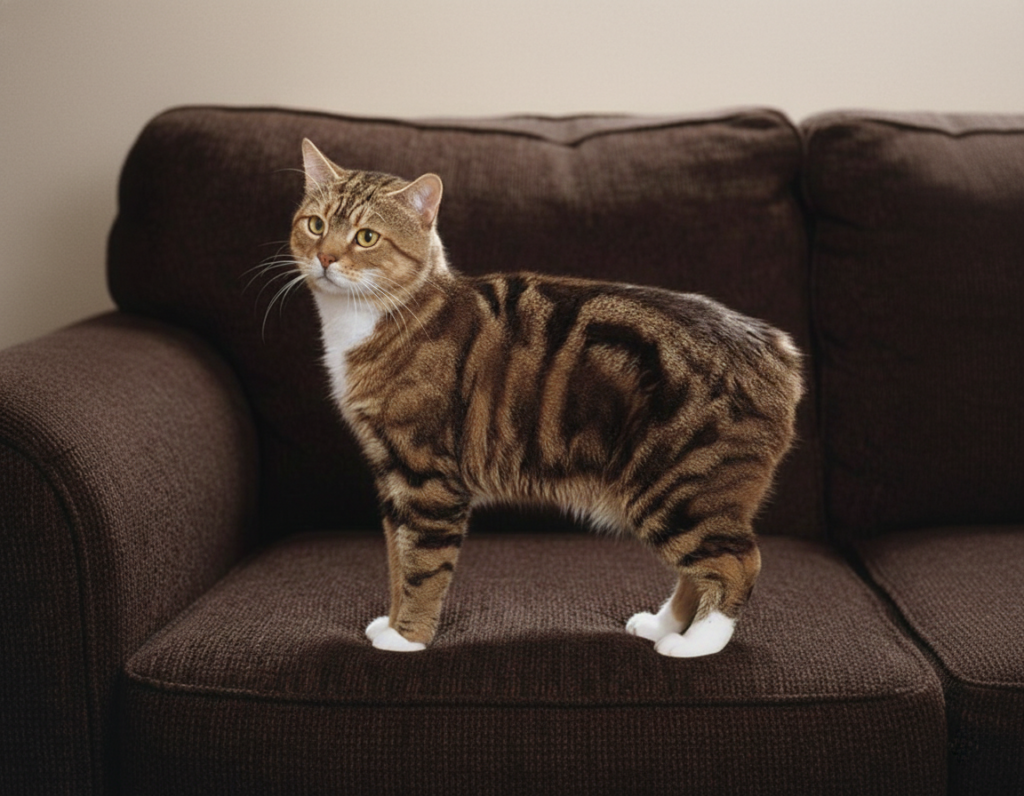
Stumpy
A stumpy Manx has a short, visible tail stump. It contains more vertebrae than a riser but is much shorter than a typical cat tail.
The stump may be straight, curved, or slightly kinked. Ideally, it should be smooth and comfortable rather than tightly kinked or painful.
Although stumpies are often sold as pets rather than show animals, they are still purebred Manx and share the breed’s rounded body shape and other distinctive traits.
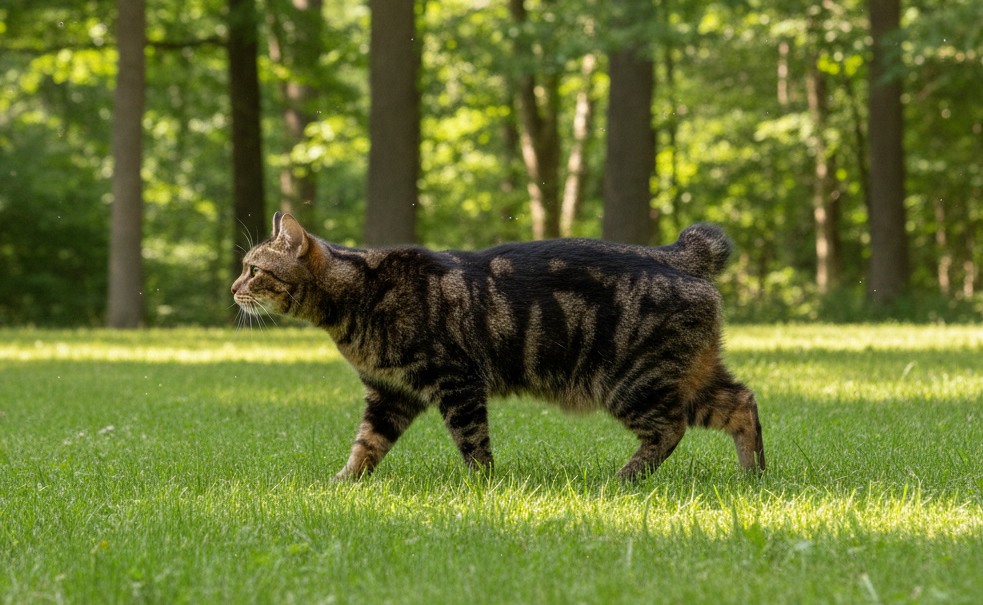
Longy (Tailed)
A longy (sometimes spelled longie) is a Manx cat with a longer tail. This tail may be about half the usual length or fully normal.
Some breeders simply call these “tailed Manx.” While they are typically not shown in tailless classes, they play an essential role in breeding programs for health reasons.
In short: rumpies have no tail, stumpies have a short stump, and longies have a longer — sometimes full — tail. All are still Manx cats.
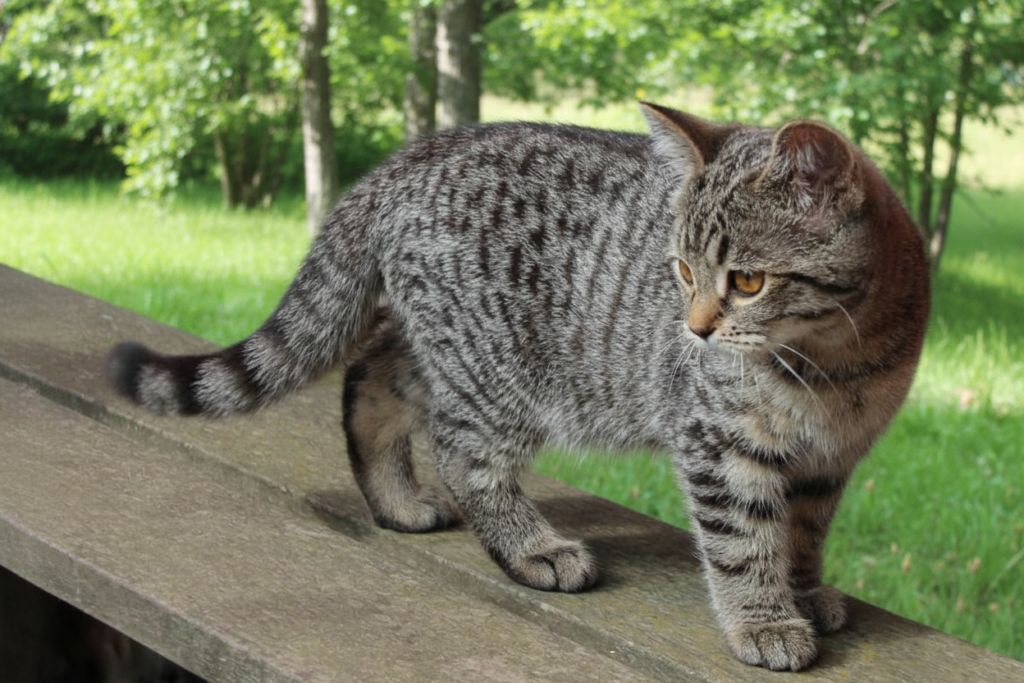
Why Tail Length Varies: The Genetics Behind Manx Cats
The Manx cat’s tail variation is caused by a mutated autosomal dominant gene, commonly called the Manx gene (M). This gene affects the development of the sacral and coccygeal vertebrae — the bones that form the lower spine and tail.
All living Manx cats are believed to carry one copy of this gene (Mm). Kittens inheriting two copies (MM) usually die before birth or shortly after, which is why the gene is considered lethal in its homozygous form.
Because the gene is dominant but varies in how strongly it expresses itself, a single litter can include kittens that are:
- completely tailless
- partially tailed
- fully tailed
Put simply, one powerful gene shortens the spine to different degrees, creating the wide range of tail lengths seen in the breed.
Breeding Implications
Responsible breeding practices are essential for maintaining healthy Manx lines.
- Breeding a tailless Manx with a tailed Manx reduces the risk of severe spinal deformities.
- Breeding two tailless Manx together greatly increases the risk of serious defects or non-viable kittens.
For this reason, tailed and partially tailed Manx cats are vital to ethical breeding programs.
Health Considerations: Manx Syndrome
The same mutation that shortens the tail also affects the spine and spinal cord. In some cats, this leads to a collection of health problems known as Manx syndrome.
Reported issues may include:
- hind-limb weakness or wobbliness
- partial paralysis
- urinary or fecal incontinence
- chronic constipation
These problems arise from malformed vertebrae and nerve damage near the base of the spine.
Kittens with severe spinal deformities may die before birth, die young, or require euthanasia due to quality-of-life concerns.
Not all Manx cats develop these problems, but awareness is essential for prospective owners and breeders.
Ethical Breeding and Welfare Considerations
Cats evolved with tails for balance, coordination, and communication. Because the Manx trait deliberately alters the spine, some animal welfare advocates raise concerns about breeding specifically for taillessness.
Responsible breeders address these concerns by:
- avoiding breeding two completely tailless Manx together
- incorporating tailed Manx into breeding programs
- prioritizing health and structural soundness over appearance
These practices help reduce the incidence of spinal defects while preserving the breed’s unique characteristics.
So, do Manx cats have tails? Some do — and some don’t.
The Manx gene shortens the spine to varying degrees, which is why the breed includes completely tailless cats alongside those with short stumps or even full-length tails. While their distinctive appearance makes them fascinating, understanding the genetics and potential health considerations behind the trait is essential.
For cat lovers and future owners alike, appreciating this balance between uniqueness and welfare is the key to truly understanding the remarkable Manx cat.
Frequently Asked Questions (FAQ)
1. Are all Manx cats born without tails?
No, not all Manx cats are tailless. While some are born completely without a tail, others may have a small nub, a short stump, or even a full-length tail. Tail length varies due to the Manx gene and how strongly it affects spinal development.
2. What is the Manx gene and how does it affect the tail?
The Manx gene is a dominant genetic mutation that shortens the spine and tail. Because it affects cats to different degrees, kittens in the same litter can be tailless, short-tailed, or fully tailed.
3. What are the different types of Manx cat tails?
Manx cats are typically grouped into four tail types:
- Rumpy — completely tailless
- Rumpy-riser — tiny bump under the skin
- Stumpy — short visible tail stump
- Longy (tailed) — partial to full-length tail
All of these are considered true Manx cats.
4. Are Manx cats with tails still purebred?
Yes. A Manx cat with a short or full-length tail is still a purebred Manx. Tailed Manx cats are important in breeding programs because they help maintain healthier genetic lines.
5. Do Manx cats have health problems because they lack a tail?
Some Manx cats can develop spinal issues known as Manx syndrome, which may cause mobility problems, nerve issues, or digestive difficulties. However, responsible breeding practices significantly reduce these risks, and many Manx cats live healthy lives.
Was this article helpful?