
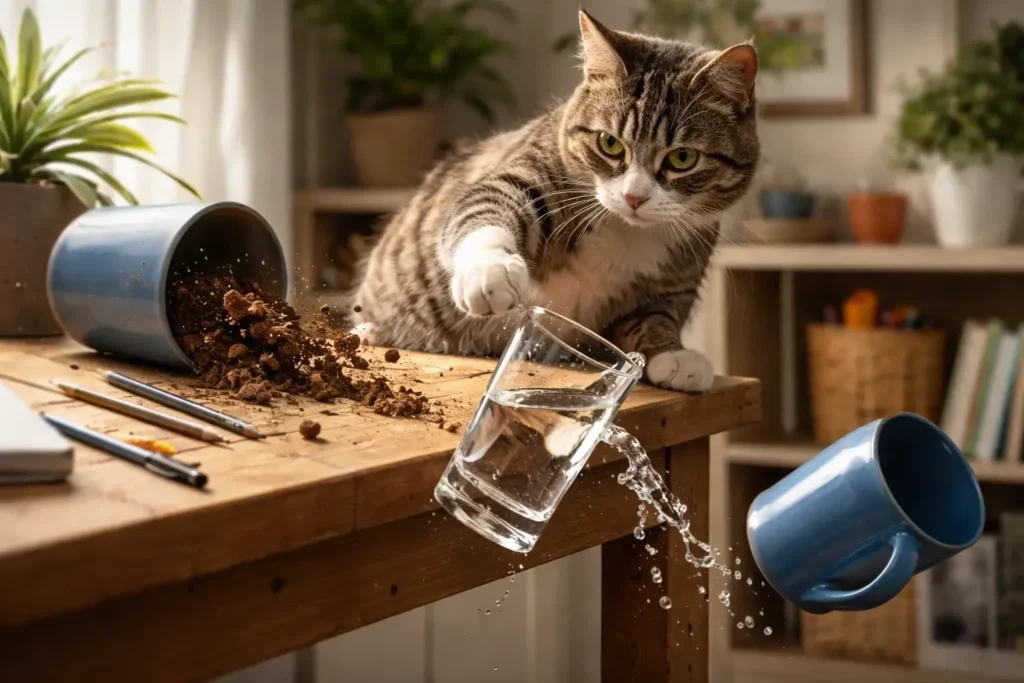
You’re working peacefully at your desk when it happens again. Your cat locks eyes with you, stretches one elegant paw toward your favorite mug, and with the kind of slow-motion precision usually reserved for action films… push. The mug sails off the edge and smashes on the floor. Your cat blinks. You blink. And then they saunter away, tail held high, like it’s all part of some unspeakable feline agenda.
But here’s the thing: it kind of is.
While it might feel like your cat is personally targeting your belongings (and your sanity), this oddly specific behavior is more than just feline flair for the dramatic. Science tells us that this isn’t random chaos it’s a cocktail of instinct, emotion, and sometimes boredom. There’s real method behind that perfectly timed mug massacre.
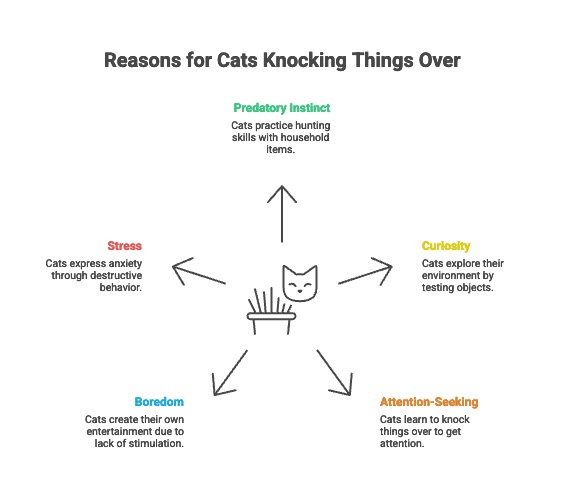
So, what’s really going on in your cat’s head when they channel their inner gravity scientist? Let’s break it down. Here are five research-backed reasons your cat just has to knock things off tables no matter how many times you say “no.”
Reason 1: Predatory Instinct and “Practice Hunting”
To your cat, that pen on the edge of your desk isn’t just stationery it’s prey. Tiny, wobbly, and unpredictable, it mimics the twitchy movements of a rodent or insect. In the wild, cats hone their skills by stalking and pouncing on moving targets. Indoors, they improvise with your stuff.
Behaviorists call this “object play,” and it’s a critical part of a cat’s mental and physical development. When your cat eyes a bottle cap, taps it to see how it moves, and then gleefully bats it across the room, they’re not being naughty they’re practicing. Knocking something off a table isn’t the end of the game; it’s the climax of a mini hunt. The object skitters, makes noise, and becomes “catchable.” Victory.
Reason 2: Curiosity and Investigating Their World
Cats don’t have thumbs, but they do have paws and they use them with surgical precision to explore their surroundings. A gentle poke, a swipe, a slow push to the edge… it’s all part of a feline experiment. They’re not trying to annoy you (okay, maybe a little), they’re testing the world around them.
To a curious cat, every object is a mystery waiting to be solved. Will it move? Bounce? Make noise? Will it fall or fight back? The moment something drops and crashes, it gives a jolt of instant feedback. Cause-and-effect is deeply satisfying like a toddler pushing buttons just to see what happens. And the best part? There’s always more stuff to test.
Reason 3: Attention-Seeking and Learned Behavior
Ever notice how your cat becomes an expert in object-knocking the moment you’re on a Zoom call or finally sitting down with a cup of tea? That’s not a coincidence it’s strategy.
Cats are incredibly smart, and they’re masters of human behavior. If you rush over, scold, or pick up the object every time they knock something off, they learn that this is how to summon you. And to a cat, attention is attention. Whether you’re yelling, gasping, or pleading you’re engaged. That’s all that matters.
Over time, your cat associates swatting items with guaranteed interaction. So next time your feline makes a dramatic leap toward your precariously placed sunglasses, remember: you might have trained them without even realizing it.
Reason 4: Boredom and Lack of Enrichment
Indoor cats often live in environments that while safe and cozy lack stimulation. No bugs to chase, no birds to stalk, and certainly no real prey to pounce on. So, they create their own adventures… right off your shelves.
Knocking things down becomes a DIY game. It’s thrilling, noisy, and unpredictable. One swipe can spark a whole chase scene, complete with satisfying chaos. It’s feline Netflix.
To curb the habit, it’s important to meet your cat’s need for play and exploration. Try:
- Daily interactive play sessions with feather wands or laser pointers
- Puzzle feeders that challenge their brain and mimic foraging
- Cat trees, tunnels, or window perches to offer vertical stimulation
When your cat has healthier outlets, your valuables are less likely to become casualties of boredom.
Reason 5: Stress, Anxiety, and Frustration
Sometimes, a knocked-over vase isn’t a sign of play it’s a cry for help. Stress-based object-knocking can look more intense, destructive, or targeted. Maybe it’s always your water glass. Or only when a new guest arrives. Or every time you leave for work.
Cats are sensitive creatures, and changes in their environment like a new pet, furniture rearrangement, loud noises, or even hunger can create anxiety. With no way to express frustration in words, they turn to behaviors they can control: swatting objects, making noise, causing a scene.
The key difference here is the energy behind the action. If your cat’s swats feel angry, desperate, or unusually focused, it might be time to look deeper. Consider:
- Keeping a consistent routine
- Providing safe spaces to retreat to
- Talking to a vet or feline behaviorist if stress signals escalate
In the end, that crashing glass might be more than an inconvenience it might be a message. The trick is learning to listen.
Conclusion
So, why does your cat knock things off tables? Here’s the breakdown:
- Predatory instinct: They’re wired to hunt, and object play is their training ground.
- Curiosity: Knocking things off is a form of paw-powered exploration.
- Attention-seeking: You react, they learn it’s basic (but brilliant) cat psychology.
- Boredom: Without enough stimulation, even your sunglasses become a toy.
- Stress or anxiety: Sometimes, a swatted object is a symptom of emotional unrest.
Now that you know the why, it’s time to become a behavior detective. Watch when and where your cat tends to go full demolition mode. Is it during quiet evenings? When you’re distracted? After you’ve moved furniture or skipped playtime? Context is everything, and your cat’s patterns are clues.
And finally, if you notice sudden changes in behavior, signs of stress, or object-knocking that feels aggressive or obsessive, it’s worth speaking to your vet or a certified feline behaviorist. What looks like mischief might actually be a message.
Because at the end of the day, your cat isn’t being difficult they’re just being deeply, delightfully feline. And now, you’re one step closer to understanding them.
Frequently Asked Questions (FAQ)
1. Is it normal for cats to knock things off tables?
Yes, it’s totally normal and surprisingly common. Cats do this as part of their natural instincts, curiosity, or sometimes as a way to get your attention. It’s not misbehavior; it’s communication (and entertainment).
2. How can I stop my cat from knocking things over?
Start by identifying the root cause boredom, attention-seeking, or stress. Then offer alternatives like interactive toys, puzzle feeders, or daily playtime. Also, avoid reacting dramatically when it happens, as that can unintentionally reinforce the behavior.
3. Why does my cat only knock things over when I’m watching?
Because you’re the audience! Cats quickly learn that object-knocking gets a response. If they want your attention and this trick works they’ll keep doing it. Consider giving them positive attention before they escalate to drama.
4. Can this behavior be a sign of stress or illness?
Sometimes, yes. If your cat’s object-knocking is new, unusually intense, or paired with other changes (e.g., hiding, aggression, appetite loss), it could be a sign of stress or an underlying issue. A vet check is a smart move.
5. Should I cat-proof my home to stop this?
Definitely. Keep fragile or valuable items off ledges and tables, especially if you’re not around. But remember: managing the environment helps but addressing the why behind the behavior is what truly makes the difference.
Was this article helpful?