
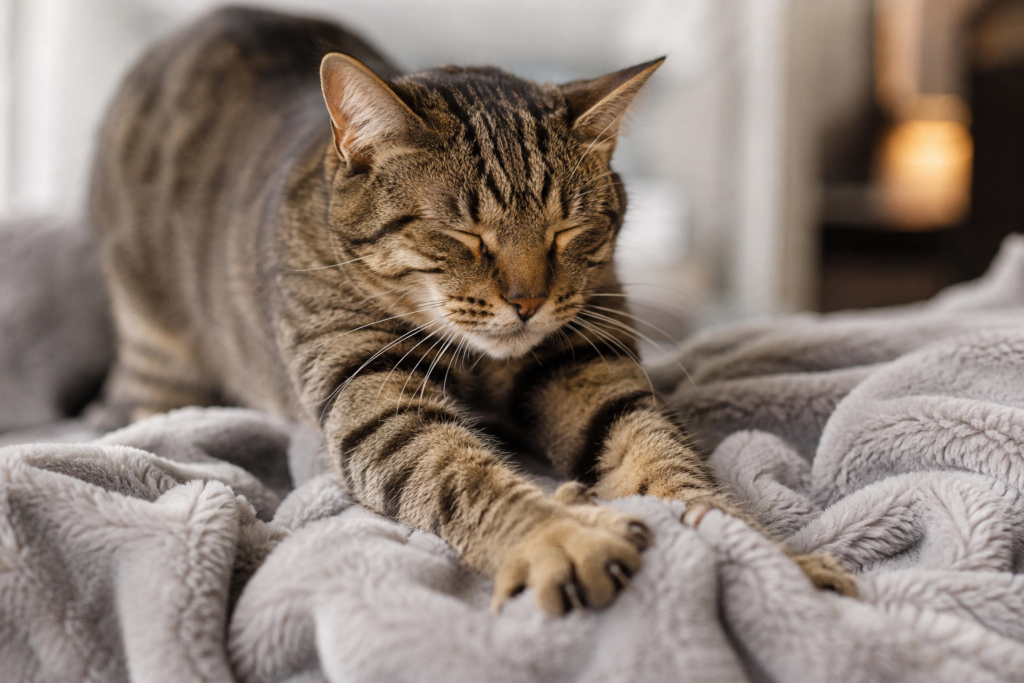
Making biscuits: the cutest thing your cat does with a straight face
You know the scene. Your cat climbs onto a blanket, your lap, or a pillow that was perfectly fine a second ago — and starts pushing into it, paw after paw, slow and rhythmic, like a tiny baker who takes their job very seriously. Push, push, push. Sometimes with a purr. Sometimes with a faraway look, as if they’ve left the room entirely.
The internet calls it “making biscuits.” Vets call it kneading. Whatever you call it, it’s one of the most endearing — and most misunderstood — things cats do. So what’s actually going on in that fluffy little head?
The short answer: kneading is almost always a good sign. But the full story is sweeter than you’d expect, and it starts before your cat ever met you.
What kneading actually is
Kneading is the rhythmic pressing of a cat’s front paws against a soft surface — a blanket, a cushion, your stomach, another cat. Some cats keep their claws tucked in. Others extend them slightly with each push (more on that, and how to survive it, below). Many purr while they do it. A few even drool a little, which is the ultimate cat compliment whether you asked for it or not.
It looks deliberate because it is. This isn’t a random twitch — it’s a behavior with deep roots.
It all begins in kittenhood
Here’s where the “biscuits” story really comes from. Newborn kittens knead their mother’s belly while nursing. The pushing motion stimulates the flow of milk from her mammary glands — so from day one, kneading is tied to the best things in a kitten’s world: warmth, food, and mom. Interestingly, the kitten’s kneading can also trigger the release of oxytocin, the “bonding hormone,” in the mother. (PetMD, Scientific American)
That early association never really goes away. Which brings us to the big question…
So why do adult cats keep doing it?
They’re grown. They’re weaned. And yet the biscuits keep coming. Kneading is just one line in your cat’s body-language vocabulary — their tail tells a whole story too. Vets point to a handful of overlapping reasons:
1. Pure comfort and contentment. Because kneading is wired to those cozy kitten memories of nursing, adult cats often knead when they feel calm, safe, and happy. When your cat kneads, they’re basically re-living the most secure feeling they’ve ever known. (Cornerstone Veterinary Hospital)
2. Marking their territory. Cats have scent glands in the soft pads of their paws. When they knead a blanket — or you — they’re leaving behind their personal scent, quietly stamping the object as mine. It’s not possessiveness in a bad way. It’s more like your cat signing their name on their favorite things. (PetMD)
3. Building the perfect nest. Wild cats tread down tall grass or leaves to make a soft, safe spot to rest or give birth. Your indoor cat inherited that instinct. So when they knead a cushion into submission before flopping down, they’re prepping their bed the way their ancestors did. (Scottish SPCA)
4. Showing you affection. If your cat climbs onto you specifically to make biscuits, take it as a compliment. Kneading on a person is a sign of trust and bonding — your cat has decided you’re warm, safe, and part of their inner circle. (Dix Hills Animal Hospital)
5. Self-soothing. Most kneading is happy. But cats also knead to calm themselves down when they’re a little anxious or unsettled — the same way a person might fidget or take a deep breath. Context usually tells you which one it is: a relaxed, purring cat is content; a tense one may be trying to comfort itself. (Berthoud Animal Hospital)
Why do cats knead and purr at the same time?
Because they’re running the full comfort program at once. Purring and kneading both trace back to nursing and both signal a deeply relaxed, content cat. When you get the combo — biscuits plus a rumbling purr — that’s about as close to a five-star review as your couch is ever going to get.
Why does my cat knead me specifically?
Two reasons stack up here. First, you’re warm and soft — prime kneading real estate. Second, and more touching: you smell like safety. Kneading on your lap or chest is your cat blending comfort, scent-marking, and bonding into one gooey little ritual. Translation: you’re my human, and I’ve claimed you. It’s the same instinct behind why your cat picks your lap over any empty chair in the house.
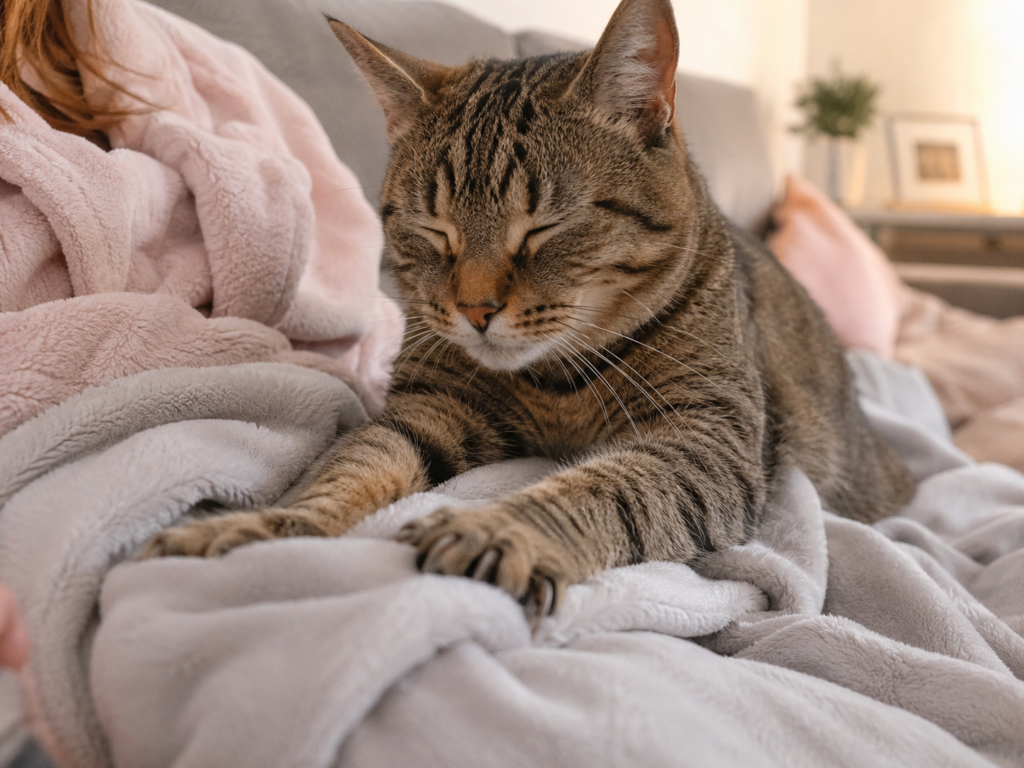
When “making biscuits” comes with claws
Let’s talk about the part nobody puts on a greeting card: sometimes it hurts. Cats that extend their claws while kneading can turn your thighs into a pincushion. The golden rule — never punish a kneading cat. It’s an instinctive, affectionate behavior, and scolding only confuses and stresses them.
Instead, manage it gently:
- Lay a barrier down. Keep a thick, soft blanket nearby and slide it between the claws and you when biscuit hour begins. [affiliate spot: link to a soft, durable cat blanket / throw]
- Keep those nails trimmed. Regular nail trims make kneading far more bearable. [affiliate spot: cat nail clippers]
- Try soft nail caps if trims aren’t enough — they blunt the claws without stopping the behavior. [affiliate spot: soft nail caps]
- Redirect, don’t reject. Gently move your cat onto a cushion or their own bed and let them knead there. [affiliate spot: plush cat bed]
Should you try to stop your cat from kneading?
Honestly? No. Kneading is normal, healthy, and one of the clearest signs your cat feels good. Unless the claws are a genuine problem, the kindest thing you can do is let your little baker bake. Manage the sharp bits, provide a cozy surface, and enjoy the compliment.
One small thing to watch
Very occasionally, kneading tips into something more compulsive — especially when it’s paired with sucking on wool or fabric for long stretches, or when an otherwise calm cat starts doing it constantly and frantically. That can point to stress or, rarely, an underlying issue. If your cat’s kneading suddenly changes or seems obsessive, it’s worth a quick chat with your vet. For the everyday biscuit-maker, though? Nothing to worry about. Just enjoy the show.
FAQ
Yes — completely. Kneading is a natural instinct that starts in kittenhood and usually signals a happy, relaxed cat.
Because kneading you combines comfort, scent-marking, and bonding. Choosing your lap over the furniture is a sign your cat trusts you and considers you “theirs.”
It’s an inherited nesting instinct. Wild cats tread down grass to build a soft, safe spot to sleep, and indoor cats do the same to their beds and blankets.
No. It’s a healthy, comforting behavior. If the claws hurt, use a blanket as a barrier, keep nails trimmed, or try soft nail caps — but never punish the kneading itself.
Drooling during kneading is usually a sign of deep relaxation, tied to those cozy nursing memories. It’s a bit messy, but it’s one of the biggest compliments your cat can give.
Sources
- PetMD — Why Do Cats Knead? — https://www.petmd.com/cat/behavior/why-do-cats-knead
- Scientific American — Why Do Cats Knead Like They’re Making Biscuits? — https://www.scientificamerican.com/article/why-do-cats-knead-like-theyre-making-biscuits/
- Cornerstone Veterinary Hospital — Cat Kneading: Why Do Cats Make Biscuits? — https://cvhcp.com/blog/cat-kneading/
- Dix Hills Animal Hospital — Why Does My Cat Make Biscuits on Me? — https://dixhillsanimalhospital.com/blog/why-does-my-cat-make-biscuits-on-me/
- Berthoud Animal Hospital — The 5 Reasons Behind Cat Kneading — https://berthoudanimalhospital.com/blog/cat-kneading/
- Scottish SPCA — Why Do Cats Make Biscuits? — https://www.scottishspca.org/advice/cats/why-do-cats-make-biscuits/
Was this article helpful?