
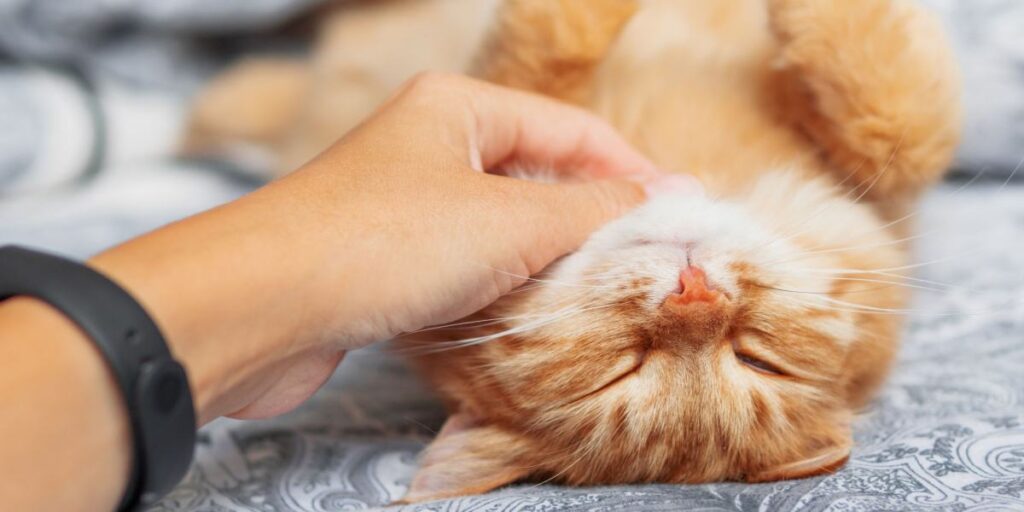
The most misunderstood sound in your house
You stroke your cat, the engine starts up, and everyone agrees on what it means: happy cat.
Except that’s only half the story. Cats also purr at the vet. They purr when they’re frightened. Some purr while they’re dying. And one particular type of purr is a carefully evolved piece of manipulation aimed squarely at you.
So what’s really going on inside that rumble? Turns out it’s stranger, and far more interesting, than “my cat is pleased.”
First — how does a cat even do that?
For a long time nobody was sure. We now know a purr comes from the larynx: the muscles around the vocal cords twitch rapidly and rhythmically, separating the cords so that air vibrates as it passes through. The clever part is that this happens on both the inhale and the exhale, which is why a purr can roll on continuously for minutes without a break.
The result sits at a very low frequency — roughly 25 to 150 Hz. Hold that number, because it comes back later in a surprising way.
Reason 1: Yes, contentment (mostly)
Let’s give the obvious answer its due. Most purring really is a good sign.
A cat curled on your lap, eyes half-closed, purring steadily is a cat that feels safe, warm, and unbothered. You’ll often see it paired with other happy-cat signals — slow blinking, a relaxed tail, and kneading, or “making biscuits”. When you get purring and kneading together, that’s the full contentment package.
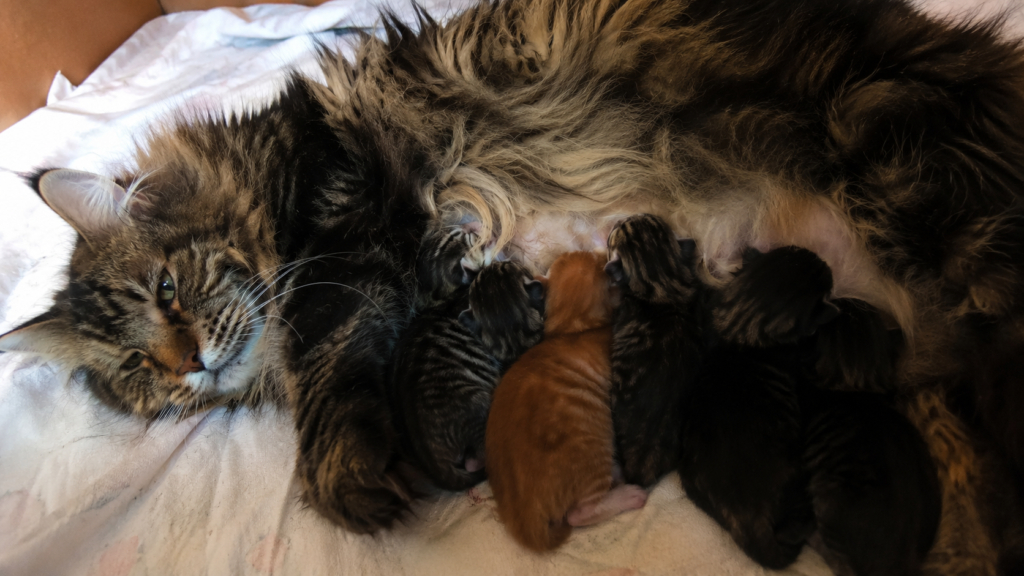
Purring is also a social behaviour. Kittens can purr when they’re only a couple of days old — long before their eyes work properly — and they purr while nursing to stay in contact with their mother, who purrs back. Your adult cat purring at you is running that same ancient “we’re okay, we’re together” signal.
Reason 2: The purr that’s secretly a demand
Here’s where it gets sneaky.
Researchers at the University of Sussex, led by Dr Karen McComb, identified something they called the solicitation purr — the one cats use when they want something, usually food or attention. Hidden inside that normal low rumble is a high-frequency cry, sitting at a pitch strikingly similar to a human baby’s cry.
When people were played both kinds of purr at the same volume, they consistently rated the solicitation purrs as more urgent and less pleasant — even people who had never owned a cat. And when the researchers digitally removed the embedded cry, that sense of urgency dropped away. (University of Sussex, Scientific American)
In other words: your cat has evolved a sound that hijacks the same instinct that makes you unable to ignore a crying infant. The study was inspired, fittingly, by the lead researcher’s own cat, who woke her up every morning with exactly this noise.
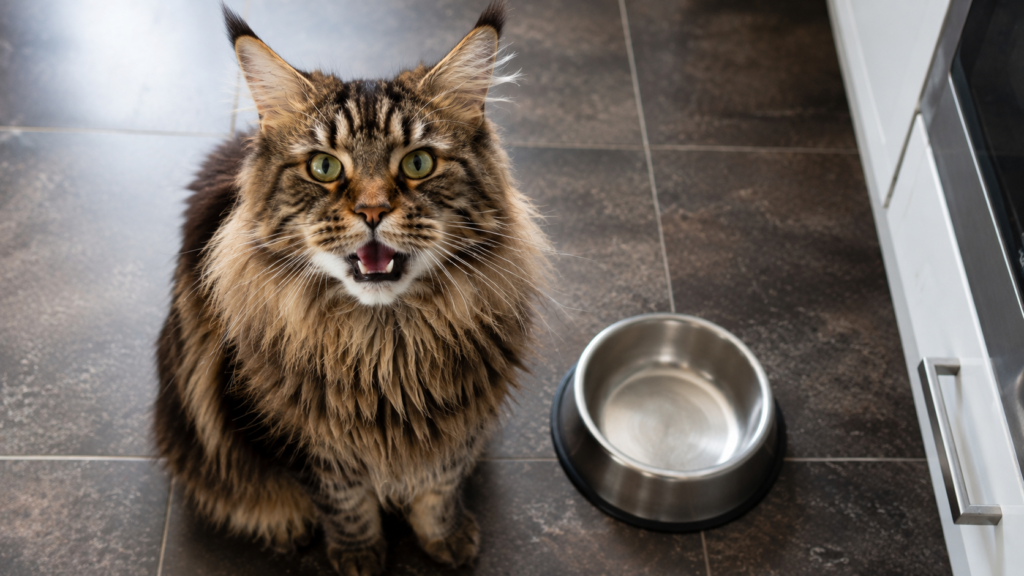
If your cat’s 6 a.m. purr feels weirdly impossible to sleep through — that’s not your imagination. That’s design.
Reason 3: Self-soothing when things are bad
This is the part most owners don’t know, and it matters.
Cats purr when they’re stressed, injured, or in pain. It’s common in vet waiting rooms, after an injury, during labour, and even in cats near the end of life. Purring in these moments appears to be a self-calming mechanism — the feline equivalent of deep breathing — and it may trigger the release of endorphins, the body’s own painkillers.
So purring doesn’t automatically mean “I’m happy.” It means “I’m regulating.” Context decides which one you’re looking at: a loose, sprawled, slow-blinking cat is content. A tense, crouched, hiding cat that’s purring is trying to cope.
Reason 4: The healing frequency theory
Remember that 25–150 Hz range?
It happens to overlap almost exactly with the frequencies used in vibration therapy to support healing. Research on mechanical stimulation in that band has been linked to improved bone density, tissue repair, and reduced pain and swelling — roughly 25–50 Hz for bone, and higher up the range for pain relief and inflammation.
This has led to a genuinely elegant hypothesis: because cats spend enormous portions of the day resting, purring may act as a low-energy maintenance system — a way to keep bones and soft tissue stimulated without the calorie cost of actually moving around. Essentially, built-in physiotherapy that runs while they nap.
It’s worth being honest here: this is a well-supported hypothesis, not settled fact, and the popular claim that a cat’s purr heals human bones is a stretch. But it’s a compelling explanation for why such an odd behaviour evolved at all.
Do big cats purr?
Some do — and the split is fascinating. Cheetahs, bobcats, lynx and pumas purr. Lions, tigers, leopards and jaguars roar.
It comes down to anatomy in the throat: the structure that lets the big roaring cats produce that enormous sound also stops them from purring continuously. Broadly, a cat species gets one or the other, not both. Your housecat landed firmly on the purring side of the family tree.
When purring should get your attention
Purring itself is almost never the problem — but a change in pattern can be a clue. Worth a vet call if your cat is purring constantly while also:
- hiding, or refusing to be touched
- eating less or not at all
- breathing oddly, or open-mouth breathing
- sitting hunched, tense, or unusually still
- showing any sudden change in normal behaviour
Cats are famously good at masking illness. A purr in a cat that otherwise seems “off” is worth taking seriously rather than reading as reassurance.
The bottom line
Purring isn’t one message — it’s a whole vocabulary. It can mean I’m content, I need something from you, I’m scared and calming myself, or possibly I’m quietly maintaining my own body while I nap.
Which is which comes down to context: the body, the eyes, the tail, the situation. Learn to read the whole cat rather than just the sound, and that rumble tells you a great deal more than “happy.”
FAQ
No. Cats also purr when stressed, frightened, injured, or in pain — it works as a self-soothing mechanism. Read your cat’s body language and the situation, not just the sound.
Both behaviours trace back to kittenhood and nursing, and both signal deep comfort. Purring plus kneading is about the clearest “I feel completely safe” signal a cat can give you.
That’s likely a solicitation purr — a normal purr with a high-frequency cry embedded in it, at a pitch close to a human baby’s cry. Cats use it to get food or attention, and it’s deliberately hard to ignore.
Not directly. Purring falls in a frequency range (25–150 Hz) associated with bone and tissue stimulation, and it may help the cat itself, but claims that purring heals human bones go well beyond the evidence.
Almost all domestic cats do, though volume varies a lot between individuals — some rumble loudly, others are nearly silent. Among big cats, cheetahs and bobcats purr, while lions and tigers roar instead.
Sources
- University of Sussex — Research reveals how cats purrfect the art of exploitation — https://www.sussex.ac.uk/broadcast/read/1208
- Current Biology (McComb et al.) — The cry embedded within the purr — https://www.sciencedirect.com/science/article/pii/S0960982209011683
- Scientific American — The manipulative meow — https://www.scientificamerican.com/blog/news-blog/the-manipulative-meow-cats-learn-to-2009-07-13/
- National Geographic — Cats manipulate their owners with a cry embedded in a purr — https://www.nationalgeographic.com/science/article/cats-manipulate-their-owners-with-a-cry-embedded-in-a-purr
- BBC Science Focus — Why do cats purr? — https://www.sciencefocus.com/nature/why-do-cats-purr
Keep reading:
- Why Do Cats Knead? (a.k.a. Making Biscuits)
- What Does Your Cat’s Tail Position Really Mean?
- Why Does My Cat Sit on My Lap?
Was this article helpful?