
Ocicat
The Ocicat is a wild-looking spotted breed with a completely domestic temperament. Resembling a small ocelot but with no wild ancestry, these social, athletic, dog-like cats are devoted family companions.
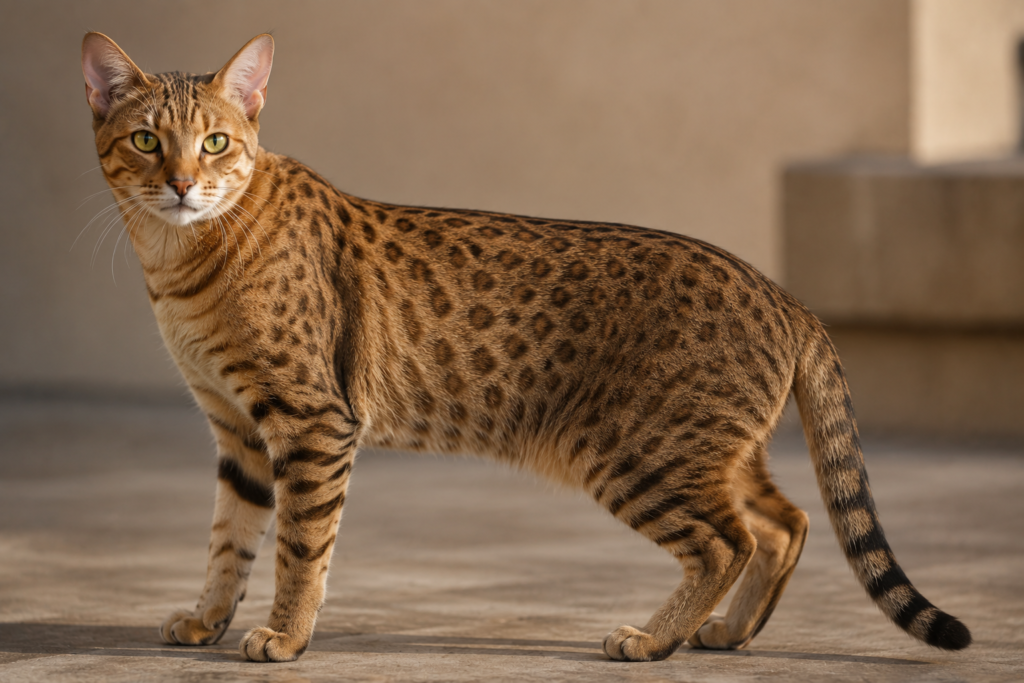
About the Ocicat
History and Origins
The Ocicat was born by happy accident in 1964, when Michigan breeder Virginia Daly was trying to create an Abyssinian-pointed Siamese. One kitten in the resulting litter turned out spotted, ivory with golden markings, and Daly’s daughter remarked that it looked like a baby ocelot — inspiring both the breed and its name.
Daly and other breeders developed the spotted cats into a breed, adding American Shorthair to the Siamese and Abyssinian foundation, which introduced silver coloring and a sturdier build. The Ocicat was recognized by the Cat Fanciers’ Association in the 1980s. Crucially, despite looking like a wild spotted cat, the Ocicat has no wild DNA whatsoever — it’s entirely domestic, so it carries none of the legal or dietary requirements of true hybrids.
Personality and Temperament
Ocicats may look wild, but their personality is anything but aloof. They are outgoing, confident, and intensely social — often greeting visitors at the door, seeking out attention, and involving themselves in everything their family does. Many are described as dog-like: they bond deeply, follow their people around, and dislike being left alone for long.
They are highly intelligent and trainable, readily learning to walk on a harness, play fetch, respond to their name, and even do tricks. Athletic and energetic, Ocicats need plenty of activity and mental stimulation, and a bored one can get into mischief. Adaptable and self-assured, they usually take new situations, people, children, and other pets in stride, making them engaging, interactive companions for lively, attentive households.
Care and Grooming
Grooming an Ocicat is refreshingly easy. Their short, tight, satiny spotted coat needs only a weekly rub with a grooming glove or soft brush to lift loose hair and bring up its shine, and they shed modestly. The distinctive “thumbprint” spots need no special care beyond a healthy coat.
Their real needs are physical and social. Ocicats are athletic and clever, so provide tall cat trees, climbing shelves, puzzle toys, and daily interactive play to satisfy their energy and intelligence. Because they’re so people-oriented and dislike solitude, many do best with a companion pet if the household is out during the day. Round out care with routine nail trims, ear checks, and dental hygiene, plus a quality diet to fuel their active, muscular build.
Health and Lifespan
Ocicats are generally a healthy, robust breed, often living 12–18 years, but because they descend from Siamese, Abyssinian, and American Shorthair lines, they can inherit a few conditions from those breeds. Hypertrophic cardiomyopathy (HCM) can occur and should be screened for, and the Abyssinian side can carry pyruvate kinase (PK) deficiency and progressive retinal atrophy (PRA), both of which have DNA tests. Periodontal (dental) disease is also relatively common, and renal amyloidosis is seen rarely.
Choose a breeder who screens for HCM and DNA-tests for PK deficiency and PRA, keep up with dental care, provide plenty of exercise, and maintain regular veterinary checkups to support a long, healthy life.
Cost and Is the Ocicat Right for You?
An Ocicat kitten from a reputable breeder generally costs $800 to $1,500 in the United States, with show-quality lines and sought-after colors running higher. Health-tested lines are worth the premium given the breed’s inherited risks.
The Ocicat is perfect for people who want the wild spotted look without the challenges of a true hybrid, in an outgoing, affectionate, trainable package — and who are home enough to give it attention. They suit active families, multi-pet homes, and owners who enjoy an interactive, dog-like cat. They are less ideal for those wanting a calm, independent lap cat, or for households away for long hours, since Ocicats crave company and stimulation.
Frequently Asked Questions
Are Ocicats wild cats?
No — despite their striking resemblance to wild ocelots, Ocicats have no wild cat DNA at all. They were created entirely from domestic breeds: Siamese, Abyssinian, and American Shorthair. This means they behave like affectionate, social house cats and carry none of the legal restrictions or special dietary needs of true hybrids like the Bengal, Savannah, or Chausie. Their wild look is purely cosmetic.
How big do Ocicats get?
Ocicats are medium to large cats, typically weighing around 9–15 pounds, with males noticeably larger than females. They’re solid, muscular, and athletic, so they often feel heavier than they look. Their powerful build reflects their active, energetic nature. They reach full size and muscular maturity gradually, usually over the first two years, developing into impressive, substantial cats.
Are Ocicats good family cats?
Yes, excellent ones. Ocicats are outgoing, confident, and highly social, and they generally do wonderfully with children and other pets, taking new situations in stride. They’re affectionate, playful, and interactive, thriving on the activity and attention of a busy household. The main requirement is companionship and stimulation — Ocicats don’t like being left alone for long, so they suit engaged, active families best.
Do Ocicats need a lot of exercise?
Yes. Ocicats are athletic, energetic, and highly intelligent, so they need plenty of daily exercise and mental stimulation to stay happy. Provide interactive play sessions, climbing structures, and puzzle toys, and consider harness training or fetch, which many Ocicats love. Without enough outlets for their energy and cleverness, they can become bored and mischievous, so an active home is important.
Are Ocicats vocal?
Ocicats are communicative but not excessively loud. Thanks to their Siamese heritage they’ll “talk” to their owners and can be quite expressive, but their voice is generally softer and less relentless than a true Siamese. They use vocalization along with their social, attention-seeking behavior to stay connected with their people, making them engaging without being overwhelmingly noisy.
Explore More
Love the wild spotted look in a domestic cat? Compare the Ocicat with the Bengal, the naturally spotted Egyptian Mau, and the rare California Spangled. Meet its Abyssinian relative the Somali, or browse all cat breeds.
Frequently Asked Questions
No — despite their striking resemblance to wild ocelots, Ocicats have no wild cat DNA at all. They were created entirely from domestic breeds: Siamese, Abyssinian, and American Shorthair. This means they behave like affectionate, social house cats and carry none of the legal restrictions or special dietary needs of true hybrids like the Bengal, Savannah, or Chausie. Their wild look is purely cosmetic.
Ocicats are medium to large cats, typically weighing around 9–15 pounds, with males noticeably larger than females. They're solid, muscular, and athletic, so they often feel heavier than they look. Their powerful build reflects their active, energetic nature. They reach full size and muscular maturity gradually, usually over the first two years, developing into impressive, substantial cats.
Yes, excellent ones. Ocicats are outgoing, confident, and highly social, and they generally do wonderfully with children and other pets, taking new situations in stride. They're affectionate, playful, and interactive, thriving on the activity and attention of a busy household. The main requirement is companionship and stimulation — Ocicats don't like being left alone for long, so they suit engaged, active families best.
Yes. Ocicats are athletic, energetic, and highly intelligent, so they need plenty of daily exercise and mental stimulation to stay happy. Provide interactive play sessions, climbing structures, and puzzle toys, and consider harness training or fetch, which many Ocicats love. Without enough outlets for their energy and cleverness, they can become bored and mischievous, so an active home is important.
Ocicats are communicative but not excessively loud. Thanks to their Siamese heritage they'll "talk" to their owners and can be quite expressive, but their voice is generally softer and less relentless than a true Siamese. They use vocalization along with their social, attention-seeking behavior to stay connected with their people, making them engaging without being overwhelmingly noisy.