
Savannah
The Savannah is a tall, exotic hybrid breed with wild African serval ancestry. These intelligent, active cats are known for their dog-like loyalty and jaw-dropping jumping ability.
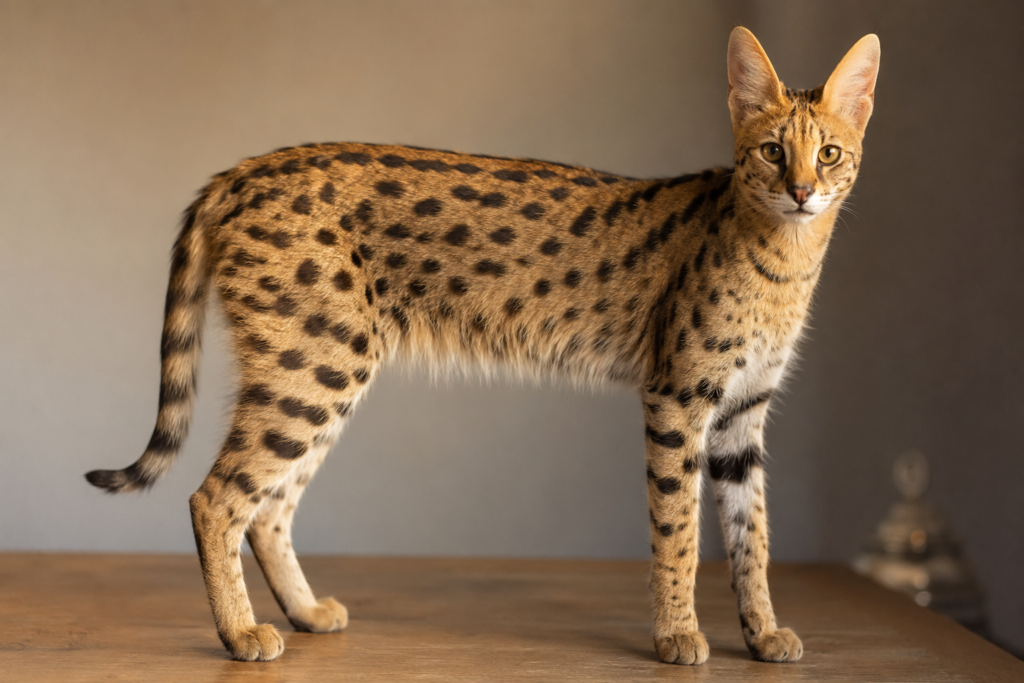
About the Savannah
History and Origins
The Savannah is one of the newest and most striking domestic breeds — a cross between a wild African serval and a domestic cat. The very first Savannah kitten was born in 1986 in Pennsylvania, to a serval father and a domestic mother, and the resulting tall, spotted, exotic-looking cat quickly captured attention. The breed was accepted by The International Cat Association (TICA) in 2001 and reached full championship status in 2012.
Savannahs are classified by generation, showing how many steps removed they are from their wild serval ancestor. An F1 is roughly 50% serval and the largest and most wild; each subsequent generation (F2, F3, F4, F5) is further removed and progressively more domestic in size and temperament. Because F1–F4 males are frequently sterile, breeders rely on fertile females and serval studs to keep producing new lines — one reason early-generation Savannahs are so rare and expensive.
Personality and Temperament
Savannahs are often described as the most dog-like of all cats. They are intensely loyal, follow their owners from room to room, and can be taught to fetch, walk on a harness, and come when called. They are also astonishingly athletic — a Savannah can leap up to eight feet from a standing start and will happily claim the highest point in any room.
This is a bold, curious, high-energy breed that bonds hard with its family but is not a placid lap cat. They are endlessly inquisitive, opening cupboards and doors, and they crave constant mental and physical stimulation. Early generations (F1–F2) retain more wild traits and are best suited to very experienced owners, while later generations (F4–F5) are friendlier and more manageable. Many Savannahs also famously love water and will splash in tubs or join you in the shower.
Care and Grooming
Grooming is the easy part. The Savannah’s short, spotted coat needs only a weekly brush or wipe-down to stay sleek, and they shed modestly.
Everything else about this breed is a serious commitment. Savannahs need enormous amounts of exercise, climbing space, and enrichment — think tall, sturdy cat towers, wall shelves, puzzle feeders, and daily interactive play. A bored Savannah is a destructive one. Many owners leash-train them or build secure outdoor “catios” to burn energy. They are highly intelligent escape artists, so a secure home is essential. Feed a high-quality, meat-rich diet (some breeders recommend specific feeding guidance, especially for early generations), and keep up with routine nail, ear, and dental care.
Health and Lifespan
Savannahs generally live 12–20 years and benefit from “hybrid vigor,” making them a fairly robust breed. Even so, hypertrophic cardiomyopathy (HCM) — the most common feline heart disease — can occur and is worth screening for. Early-generation cats can have more sensitive digestion, and males in generations F1–F4 are typically infertile. Some Savannahs are sensitive to certain anesthetics, so an experienced vet is valuable.
Buy only from a reputable, TICA-registered breeder who screens their breeding cats and can advise on diet and generation-specific needs. A proper diet, plenty of exercise, and regular veterinary care keep this athletic breed healthy.
Cost, Legality, and Is the Savannah Right for You?
Price varies more than almost any other breed, driven entirely by generation. An F1 Savannah can cost $15,000–$25,000, while more domesticated later generations like F5 typically run $1,000–$2,000. On top of that, legality is a major consideration: rules are set at the state — and sometimes city or county — level and usually depend on generation. Early generations (often F1–F3) are treated as exotic animals requiring permits or are banned outright, while later generations are usually regulated like ordinary house cats. Savannahs are banned entirely in some places, including Hawaii, Rhode Island, Nebraska, and Georgia (and the whole of Australia). Always check your local laws before buying.
The Savannah suits experienced, active owners who can provide space, enrichment, time, and a secure home — ideally people who want an adventurous, dog-like feline companion. They are a poor fit for first-time owners, quiet or low-energy households, small apartments, or anyone unable to meet their intense exercise and stimulation needs.
Explore More
Savannahs are one of the rare breeds that love water — read why most cats hate water to see why this hybrid is an exception. For another wild-looking, high-energy cat, compare the Bengal, or browse all cat breeds.
Frequently Asked Questions
It depends on where you live and the cat's generation. Legality is set at the state and sometimes city or county level, and early generations (often F1–F3) are commonly treated as exotic animals needing permits or are banned, while later generations are usually regulated like normal cats. Savannahs are banned outright in places like Hawaii, Rhode Island, Nebraska, Georgia, and all of Australia. Always confirm local laws first.
Savannahs are among the tallest domestic cats. Size depends heavily on generation: early F1 cats are the largest, often weighing 17–25 pounds with long, lean frames and standing up to around 17 inches tall, while later generations are closer to a large domestic cat at 11–20 pounds. Their long legs and athletic build make them look even bigger than they weigh.
For the right owner, yes — they are loyal, intelligent, and endlessly entertaining. But they are not for everyone. Savannahs need experienced owners who can provide huge amounts of exercise, space, and stimulation. Later generations (F4–F5) are friendlier and more manageable, while early generations retain wild traits and are far more demanding. They are a poor choice for first-time or low-energy owners.
Many do. Unlike most domestic cats, Savannahs often enjoy water — a trait linked to their serval ancestry. They may splash in the bathtub, play in their water bowl, or even join you in the shower. Providing safe water play can be a great source of enrichment for this active, curious breed.
Prices vary dramatically by generation. An F1 Savannah, the closest to a serval, can cost $15,000–$25,000, while more domesticated later generations such as F5 typically run $1,000–$2,000. Beyond the purchase price, factor in the cost of a secure home, enrichment, quality diet, and any permits your area may require for early-generation cats.