

Why do cats have 9 lives? Nobody knows where it started
The honest answer to the origin question is that it is untraceable. The proverb is old, it appears across many cultures, and no single documented source starts it. Anyone who tells you precisely who coined it is guessing.
What can be said is that the idea was already familiar in English by the sixteenth century. Shakespeare has Mercutio demand one of Tybalt’s nine lives in Romeo and Juliet, and he throws the line away as something the audience will already recognise — which is how you can tell a saying is older than the text you find it in.
The association between cats and survival runs older still. Ancient Egypt treated cats with unusual reverence, mummifying them and linking them to protective deities, and cats have carried an air of the uncanny through European folklore ever since, not always to their benefit. A creature that survives falls, disappears for days and returns unharmed accumulates that kind of reputation.
Why nine, and why not everywhere
Nine is not universal. This is the detail that gives the game away, and it is the most interesting part of the story.
Many languages give cats seven lives: Spanish, German, Italian, Greek, Arabic and others. Turkish tradition and some Persian sources give them six. English, along with a handful of other languages, settled on nine.
The numbers themselves are the clue. Three, seven and nine turn up repeatedly across mythologies as significant or “complete” figures — three has been treated as a number of fullness in many traditions, and nine as three times three. In other words, the choice of nine is cultural arithmetic, not observation. Nobody counted.
You can see how the phrase works from the inside: it is a way of saying “improbably many” rather than a specific claim. Asking why do cats have 9 lives is a bit like asking why a cat has more lives than it is entitled to — the number was never the point.
English kept nine, and it is worth noticing how comfortably the saying sits alongside the rest of our cat folklore. Cats attract superstition in a way dogs never have: black cats crossing paths, cats sensing weather, cats as witches’ familiars. A number pulled from the symbolic shelf fits an animal people already regarded as slightly outside the ordinary rules.
What cats actually do that started the legend
Here is where folklore meets something real. Survival rates after falls genuinely surprise people, and the mechanism is well understood.
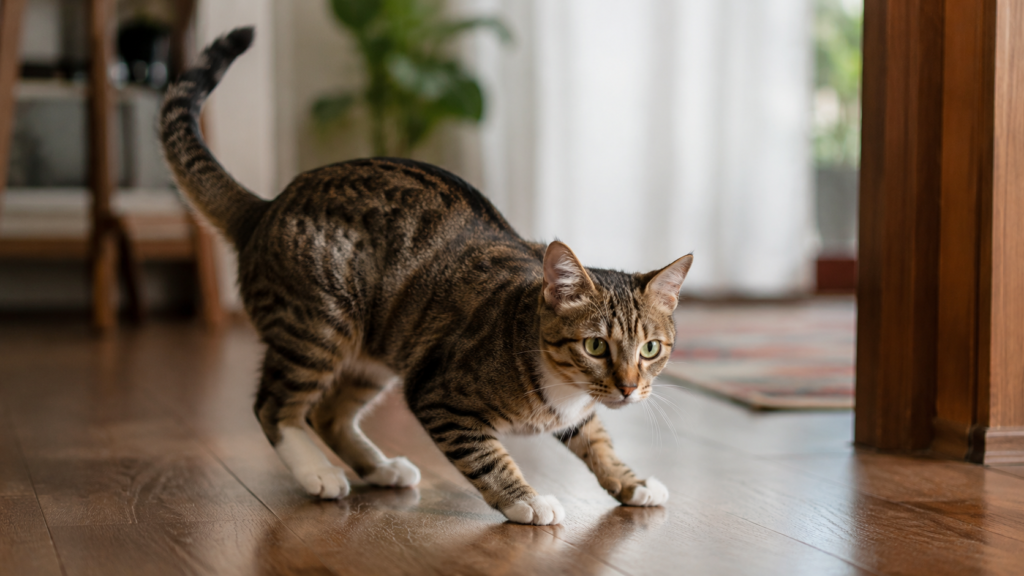
The core of it is the righting reflex — the ability to twist in mid-air and land feet first. Kittens develop it from around three to four weeks and have it working reliably by six or seven weeks. It relies on the vestibular apparatus in the inner ear to establish which way is up, and on an unusually flexible spine that lets the front and back halves of the body rotate in opposite directions. A cat can complete the twist in a remarkably short drop.
Several other traits stack on top of it:
- Low body weight relative to surface area, which caps the terminal velocity a falling cat reaches.
- A spread-eagle posture that some cats adopt after the initial twist, increasing drag much as a parachutist does.
- Long, flexible limbs and loose joints that absorb impact through the whole body rather than one point.
- A light, compact skeleton that tolerates the shock better than a heavier frame would.
None of this makes cats indestructible. It makes them very good at surviving an event that most mammals do not survive.
High-rise syndrome: the part people get wrong
There is a well-known observation from veterinary practice, usually called high-rise syndrome, describing cats brought in after falling from apartment windows. The finding that made it famous is counterintuitive: in the reported cases, cats falling from higher floors sometimes had less severe injuries than those falling from middle floors.
The proposed explanation is that a falling cat reaches terminal velocity after a certain distance, and once it stops accelerating it relaxes and spreads out, which slows it further and distributes impact. Below that distance, the cat is still accelerating and still rigid from the initial twist.
The important caveat is one the internet routinely drops. Those studies looked at cats that were brought to a veterinary clinic — meaning cats that survived the fall and had an owner able to bring them in. Cats killed outright, or that fell and were never found, are not in the data. This is a textbook case of survivorship bias, and it means the figures cannot be read as “falling further is safer”.
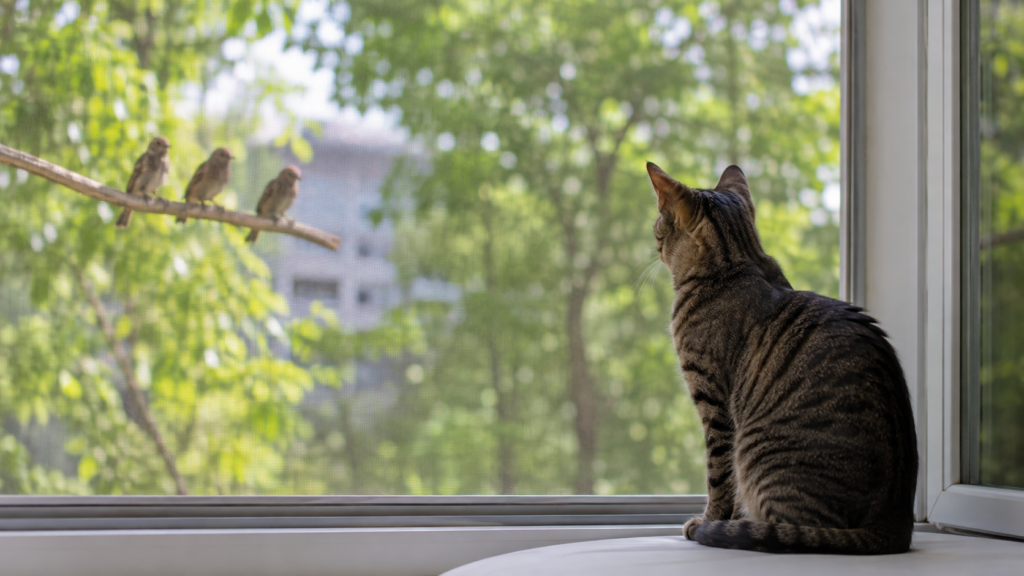
The practical takeaway is unambiguous and worth stating plainly: falls injure and kill cats. Screen your windows. Cats fall while dozing on sills, while tracking birds, and while misjudging a leap onto a balcony rail, and an unscreened upper-floor window is a genuine hazard rather than a theoretical one. Insect screens are not enough on their own, since a cat’s weight can push a mesh screen out of its frame.
The other survival traits behind the reputation
Falls are only part of why cats read as unkillable.
Being quiet, fast and small lets a cat escape situations that would trap a larger animal. They are also drawn to enclosed, defensible spaces — the instinct behind why cats love boxes doubles as a survival habit, since a cat wedged into a gap is a cat that most predators cannot reach. And they are extremely good at hiding while unwell — an instinct that keeps a vulnerable predator out of sight of anything hunting it. That last one is a double edge. It is also the reason owners so often catch illness late, because a cat that feels rotten simply becomes less visible rather than obviously sick.
Sensory range contributes as well, and it is easy to underrate how much of it a cat has. Even the whiskers and tail are instruments rather than decoration: the tail counterbalances a cat mid-turn on a narrow ledge, which is part of why a cat can walk a fence rail that no dog would attempt.
Their other senses contribute too. Hearing runs well into the ultrasonic range, they see in roughly a sixth of the light people need, and their whiskers register air movement precisely enough to navigate a dark room. A creature that avoids most dangers before they happen looks lucky from the outside.
Modern life has extended the impression. Indoor cats commonly reach 12 to 18 years now, and cats into their twenties are no longer remarkable, largely thanks to vaccination, parasite control, neutering, better nutrition and staying indoors. A cat that outlives the family dog by a decade fits the legend neatly.
The bottom line
So why do cats have 9 lives? Because a very old saying, built on numbers that different cultures picked differently, attached itself to an animal that is genuinely hard to kill — and folklore rarely lets go of a good story.
Cats have one life, and the way to protect it is unglamorous: screened windows, indoor living or supervised outdoor access, current vaccinations, and a vet visit when something in your cat’s routine changes. The righting reflex is real. It is not a safety net.
FAQ
No. Cats have one life, like every other animal. The saying is folklore that stuck because cats survive falls and accidents that would kill most animals of similar size, thanks to a righting reflex, a flexible spine and a low terminal velocity. The phrase is a figure of speech meaning improbably lucky, not a claim anyone ever tested.
Because the number is cultural rather than observed. Spanish, German, Italian, Greek and Arabic traditions commonly give cats seven lives, while Turkish and some Persian sources say six, and English settled on nine. Three, seven and nine all recur across mythologies as symbolically complete numbers, which suggests the figure was chosen for resonance rather than counted.
Through the righting reflex. The inner ear establishes which way is up, then the cat rotates its front half and back half in opposite directions using an unusually flexible spine, bringing the feet underneath before landing. Kittens develop the reflex at around three to four weeks and have it reliable by six or seven. It is not infallible, particularly in very short falls.
Some do, but the well-known data is misleading. Studies of high-rise syndrome only counted cats brought into clinics, meaning cats that survived and had owners to bring them, so cats killed outright never entered the figures. That is survivorship bias. Falls seriously injure and kill cats, and secure window screening is the only reliable protection.
Indoor cats commonly reach 12 to 18 years, and living into the twenties is no longer unusual. Outdoor access shortens that considerably through traffic, disease and injury. The main things that extend it are unremarkable: vaccination, parasite prevention, neutering, dental care, keeping a healthy weight, and getting changes in behaviour checked early rather than late.
Sources
- Why Do Cats Always Land on Their Feet? — Scientific American — https://www.scientificamerican.com/
- Cat — Britannica — https://www.britannica.com/animal/cat
- High-Rise Syndrome in Cats — PetMD — https://www.petmd.com/cat/conditions/musculoskeletal/c_ct_high_rise_syndrome
- Keeping your cat safe at home — PDSA — https://www.pdsa.org.uk/pet-help-and-advice/looking-after-your-pet/cats
Keep reading
Was this article helpful?