
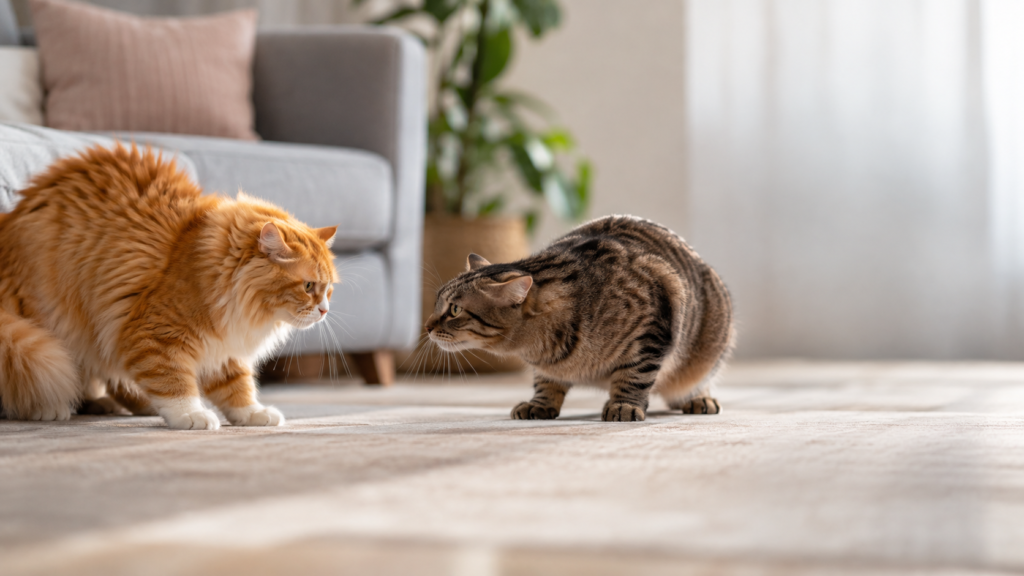
Cats are not naturally group animals
Dogs descend from pack animals. Cats do not. The domestic cat comes from a solitary desert ancestor that hunted alone, defended a territory alone, and met other cats mainly to mate or to argue.
Cats can and do form social groups, but on their own terms: related females sharing kittens, or cats raised together from kittenhood. What they did not evolve to do is share a small indoor territory with a stranger chosen by someone else. That is the situation most multi-cat households create, and a certain amount of friction is the honest baseline rather than a sign something has gone wrong.
Understanding this reframes the problem. You are not fixing a bad relationship. You are reducing the number of moments where two cats are forced to compete for something that matters.
Why do cats fight? The causes, in order of frequency
Resource competition. The commonest cause by a distance. Food, water, litter trays, sleeping spots, high perches, and access to you. Cats guard resources quietly — a cat sitting in a doorway is often blocking another cat’s route to the litter tray without a sound being made.
Territory. Indoor cats divide a home into zones and time-share the contested parts. Conflict rises where those zones overlap: corridors, staircases, doorways, and the area around the food.
Poor introductions. Two cats put nose to nose on day one frequently never recover from it. First impressions matter more than owners expect, and a rushed introduction can set a pattern that persists for years.
Redirected aggression. A cat sees an intruder through the window, cannot reach it, and attacks whoever is nearest. This one baffles owners because the trigger is invisible and the victim is usually a cat it has lived with peacefully for years.
Pain or illness. A cat that hurts becomes less tolerant. Sudden fighting between long-settled cats is a medical question until proven otherwise.
Play that escalated. Common in young cats, and often misread. Play is silent, the roles swap, and nobody hides afterwards.
Sexual maturity. Unneutered cats fight far more, and neutering reduces it markedly. Males typically reach maturity around 5 to 6 months, which is often exactly when a previously peaceful pair of kittens starts arguing.
Telling a fight from play
Owners intervene in play and ignore real conflict, usually because they are listening for noise rather than watching structure.
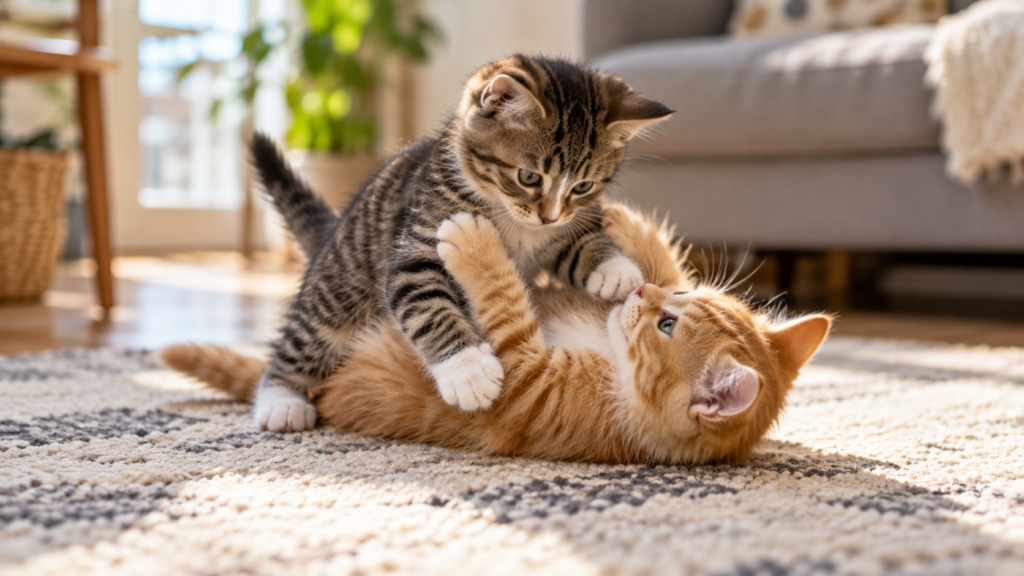
Play looks like: silence, or at most a chirp. Claws in. Roles reversing — chaser becomes chased. Pauses that neither cat uses to escape. Loose, springy body language, ears forward. Both cats go back to normal immediately afterwards.
A real fight looks like: noise, and plenty of it — growling, yowling, shrieking. Flattened ears, puffed fur, tails thrashing. One cat consistently doing the chasing while the other tries to leave. Claws out, fur on the floor. Afterwards, one cat hides, and often stops using shared resources.
The clearest single test is what happens next. Two cats that were playing settle down near each other. Two cats that were fighting do not, and the loser starts avoiding the room.
Watch also for the silent version. Some of the most damaging household conflict involves no fighting at all: one cat simply blocks doorways, stares, and takes the good spots, while the other stops eating properly and hides. Owners often report no problems at all, right up until a stress-related litter box issue appears.
How to break up a fight safely
Never reach in. Never grab a cat mid-fight. Bites and scratches to hands are the usual result, and cat bites are genuinely dangerous.
Interrupt from a distance instead: a loud clap, a cushion tossed near them, or a towel dropped over one cat. Blocking their view of each other with a large piece of cardboard works well, since much of the standoff is maintained by eye contact.
Then separate them into different rooms and leave them alone for at least 2 to 4 hours. Arousal takes real time to fade, and cats reintroduced too quickly will often go straight back at it. If one cat is badly frightened, give it a full day and let it come out on its own terms.
Check both for injuries once things are calm. Puncture wounds from cat teeth seal over fast and abscess underneath, so any bite that broke the skin deserves a vet call rather than watchful waiting, even if the cat seems fine.
Preventing it: fix the environment first
Asking why do cats fight is usually asking the wrong question; the better one is what they are fighting over. Most household conflict resolves when the competition is removed. The rule of thumb is one of everything per cat, plus one spare, distributed rather than clustered:
- Litter trays. One per cat plus one, in different rooms. Two trays side by side count as one resource.
- Food and water. Separate stations, out of sight of each other. Cats do not enjoy eating shoulder to shoulder.
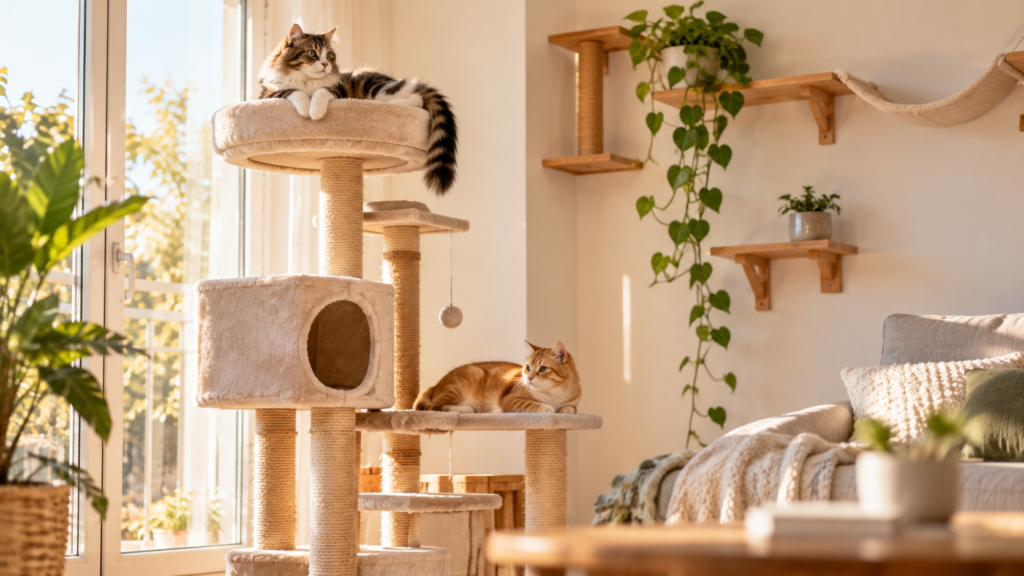
- Vertical space. Cat trees, shelves, cleared wardrobe tops. Height defuses conflict better than floor space, because it lets a cat get above the situation instead of past another cat.
- Multiple exits. Avoid dead ends. A cat that cannot leave a room without passing its rival will eventually fight instead.
- Hiding places. Boxes, covered beds, space under furniture. Somewhere to opt out of the household entirely.
Alongside that, play with each cat separately every day — much aggression is unspent hunting drive with nowhere to go. Synthetic pheromone diffusers help some households and do nothing in others; they are worth trying and not worth relying on. And if the cats are not neutered, neuter them.
For cats that already dislike each other, a full reintroduction usually works where patience alone does not: separate rooms, swap bedding and scent daily, feed on opposite sides of a closed door, then progress to a screen or a cracked door, and only then to shared space. Move at the anxious cat’s pace and expect it to take weeks.
When to involve a vet
Sudden fighting between cats that previously got along is the clearest red flag in this whole subject. Pain shortens tempers, and hyperthyroidism, arthritis, dental disease and cognitive decline all change temperament.
Book a check-up if fighting starts abruptly, if one cat has stopped using shared resources, if either is losing weight, hiding, or urinating outside the tray, or if any bite has broken skin. Ask specifically about referral to a qualified behaviourist when the environment is already right and the fighting continues — this is a solvable problem, but some cases need a proper behaviour plan rather than more cat trees.
The bottom line
So why do cats fight? Because they are territorial animals asked to share a small space, and something in that space is worth competing for.
Count your resources before you judge your cats. Add trays, separate the food, build upward, and give each cat a way out of every room. Then look at pain if the fighting is new. Most households that solve this solve it by changing the floor plan, not the cat.
FAQ
Play is quiet, claws are in, and the roles swap so the chaser becomes the chased. A real fight is loud, with growling and yowling, flattened ears, puffed fur, and one cat consistently trying to leave. The clearest test comes afterwards: cats that were playing settle down near each other, while cats that were fighting separate and one starts avoiding the room.
Sudden conflict between settled cats usually has a specific cause. Pain is the first to rule out, since arthritis, dental disease and hyperthyroidism all shorten tempers. Redirected aggression is the other common culprit: one cat sees a strange cat outside, cannot reach it, and attacks whoever is nearest. A vet check comes before any behaviour work.
Fix the environment before the relationship. Provide one litter tray per cat plus a spare in separate rooms, separate food and water stations out of sight of each other, plenty of vertical space, and no dead-end rooms. Play with each cat individually every day. If they already dislike each other, do a full reintroduction over weeks at the anxious cat’s pace.
Never reach in or grab a cat mid-fight, because hands get badly bitten and cat bites are genuinely dangerous. Interrupt from a distance with a loud clap, a cushion tossed nearby, or a piece of cardboard held between them to break eye contact. Then separate them into different rooms for several hours before letting them meet again.
Yes, noticeably. Unneutered cats fight considerably more, particularly males competing over territory and access to females. Neutering reduces roaming, spraying and fighting, though it does not eliminate conflict caused by resource competition or poor introductions. If your cats are not neutered and are fighting, that is the first change to make.
Sources
- Aggression Between Cats in the Same Household — PetMD — https://www.petmd.com/cat/behavior/aggression-cats
- Feline Behavior Problems: Aggression — Cornell Feline Health Center — https://www.vet.cornell.edu/departments-centers-and-institutes/cornell-feline-health-center
- Cats living together — PDSA — https://www.pdsa.org.uk/pet-help-and-advice/looking-after-your-pet/cats
- Managing multi-cat households — International Cat Care — https://icatcare.org/advice/
Keep reading
Was this article helpful?