
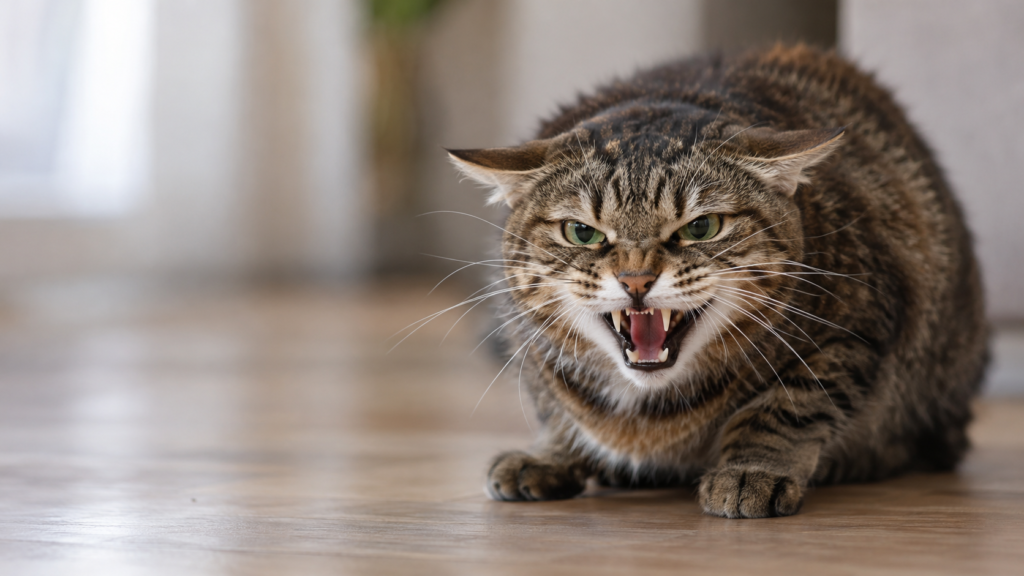
A hiss is a defensive signal, not an attack
Cats are small predators who are also prey. An injury that a large animal shrugs off can end a cat, so feline conflict is built around avoiding actual fighting wherever possible. Threat displays do the work instead.
The hiss sits in the middle of that escalation ladder. A cat that wants you gone starts with posture and stare, moves to a hiss, then a growl, then a swat with claws sheathed, and only reaches biting when everything earlier has failed. Reading the hiss as the beginning of an attack gets it backwards. It is the point at which your cat is still choosing not to attack.
That is why punishing a hiss is counterproductive. Take away the warning and you do not get a calmer cat; you get one that skips to the swat, because the polite version stopped working.
What the sound actually is
The mechanism is simple and revealing: a hiss is a forced burst of air pushed through an open mouth with the tongue arched and the lips pulled back. There is no voice in it. Unlike a meow or a purr, the vocal cords are not involved at all.
You can often feel it as much as hear it — cats at close range direct a genuine puff of air at the target’s face.
The resemblance to a snake is the interesting part. A frequently repeated idea holds that hissing is defensive mimicry of snakes, since a great many animals recognise that sound as dangerous. It is a plausible story and it appears constantly online, but it remains a hypothesis rather than a demonstrated fact. The simpler explanation — that forcing air through a narrow opening just sounds like that — accounts for the noise equally well.
Why do cats hiss? The triggers, ranked
Hissing has a small number of triggers, and they are all versions of the same message.
- Fear. The dominant cause. Something has entered the space and the cat wants it out: a stranger, a dog, a vacuum, a carrier.
- Pain. A cat that hisses when a particular spot is touched is often hurting there. Arthritis, dental disease, an abscess or an injury under thick fur.
- Territorial pressure. A new cat, a smell on your clothes, a cat visible through the window.
- Overstimulation. Handling that went on too long, particularly during grooming or nail trims.
- Maternal defence. A queen with kittens hisses readily at anything approaching, including familiar people, and it passes.
- Redirected upset. A cat that cannot reach what alarmed it — usually a cat outside — hisses at whoever is nearest. This one blindsides owners because the trigger is invisible.
Redirected upset is worth dwelling on, because it accounts for a surprising share of the cases where owners insist the hissing came from nowhere. A cat sees or smells an intruder through a window, cannot get at it, and the arousal has to go somewhere. The nearest housemate cat gets it, or you do. Cats in that state can stay wound up for hours after the trigger has gone, which is why separating them and letting things cool down beats trying to reconcile them immediately.
Kittens hiss too, and often theatrically, from as young as a few weeks. It is instinctive rather than learned, and a small kitten hissing at your hand is running an ancient program rather than making a considered threat.
The body tells you what the hiss means
The sound alone is ambiguous. The posture that comes with it is not, and it tells you whether your cat is frightened or genuinely ready to escalate.
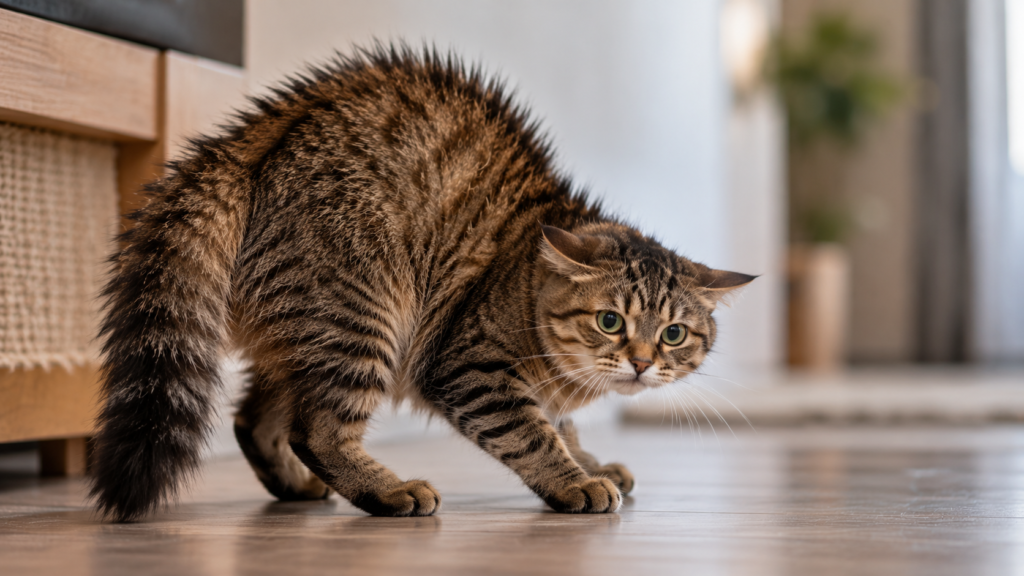
Defensive and afraid: body crouched and compact, ears flattened sideways or back, pupils wide, whiskers pulled back, tail tucked close or wrapped. Sometimes the arched back and puffed fur of the classic Halloween cat — which is a bluff, designed to make a small animal look larger.
Confident and warning: body upright and forward-leaning, ears rotated but not flat, pupils narrow, weight on the front legs, staring directly.
The frightened version is far more common in homes, and it needs a different response than most people give. The tail carries a lot of this information, and reading it takes only a moment once you know what to look at.
What to do when your cat hisses
Back off. That is genuinely most of it.
Stop whatever you are doing, take a step away, and avoid direct eye contact — a hard stare is confrontational in cat terms, and a slow blink is the opposite. Give the cat an obvious escape route, and let it leave rather than cornering it. Then leave it alone; a cat coming down from a fright needs time, and reaching in to reassure it is how people get bitten.
Do not shout, spray water, or scruff. All three confirm the cat’s assessment that the situation is threatening.
The timing matters more than people expect. A cat that has just hissed is running on adrenaline, and that takes real time to clear — often 20 to 30 minutes for a mild fright, and considerably longer after a serious one. Approaching during that window tends to restart the whole sequence, so the most useful thing you can do is genuinely nothing.
Afterwards, work out what triggered it. If it was a one-off — a visitor, a noise, the carrier — nothing more is needed. If it repeats, look at what is constant.
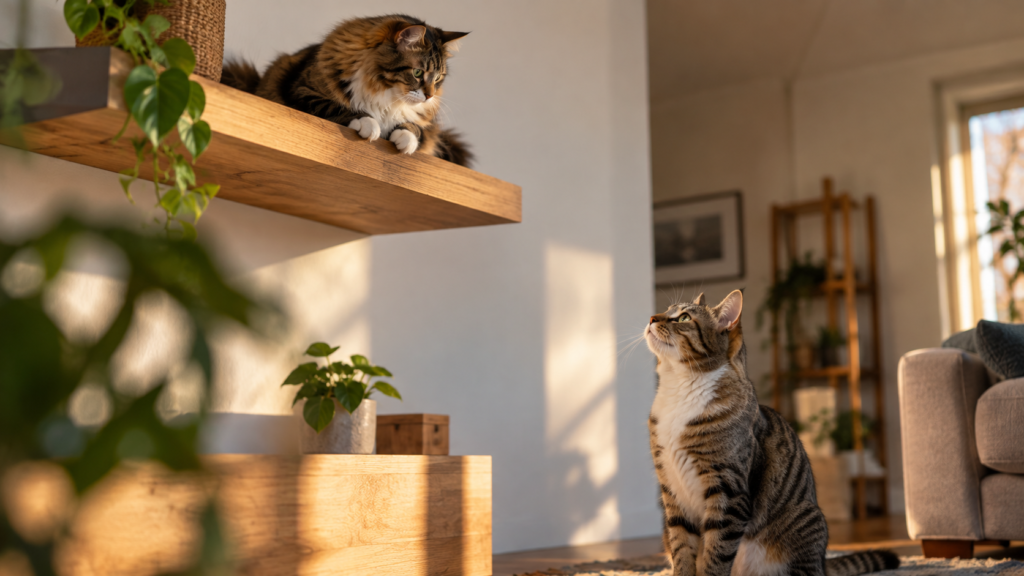
For hissing between cats in the same house, a hiss during introductions is normal and not a failure. What matters is the resource layout underneath: separate food and water stations, one litter tray per cat plus a spare, and enough vertical space that a cat can get above and away rather than being forced past another. Most sustained inter-cat tension is a resource problem wearing a personality costume. Reintroduce slowly through a closed door with scent swapping, and go at the pace of the more anxious cat.
When hissing means a vet visit
Sudden hissing in a cat that never hissed before is a symptom until proven otherwise.
Pain is the reason to take this seriously. Cats conceal discomfort well, and a change in tolerance for handling is one of the few early signals owners get. Book a check-up if the hissing is new, if it happens reliably when one area is touched, or if it comes alongside hiding, reduced jumping, appetite or litter box changes, or a coat that has gone unkempt. Dental disease and arthritis are both common, both easy to miss, and both treatable.
Get seen the same day if hissing accompanies obvious distress: an inability to settle, laboured breathing, straining in the litter tray, or a cat that will not let you near a specific spot at all.
The bottom line
So why do cats hiss? Because something frightened them, hurt them, or crowded them, and they are asking for space before things get worse.
Treat a hiss as information rather than misbehaviour. Give the cat room, remove whatever caused it, and check with a vet if it is new or attached to being touched in one place. A cat that hisses is a cat still using its words.
FAQ
No. Hissing is defensive and sits partway along an escalation ladder that runs from staring, through hissing and growling, to swatting and finally biting. A hissing cat is warning you rather than attacking, and is actively trying to avoid a fight. Punishing the hiss removes the warning without removing the fear, which produces a cat that skips straight to swatting.
A sudden change in an adult cat usually means pain, fear or redirected upset. Pain is the one to rule out first, especially if the hissing happens when a particular area is touched, since arthritis and dental disease are common and easy to miss. Redirected upset is the sneaky one: a cat that spotted another cat outside may hiss at whoever is nearest.
It is a popular theory but not an established fact. The idea is that mimicking a sound many animals instinctively avoid gives a small predator a useful bluff. The simpler explanation is that forcing air through a narrow opening with the tongue arched produces that noise anyway. Treat snake mimicry as an interesting hypothesis rather than settled science.
Look at resources before personalities. Provide separate food and water stations, one litter tray per cat plus a spare, and plenty of vertical space so a cat can move away upward instead of being forced past another. Hissing during introductions is normal. If it persists, restart the introduction slowly through a closed door with scent swapping, at the anxious cat’s pace.
Never. Shouting, spraying water or scruffing all confirm the cat’s judgement that the situation is threatening, which increases the fear driving the behaviour. The correct response is to back off, break eye contact, give a clear escape route, and let the cat calm down without being approached. Then identify and remove whatever triggered it.
Sources
- Why Do Cats Hiss? — PetMD — https://www.petmd.com/cat/behavior/why-do-cats-hiss
- Feline Behavior Problems: Aggression — Cornell Feline Health Center — https://www.vet.cornell.edu/departments-centers-and-institutes/cornell-feline-health-center
- Cat body language and communication — PDSA — https://www.pdsa.org.uk/pet-help-and-advice/looking-after-your-pet/cats
- Understanding feline body language — International Cat Care — https://icatcare.org/advice/
Keep reading
Was this article helpful?