
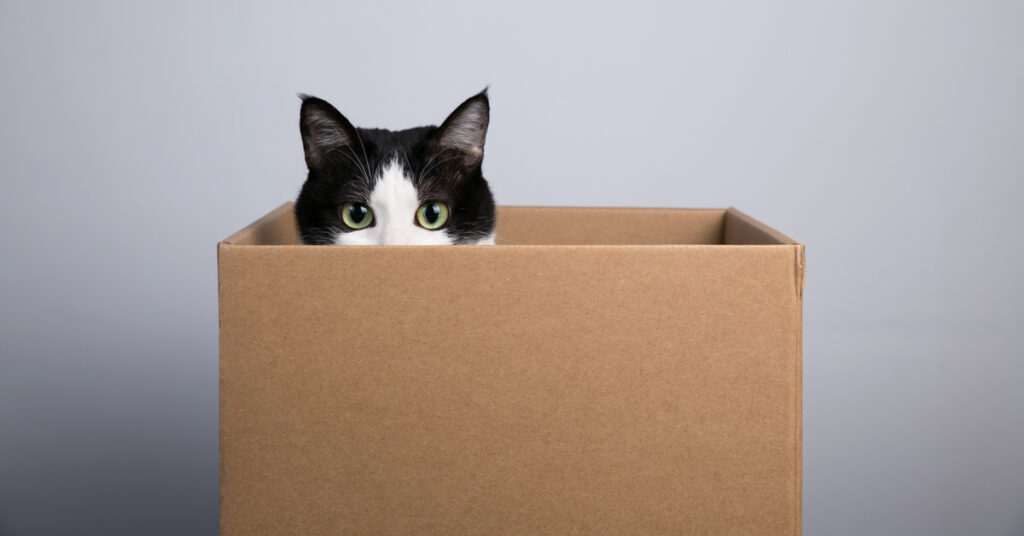
The great cardboard mystery
You spend good money on a fancy cat bed or a deluxe toy. Your cat sniffs it once, walks away — and climbs straight into the plain cardboard box it arrived in. If this has happened to you, you’re in good company: it happens in nearly every cat household on earth.
So what’s the deal? Why does a free, empty box beat everything you could ever buy? It turns out there’s real science behind the obsession — and it’s more interesting than “cats are weird.”
Reason 1: Boxes feel safe
The single biggest reason is security. Cats are both predators and prey, and in the wild an enclosed hiding spot is where a cat can feel protected — out of sight of anything bigger, with solid walls on most sides. A box scratches that ancient itch perfectly: four walls, one entrance, and a clear view of anything approaching.
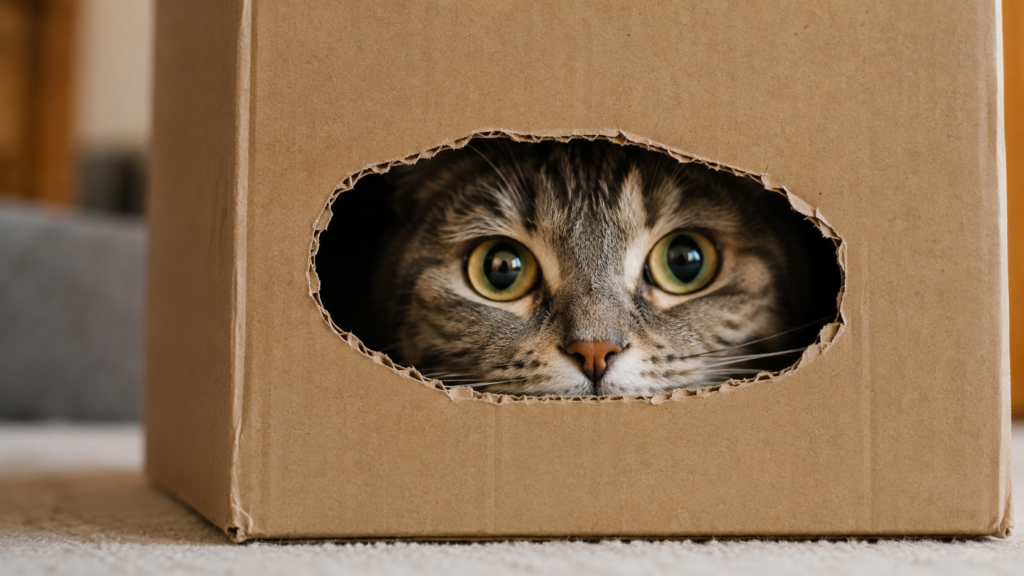
This isn’t just a theory. A well-known study of shelter cats at Utrecht University gave some newly arrived cats hiding boxes and withheld them from others. The cats with boxes were noticeably less stressed and adjusted to their new environment far faster. (Utrecht research, via Britannica) In other words, a box isn’t just fun — it’s a genuine stress-management tool.
Reason 2: Boxes are warm
Here’s a factor people rarely think about. Cats like it much warmer than we do. Their comfortable temperature range sits roughly between 86 and 97°F (30–36°C) — but most of us keep our homes around 72°F (22°C). To a cat, your cozy living room is a little chilly.
A cardboard box is surprisingly good insulation. Its snug walls trap the cat’s body heat and block drafts, turning a plain box into a warm little pocket. That’s a big part of why a cat will happily fold itself into a box that seems far too small — the tighter the fit, the warmer and cozier it feels. (PetMD)
Reason 3: The perfect ambush spot
Cats are ambush hunters by instinct, and a box is a dream hunting hide. From inside, a cat can watch the world go by, then explode out to “attack” a passing toy, a sibling cat, or your unsuspecting ankles.
That’s why the box becomes command central for play: it offers concealment, a surprise-attack launch pad, and a safe base to retreat to. Even well-fed indoor cats run this ancient program daily, and a box makes the game irresistible. It’s the same predatory instinct behind why cats knock things off tables – that urge to bat, pounce, and test the world with their paws.
Reason 4: A place to cope with stress
Because boxes feel so safe, they double as a cat’s favorite coping mechanism. When something stressful happens — visitors, a loud appliance, a new pet, a trip to the vet — many cats don’t confront the problem; they hide from it. A box gives them a controlled, enclosed retreat where they can calm down on their own terms.
It’s worth remembering this the next time your cat disappears into a box after something startling: they’re not sulking, they’re self-soothing. Providing hiding spots is one of the simplest things you can do for a nervous cat’s wellbeing.
Reason 5: “If I fits, I sits” — even without a box
Any cat owner knows the rule: if a cat can squeeze into a space, it will. But how much of this is about the box itself versus just the shape of an enclosed area?
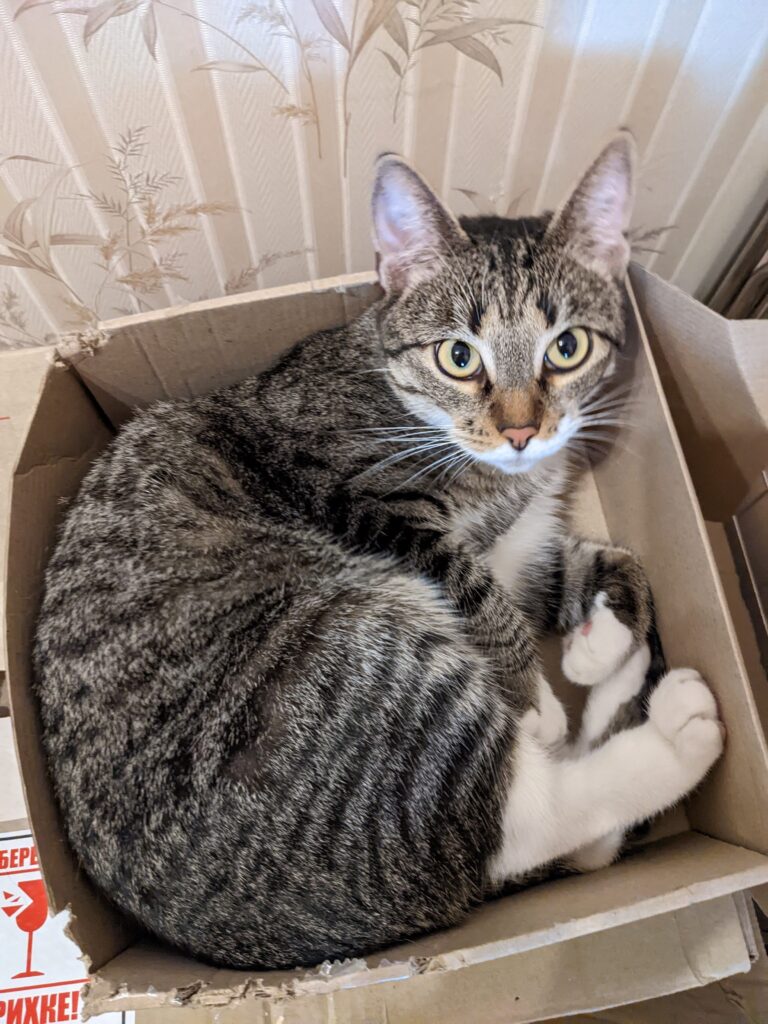
A clever citizen-science study put tape “squares” on the floor — flat outlines with no walls at all — and found that cats would happily sit inside them. Even more remarkably, cats also sat inside illusory squares (created using an optical illusion), suggesting they’re genuinely drawn to the outline of an enclosed space, not just a physical container. The instinct to seek out and settle into a defined, bounded spot runs deep — box or no box.
Should you give your cat boxes? (Yes!)
Absolutely — boxes are one of the cheapest, most effective forms of cat enrichment there is. Pair a rotating supply of boxes with other cheap boosts — a scratching post, a window perch, or a little catnip — and you’ll keep even an indoor cat happily stimulated.
A few quick safety tips:
- Remove staples, tape, and plastic that a cat could chew or swallow.
- Cut a couple of entrances in bigger boxes so a cat is never cornered.
- Skip glossy or chemically treated cardboard in favor of plain, untreated boxes.
- Offer variety — different sizes and a few “cat caves” keep things interesting.
The bottom line
Your cat isn’t snubbing the expensive bed to be difficult. A simple cardboard box hits several deep feline needs at once: it feels safe, it’s warm, it’s the perfect ambush base, and it’s a private place to de-stress. So the next time a delivery arrives, don’t be surprised if the box turns out to be the real gift. Keep a few around — your cat will thank you.
FAQ
Boxes satisfy several instincts at once. Most importantly they feel safe — enclosed spaces let a cat hide from threats and feel secure, which measurably lowers stress. Boxes are also warm and insulating, make ideal ambush hunting hides, and provide a private place to cope with anything scary. That combination of safety, warmth, and play is why a plain box beats almost any store-bought bed.
Yes. A study of shelter cats at Utrecht University found that cats given hiding boxes were significantly less stressed and settled into their new surroundings faster than cats without them. Because cats instinctively hide when anxious, an enclosed box gives them a safe retreat to calm down in, making it a genuine stress-management tool, not just a toy.
Two reasons: warmth and security. A tight box traps more of the cat’s body heat, making a snug fit feel extra cozy — and cats like it much warmer than we keep our homes. The close walls also press in on all sides, which feels safe and comforting. So a box that looks comically small to us can feel perfect to a cat.
A citizen-science study found cats will sit inside flat square outlines made of tape — and even inside optical-illusion “squares” with no real edges. This suggests cats are drawn to the shape of an enclosed or bounded space, not just physical walls. The instinct to settle into a defined spot is so strong that even the suggestion of a boundary is enough.
Generally yes, and they make excellent free enrichment. Just remove any staples, tape, or plastic your cat might chew or swallow, avoid glossy or chemically treated cardboard, and cut extra openings in large boxes so your cat is never cornered. With those simple precautions, a rotating supply of plain boxes is a safe, healthy source of play and comfort.
Sources
- Britannica — Why Do Cats Like Boxes? — https://www.britannica.com/science/Why-Do-Cats-Like-Boxes
- PetMD — Why Do Cats Like Boxes? — https://www.petmd.com/cat/behavior/why-do-cats-like-boxes
- Vinke et al., Applied Animal Behaviour Science (Utrecht University shelter-cat hiding box study) — https://www.sciencedirect.com/science/article/abs/pii/S0168159114000860
- Smith et al. (2021), Applied Animal Behaviour Science — “If I fits I sits” illusory-square study — https://www.sciencedirect.com/science/article/abs/pii/S0168159121000861
Keep reading:
Was this article helpful?