

What a whisker actually is
The proper name is vibrissae. Each one grows from a follicle packed with blood vessels and nerve endings, and that follicle sits far deeper than a normal hair root.
The whisker itself is dead keratin and feels nothing. All the sensing happens at the base: when the shaft moves, even fractionally, it acts as a lever that amplifies the movement and transmits it to the nerves below. The follicle is dense with mechanoreceptors, and the signal travels to the same brain region that processes touch — with an area devoted to it that is disproportionately large for such small structures.
The nerve supply is what separates a whisker from a hair. A single follicle can be served by well over a hundred nerve cells, and the whole array feeds a region of the brain comparable in prominence to the one primates devote to their fingertips. It is reasonable to think of a cat’s muzzle as doing something closer to reading than to feeling.
Cats have roughly 24 whiskers on the muzzle, arranged in four rows on each side, and the arrangement is not random. The upper rows move independently of the lower ones, which lets a cat sweep them forward and build a picture of what is directly in front of its face — precisely the zone its eyes cannot focus on.
Whiskers are not only on the face
Most people know about the muzzle. The others are the interesting part:
- Above the eyes, working like eyebrows. A touch here triggers a protective blink, which is why a cat pushing through undergrowth does not scratch its corneas.
- On the cheeks, adding width to the sensory map.
- On the chin, below the mouth.
- On the back of the front legs, called carpal whiskers. These matter for hunting: a cat that has caught prey cannot see it clearly at close range, so the carpal whiskers report where it is and whether it is still moving.
They also move under muscular control rather than hanging passively. A cat can sweep them forward, fan them out, or pin them back, and it does so constantly as it investigates. Watching a cat approach something unfamiliar in a cardboard box or a bag shows the whiskers working before the nose arrives.
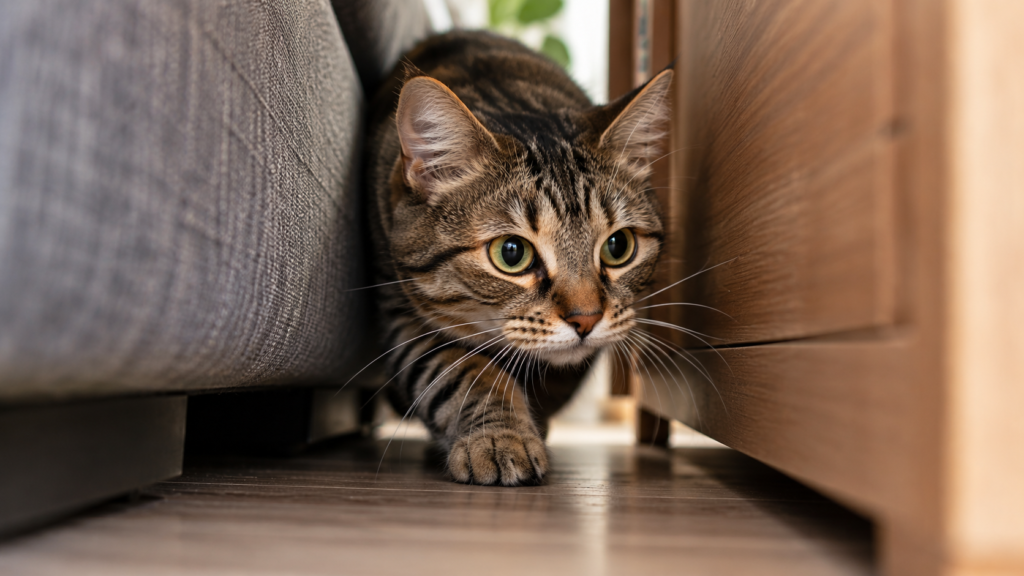
That last set explains a common observation. A cat holding something in its paws often appears to be looking past it rather than at it, and it is — cats are long-sighted at close range, and the whiskers are doing the work the eyes cannot.
Why do cats have whiskers? Four jobs they do
Spatial navigation. Whiskers detect tiny changes in air currents, which lets a cat sense obstacles before touching them. Air moving around a wall or a table leg deflects differently, and a cat reads that. In darkness this is close to a substitute for sight, and it is a large part of why a cat moves confidently through a pitch-black room.
Judging gaps. The often-repeated claim is that whiskers span exactly the width of the body, so a cat can measure whether an opening will admit it. The principle is broadly right and useful, but the precision is overstated — whisker span does correlate with body width, though an overweight cat’s whiskers do not grow to match its new dimensions, which is why fat cats get stuck in places their whiskers approved.
Hunting. Forward-swept whiskers form a basket around prey held in the mouth or paws, tracking movement in the blind zone under the chin.
Emotional signalling. Whisker position is a reliable mood indicator and easy to learn: relaxed and out to the sides means calm; pushed forward means alert, curious or hunting; flattened back against the cheeks means frightened or defensive. It pairs with ear and tail position to give a complete reading.
Whisker fatigue: real, but overstated
You will see a great deal written about whisker fatigue — the idea that repeatedly brushing whiskers against the sides of a deep bowl causes sensory overstimulation and stress, leading cats to eat reluctantly, paw food onto the floor, or leave the middle of the bowl untouched.

Here is the honest position. The proposed mechanism is plausible given how sensitive whiskers are, and plenty of owners report improvement after switching to a wide, shallow dish. But the evidence base is thin, and the term circulates far more confidently in marketing than in veterinary literature.
The practical upshot is easy either way: a shallow, wide bowl costs almost nothing and has no downside. Try it if your cat is fussy at mealtimes. But do not stop there — a cat that has suddenly become reluctant to eat needs dental disease, nausea and pain ruled out before the bowl gets the blame.
Never trim a cat’s whiskers
This is the one genuine warning in the subject, and it is absolute: do not cut them, and do not let anyone else.
A cat with trimmed whiskers is sensorily impaired. It will misjudge distances, become disoriented in the dark, hesitate at gaps it used to pass through easily, and often become noticeably anxious. Whiskers cannot be trimmed harmlessly the way fur can, and the effect lasts until they grow back.
Groomers occasionally trim whiskers for tidiness, particularly on long-haired breeds, and it is worth saying explicitly when you book: ask that the whiskers, including the ones above the eyes and on the front legs, are left untouched. Most professionals know this already, and the ones who do not will benefit from being told.
The good news is they grow back, over weeks to a few months, and shedding the occasional whisker is entirely normal — you will find them on the floor, and finding one is not a problem. What is not normal is losing several at once, or losing them alongside broken fur, bald patches or scabbing. That combination points to skin disease, infection, over-grooming or a fight, and it deserves a vet visit rather than a wait.
Kittens are born with whiskers already in place, incidentally, and use them from the first days of life to find their mother.
How whiskers change with age and health
Whisker colour shifts over a cat’s life, and it catches owners by surprise. A black cat can develop white whiskers with age, and a white-whiskered cat can grow the odd black one — pigment production in the follicle simply changes, and it means nothing medically on its own.
Curling or crimping is a different matter. Whiskers that have become wavy, brittle or noticeably shortened can point to poor nutrition, hormonal disease, or damage from repeatedly pushing into a bowl that is too narrow. Rex breeds are the exception: Devon and Cornish Rex cats have naturally curled, fragile whiskers that break easily, and that is a breed characteristic rather than a problem.
The bottom line
So why do cats have whiskers? Because a small nocturnal predator needs to map its surroundings in the dark, judge whether a gap will fit, and track prey it cannot see under its own chin.
Leave them alone, feed from a wide shallow bowl if your cat seems fussy, learn to read their position for mood, and never let a groomer trim them. A cat’s whiskers are doing more work than almost anything else on its face.
FAQ
Whiskers detect tiny air currents, letting a cat sense obstacles before touching them and navigate confidently in darkness. They help judge whether a gap is wide enough, form a sensory basket around prey held under the chin where the eyes cannot focus, and signal mood through their position. They are precision touch organs rather than decorative hair.
No, never, and do not allow a groomer to either. Trimmed whiskers leave a cat sensorily impaired: it will misjudge distances, become disoriented in the dark, hesitate at familiar gaps and often grow anxious. Whiskers contain no nerves along the shaft so cutting does not hurt, but the loss of information genuinely disables the cat until they regrow over weeks or months.
The mechanism is plausible and many owners report improvement with wide shallow bowls, but the evidence base is thin and the term appears far more in marketing than in veterinary literature. Switching bowls costs little and has no downside, so it is worth trying. Do not let it delay ruling out dental disease, nausea or pain in a cat that has stopped eating properly.
Yes. Besides the muzzle, cats have whiskers above the eyes that trigger a protective blink, on the cheeks, on the chin, and on the back of the front legs. Those leg whiskers, called carpal whiskers, track prey held in the paws, since cats cannot focus clearly at very close range and need touch information instead.
Shedding the occasional whisker is normal, and finding one on the floor is nothing to worry about since they regrow. Losing several at once is different, particularly alongside broken fur, bald patches, scabbing or scratching. That combination suggests skin disease, infection, over-grooming or injury from a fight, and warrants a veterinary examination rather than waiting to see.
Sources
- Why Do Cats Have Whiskers? — PetMD — https://www.petmd.com/cat/general-health/why-do-cats-have-whiskers
- Cat — Britannica — https://www.britannica.com/animal/cat
- Cornell Feline Health Center — Cornell Feline Health Center — https://www.vet.cornell.edu/departments-centers-and-institutes/cornell-feline-health-center
- Understanding cat senses — International Cat Care — https://icatcare.org/advice/
Keep reading
Was this article helpful?