
Korat
The Korat is an ancient Thai breed with a shimmering silver-blue coat and luminous peridot-green eyes. Intelligent, sensitive, and deeply devoted, these good-luck cats form intense bonds with their people.
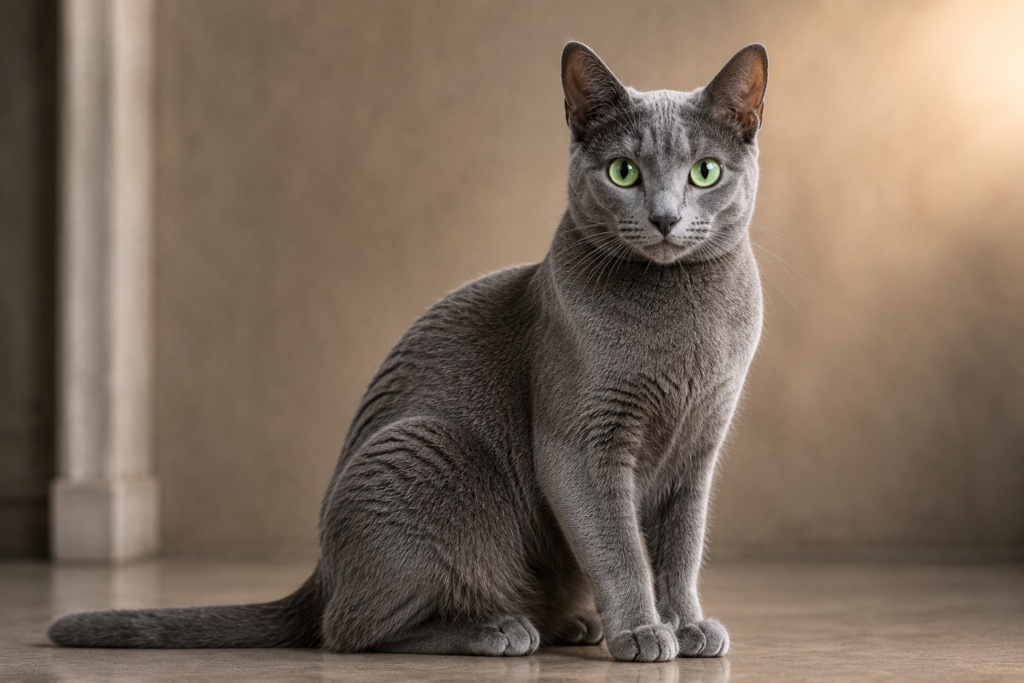
About the Korat
History and Origins
The Korat is one of the oldest natural cat breeds, native to the Korat province of Thailand, where it has existed for centuries and is called “Si-Sawat,” meaning good fortune. The breed appears in the ancient Thai manuscript the Tamra Maew (Cat-Book Poems), dating back hundreds of years, and has long been considered a living good-luck charm. Traditionally, Korats were never sold but given in pairs to newlyweds or honored guests to bestow prosperity and a happy marriage.
The breed was introduced to the West in the 1950s and 60s, and because it was so carefully preserved in Thailand, the modern Korat remains close to its ancient form — a genuinely natural, un-manufactured breed still treasured as a symbol of luck.
Personality and Temperament
Korats are intelligent, gentle, and intensely people-oriented. They bond very strongly with their families — often forming an especially close attachment to one favorite person — and they want to be involved in everything, following you around and seeking closeness. They are affectionate and can be quite demanding of attention, thriving on interaction and companionship.
They are also known for their remarkable memories and sensitivity. Korats are keenly aware of their environment and prefer calm, stable households; loud noises, chaos, or constant change can stress them. They’re playful and clever, enjoying games and gentle training, but at heart they’re devoted, sensitive companions who do best in a peaceful home where they receive plenty of love and don’t have to compete for attention.
Care and Grooming
Grooming a Korat is simple. Their short, single, silver-tipped coat has little undercoat, so it needs only a weekly brush to keep its luminous sheen, and they shed very little. The silver tipping that gives the coat its “halo” glow needs no special care beyond keeping the cat healthy.
Their more important needs are emotional. Because Korats are sensitive and attention-loving, they do best with a calm environment, predictable routines, and plenty of companionship — many are unhappy left alone for long stretches. Provide interactive play, climbing spaces, and quality time daily. Round out care with routine nail trims, ear checks, and dental hygiene.
Health and Lifespan — an important note
Korats are generally healthy and long-lived, often reaching 15–20 years. As a natural breed they have few manufactured health problems, but there is one very important, breed-specific concern every prospective owner must know about: the Korat can carry the genes for GM1 and GM2 gangliosidosis, inherited neurological disorders that are fatal in affected kittens.
The crucial good news is that a DNA test is available, and responsible breeders test their breeding cats to ensure they never produce affected kittens. This means the condition is entirely preventable through proper testing. Only buy a Korat from a breeder who DNA-tests for gangliosidosis — this is the single most important thing you can do for the breed. Otherwise, provide routine veterinary care, a healthy weight, and a calm home for a long, healthy life.
Cost and Is the Korat Right for You?
A Korat kitten from a reputable breeder generally costs $600 to $1,200 in the United States, sometimes more given the breed’s rarity. Given the gangliosidosis risk, it is essential to buy only from a breeder who DNA-tests — never from an unverified source.
The Korat suits people who want a devoted, intelligent, affectionate companion and can provide a calm, stable home with plenty of attention. They’re ideal for quieter households, singles, and couples who are home often. They are less ideal for chaotic, noisy homes, for busy households where the cat would be left alone for long hours, or for anyone wanting an independent, low-attention cat — the Korat’s sensitivity and devotion need to be matched.
Explore More
Drawn to shimmering blue-gray cats? Compare the Korat with the Russian Blue and the French Chartreux. Or meet its fellow ancient Thai breeds, the white “gem” Khao Manee and the talkative Siamese, and browse all cat breeds.
Frequently Asked Questions
Yes, quite rare — especially outside Thailand, where the breed is most established and treasured. There are relatively few breeders worldwide, so genuine Korats can be hard to find and often come with a waitlist. Because they were traditionally given rather than sold in Thailand and carefully preserved, the modern Korat remains close to its ancient natural form and is a special, uncommon breed.
Though both are blue-gray cats, they're distinct breeds. The Korat has a single silver-tipped coat, a heart-shaped face, and large peridot-green eyes, and comes only in silver-blue. The Russian Blue has a plush double coat, a more wedge-shaped head, and vivid green eyes, and is finer-boned. The Korat is a natural Thai breed, while the Russian Blue traces to northern Russia — different origins and looks.
Korats are moderately vocal and communicative. They "talk" to their owners to express their needs and stay connected, though they're not as relentlessly loud as a Siamese. Being attention-loving and people-oriented, they use their voice — along with plenty of following and cuddling — to interact with their favorite people. For those who enjoy an engaged, communicative cat, they're a good fit.
Often, yes. While Korats are affectionate with their whole family, they frequently form an especially intense bond with one favorite person, shadowing them and seeking their attention above others. They're sensitive, devoted cats that thrive on close companionship. This strong attachment is part of their charm, but it also means they don't like being left alone or ignored for long.
Korats are notably long-lived, often reaching 15–20 years with good care. Supporting their longevity means buying from a breeder who DNA-tests for gangliosidosis, keeping them at a healthy weight, feeding a quality diet, providing a calm and stable home, and maintaining regular veterinary and dental checkups. Their natural hardiness helps, but ethical breeding is the key starting point.