
Toyger
The Toyger is a designer breed developed to resemble a tiny tiger. These affectionate, playful cats combine exotic striped markings with a sweet, laid-back personality.
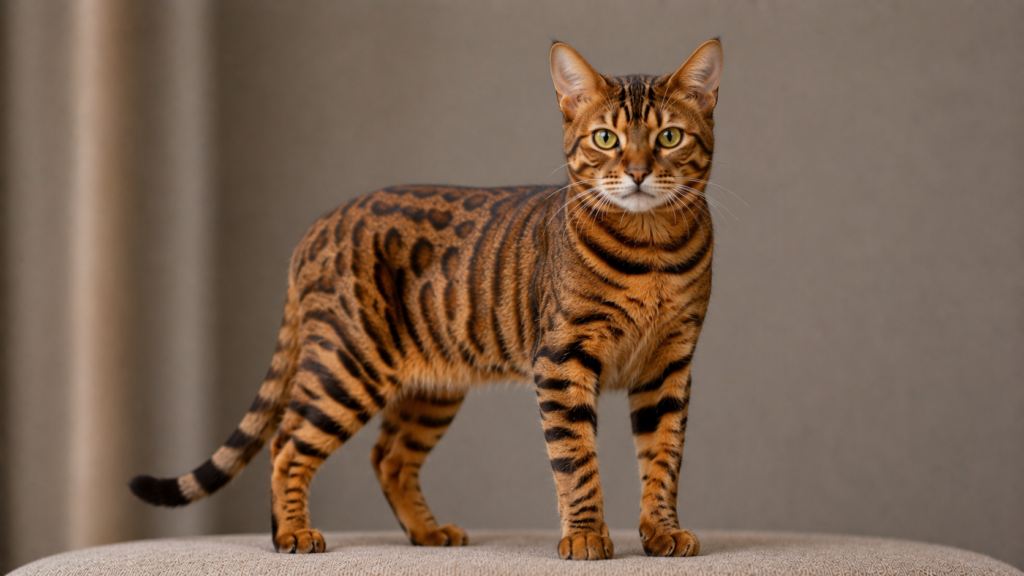
About the Toyger
History and Origins
The Toyger is one of the most deliberately designed cats in existence. It was created by Judy Sugden — daughter of Jean Mill, the breeder behind the Bengal — who noticed in the 1980s that one of her tabby cats had two unusual spots of tabby marking on its temples, hinting that a genuinely tiger-like facial pattern might be achievable in a domestic cat.
Working from that observation, Sugden combined a striped domestic shorthair, a Bengal, and in 1993 a street cat imported from Kashmir, India, that carried the bold branching markings she needed. Her explicit goal was twofold: to produce a house cat resembling a toy tiger, and to use that resemblance to build public sympathy for tiger conservation in the wild.
TICA accepted the Toyger for registration in 1993 and granted full championship status in 2007. Despite the attention the breed attracts, it remains one of the rarest cats in the world, with breeding still focused on perfecting the pattern.
Importantly, though the Bengal contributed to its development, the modern Toyger is a fully domestic cat with no recent wild ancestry.
Personality and Temperament
The wild appearance is entirely cosmetic. Toygers are sweet-natured, laid-back and notably easygoing — one of the calmer breeds among the athletic spotted and striped cats, and nothing like their tiger styling suggests.
They are affectionate and people-oriented, happy to sit on laps, sleep against their owners and follow the household around. They are confident rather than skittish, and typically greet visitors instead of hiding from them.
Intelligence is high and trainability is one of the breed’s selling points. Toygers commonly learn to walk on a harness and lead, play fetch, respond to clicker training and solve puzzle feeders — many owners treat them much as they would a small dog.
Energy is moderate to high: they enjoy climbing and interactive play but are not frenetic, and they settle readily afterward. They are usually reliable with children, dogs and other cats, and their voice is quiet and unobtrusive.
Care and Grooming
Coat care is simple. The short, dense, plush coat needs a weekly brush with a rubber mitt or soft slicker to lift loose hair and bring out the glossy, almost glittered sheen the breed is known for. Shedding is moderate and baths are seldom necessary.
Exercise and enrichment matter more. Provide tall cat trees, sturdy shelving and window perches, and set aside time daily for interactive play with wand toys. Because the breed takes so well to training, harness walks, puzzle feeders and clicker sessions are genuinely useful ways to use up energy and keep a clever cat satisfied.
Given the price and the breed’s confident, curious nature, Toygers should be kept indoors or in a secure outdoor enclosure — a free-roaming Toyger is both at risk and a theft target.
Watch weight, since they are food-motivated, and keep up tooth brushing, nail trims and ear checks.
Health and Lifespan
Toygers are generally healthy and typically live 12–15 years, sometimes longer. Because the breed is young and its founding population small, the health picture is still being established, which makes breeder diligence especially important.
Hypertrophic cardiomyopathy (HCM) is the main documented concern, as in most modern breeds. No reliable DNA test covers the Toyger, so responsible breeders screen breeding cats by echocardiogram with a veterinary cardiologist and can show you dated results.
From the Bengal side, the breed can inherit progressive retinal atrophy (PRA-b), which causes gradual retinal degeneration and eventual blindness. A DNA test is available for this, and it is inexpensive, so insist on seeing results. Bengal ancestry also means pyruvate kinase deficiency testing is worth asking about, as it too is DNA-testable.
Some Toygers show heart murmurs in kittenhood, many of which are innocent but all of which warrant cardiac evaluation. The limited gene pool is itself a consideration: ask breeders how they manage genetic diversity.
Otherwise, routine care applies — annual examinations, vaccinations, parasite prevention, dental hygiene and a lean body weight.
Cost and Is the Toyger Right for You?
Toygers are expensive. Kittens from reputable US breeders typically run $1,500 to $5,000, with well-marked show-quality cats at the top of that range and pet-quality kittens at the bottom. Scarcity drives the price: there are few breeders and long waiting lists are normal.
The Toyger suits people who want a striking, exotic-looking cat with a genuinely gentle temperament — families, first-time owners of active breeds, and anyone who enjoys training a cat to walk on a lead. They combine spectacle with an easy nature better than most wild-looking breeds.
They are wrong for buyers on a tight budget, for anyone expecting a wild or exotic temperament to match the coat, and for those unwilling to wait for a health-screened kitten from a documented line.
Explore More
Compare the Toyger with its ancestor the Bengal, and with other spotted and striped breeds such as the Ocicat and the Egyptian Mau. For a larger wild-looking option, see the Savannah, or browse all cat breeds.
Frequently Asked Questions
No. Despite the name and appearance, the Toyger has no tiger or wild cat ancestry whatsoever. It was created from domestic shorthairs, a Bengal, and a striped street cat imported from Kashmir, selected purely for markings that mimic a tiger's. The modern Toyger is a fully domestic cat requiring no special permits and carrying no wild temperament.
Scarcity and difficulty. The Toyger is among the rarest breeds in the world, with few breeders and long waiting lists, and the bold branching tiger pattern is hard to reproduce reliably, so only some kittens in a litter meet the standard. Add proper health screening costs and prices typically land between $1,500 and $5,000.
Yes, unusually so for a wild-looking breed. Toygers are sweet-natured, laid back and confident, generally reliable with children, dogs and other cats, and inclined to greet visitors rather than hide. They are affectionate lap cats with quiet voices and moderate energy, which makes them far easier to live with than their tiger styling suggests.
Yes, and many owners do. Toygers are highly intelligent, food-motivated and confident, which makes them one of the more trainable cat breeds. Most take readily to harness and lead training, fetch and clicker work. Introduce the harness gradually indoors before going outside, and never leave a harnessed cat unsupervised.
Ask for dated echocardiogram results from a veterinary cardiologist screening for hypertrophic cardiomyopathy, since no DNA test covers this breed. Because of the Bengal ancestry, also ask for DNA test results for progressive retinal atrophy (PRA-b) and pyruvate kinase deficiency. Given the small gene pool, ask how the breeder manages genetic diversity.