
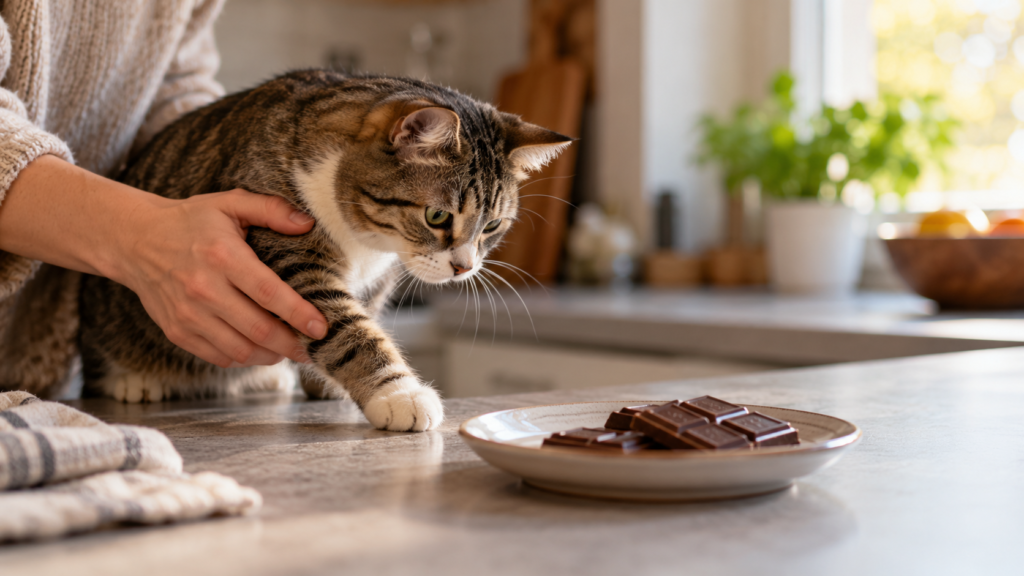
This article is general information, not veterinary advice, and it deliberately does not give toxic dose figures — safe advice depends on the chocolate type, the amount and your cat’s weight, and that calculation belongs to a veterinary professional. If your cat has eaten chocolate, contact your veterinarian or a pet poison helpline immediately rather than waiting for symptoms to appear.
My cat licked chocolate — what now? Call your veterinarian or a pet poison helpline now, before reading the rest of this. Chocolate is genuinely toxic to cats, the safe advice depends on the type of chocolate and your cat’s weight, and the window in which treatment works best is early — before symptoms appear. Do not wait to see whether your cat becomes unwell.
That said, a single lick of milk chocolate from a finger is a very different event from a cat that has eaten baking chocolate, and this article explains the difference.
My cat licked chocolate — do this first
1. Take the chocolate away and stop any further access.

2. Work out what and how much. Keep the wrapper. You need the type of chocolate, the approximate amount, and your cat’s weight. Type matters enormously, and your vet cannot advise properly without it.
3. Call for advice. Your own vet, an emergency clinic, or a pet poison control service. In the US, the ASPCA Animal Poison Control Center and the Pet Poison Helpline both operate 24 hours; both charge a consultation fee. In the UK, the Animal PoisonLine is the equivalent first call. Have the wrapper and your cat’s weight ready.
4. Do not induce vomiting unless a veterinary professional tells you to. Home methods used for dogs, including hydrogen peroxide, are not safe in cats and can cause serious harm.
5. Note the time. When it happened matters for treatment decisions.
Why chocolate is toxic to cats
The problem is theobromine, a stimulant found in cocoa, alongside a smaller amount of caffeine. Both belong to a group of compounds called methylxanthines.

People metabolise theobromine efficiently. Cats do not — they clear it far more slowly, so it accumulates and acts on the heart, the central nervous system and the kidneys. The result can be a dangerously fast heart rate, tremors, and in severe cases seizures.
The critical point is that theobromine concentration varies hugely by chocolate type. The darker and more bitter the product, the more dangerous it is per gram:
- Cocoa powder and baking chocolate — the most concentrated and the most dangerous
- Dark chocolate — high risk
- Semi-sweet and milk chocolate — progressively lower concentration, but still toxic in quantity
- White chocolate — contains very little theobromine, and is unlikely to cause theobromine poisoning, though the fat and sugar can still upset a cat’s stomach
There is a real advantage here that cats have and dogs do not: cats cannot taste sweetness. They lack a functioning sweet taste receptor, so they are much less inclined to eat chocolate voluntarily. Most feline cases involve a small taste, a cat licking a wrapper or a bowl, or chocolate combined with something a cat does want — cream, butter, milk or ice cream. Serious poisoning is correspondingly rarer than in dogs, but it does happen, and cats are small, so it takes less.
My cat licked chocolate: signs of poisoning to watch
Symptoms typically appear within a few hours, though they can be delayed, and they may last some time because theobromine clears slowly.
Early and mild signs include vomiting, diarrhoea, restlessness or hyperactivity, increased thirst and increased urination.
More serious signs include a rapid or irregular heartbeat, panting or rapid breathing, muscle tremors or twitching, unsteadiness, agitation, high temperature, seizures, and collapse.
Do not wait for symptoms before calling. Treatment is considerably more effective started early, and by the time tremors or an abnormal heart rate appear, the situation is more difficult to manage.
When to call your vet
The short answer is always, and immediately. There is no amount of chocolate for which watching and waiting is the better plan, because early treatment is simple and late treatment is not.
Call your vet or a pet poison helpline right away if:
- Your cat has eaten any dark chocolate, baking chocolate or cocoa powder, in any quantity
- Your cat has eaten more than a lick of milk chocolate
- You do not know how much was eaten, or cannot find the wrapper
- The product was sugar-free, or contained raisins, macadamia nuts, coffee or alcohol
- Your cat is very young, elderly, small, or has existing heart or kidney disease
Go to an emergency vet immediately, without phoning first if that is faster, for muscle tremors or twitching, seizures, collapse, a racing or irregular heartbeat, panting or laboured breathing, extreme agitation, or a cat that is unsteady on its feet. These indicate that theobromine is already acting on the heart and nervous system, and that situation moves quickly.
If it is the middle of the night, go anyway. Theobromine clears slowly in cats, so an overnight delay is not a neutral choice, and most areas have a 24-hour emergency clinic precisely for this.
Other things in chocolate that matter
The theobromine is the headline, but not the only concern.
Xylitol appears in some sugar-free chocolates and sweets. Its dangers are well documented in dogs; the picture in cats is less clear, but any sugar-free product should be reported to your vet when you call.
Fat content can trigger pancreatitis or gastrointestinal upset, particularly in rich products.
Raisins, macadamia nuts, coffee beans and alcohol all appear in chocolate confectionery and all carry their own risks. Read the ingredients when you keep the wrapper.
Wrappers and foil can cause an obstruction if swallowed, which is a separate problem needing its own assessment.
What treatment looks like
If you have called promptly, your vet may induce vomiting to remove chocolate still in the stomach — this is a decision for a professional, using drugs appropriate for cats, and not something to attempt at home.
Activated charcoal may be given to reduce further absorption, sometimes in repeated doses because theobromine recirculates through the body. Intravenous fluids support the kidneys and help clear the toxin. Beyond that, treatment is supportive and tailored to what the cat shows: medication to control heart rate, drugs for tremors or seizures, and monitoring with ECG where the heart is affected.
Cats that receive early treatment generally do well. The prognosis is considerably worse for cats that arrive already seizing.
Preventing the next one
Climbing is the problem: cats reach places dogs never could.
- Store all chocolate in closed cupboards, not on counters, tables or in handbags
- Be especially careful at Easter, Christmas, Halloween and Valentine’s Day, when chocolate is left out in bowls and under trees
- Warn visitors and children not to share food with the cat
- Clear away baking ingredients immediately; cocoa powder is the most dangerous form in most kitchens
- Keep hot chocolate, chocolate milk and cocoa-containing drinks covered — a milky drink is exactly the kind of thing a cat will taste
- Save your vet’s number and a poison helpline number in your phone now, before you need them
While you are at it, review the rest of the kitchen. Cats investigate food that smells of dairy or fat rather than sugar, which is why a bowl of cream-based dessert draws more feline attention than a bar of chocolate does — the same curiosity that has them supervising every meal you prepare. Onions, garlic, grapes and raisins, alcohol, and lilies are all seriously toxic to cats, and lilies in particular can cause fatal kidney failure from a tiny exposure — including pollen groomed off the coat.
The bottom line
My cat licked chocolate: is it an emergency? Assume it might be, and call. A single lick of milk chocolate from a well cat is usually a low-risk event, and a cat that has eaten dark or baking chocolate is a genuine emergency — but the line between them depends on the product and your cat’s weight, and that is a calculation for a professional with the wrapper in front of them.
Keep the packaging, note the time, do not induce vomiting yourself, and phone rather than watching and waiting. If your cat does start vomiting after eating something it should not have, mention that when you call, along with exactly when it began. Early treatment is straightforward and usually successful. Late treatment is neither.
FAQ
Call your vet or a pet poison helpline to find out, rather than deciding at home. A single lick of milk chocolate from an otherwise well cat is usually low risk, while any dark or baking chocolate is a genuine emergency. The safe threshold depends on the chocolate type, the amount and your cat’s weight, so keep the wrapper and phone for advice.
There is no single figure, which is why this article does not give one. Toxicity depends on the theobromine concentration, which varies enormously between cocoa powder, baking chocolate, dark, milk and white chocolate, and on your cat’s body weight. A veterinary professional can calculate the risk quickly if you have the wrapper and your cat’s weight to hand.
Early signs include vomiting, diarrhoea, restlessness, increased thirst and increased urination, usually within a few hours. More serious signs are a rapid or irregular heartbeat, panting, muscle tremors, unsteadiness, high temperature, seizures and collapse. Do not wait for symptoms before calling, because treatment started early is considerably more effective than treatment started late.
No, not unless a veterinary professional specifically instructs you to. Home methods used for dogs, including hydrogen peroxide, are not safe in cats and can cause serious injury. Your vet can induce vomiting safely with appropriate drugs if it is warranted. Take the chocolate away, keep the wrapper, note the time and phone for advice.
White chocolate contains very little theobromine, so theobromine poisoning is unlikely from it. That does not make it safe. The high fat and sugar content can cause gastrointestinal upset or contribute to pancreatitis, and any accompanying ingredients such as raisins, macadamia nuts or xylitol carry their own risks. Report what your cat ate when you call.
Sources
- Chocolate Poisoning in Cats — PetMD — https://www.petmd.com/cat/conditions/toxicity
- Animal Poison Control — ASPCA — https://www.aspca.org/pet-care/animal-poison-control
- Poisons and your cat — PDSA — https://www.pdsa.org.uk/pet-help-and-advice/pet-health-hub
- Poisons affecting cats — International Cat Care — https://icatcare.org/advice/
Keep reading
Was this article helpful?