

You just fed them. You watched them eat. And yet here they are again — winding around your ankles, yelling at the cupboard, staring at you like you’ve never fed them in your life. Some cats treat every meal like it’s their last and every hour like it’s dinnertime.
So is your cat genuinely starving, brilliantly manipulating you, or is something actually wrong?
The honest answer: it’s usually one of a handful of things, and they split neatly into two groups — behaviour and feeding habits (mostly harmless, fixable at home) and medical causes (which need a vet). The trick is knowing which camp your cat is in. Let’s walk through both.
First, is it real hunger — or a very good performance?
Cats are master negotiators. If yelling at 6 a.m. once produced breakfast, your cat has filed that away as a proven strategy and will run it forever. This is learned begging, and it’s incredibly common. The food isn’t the point; the response is.
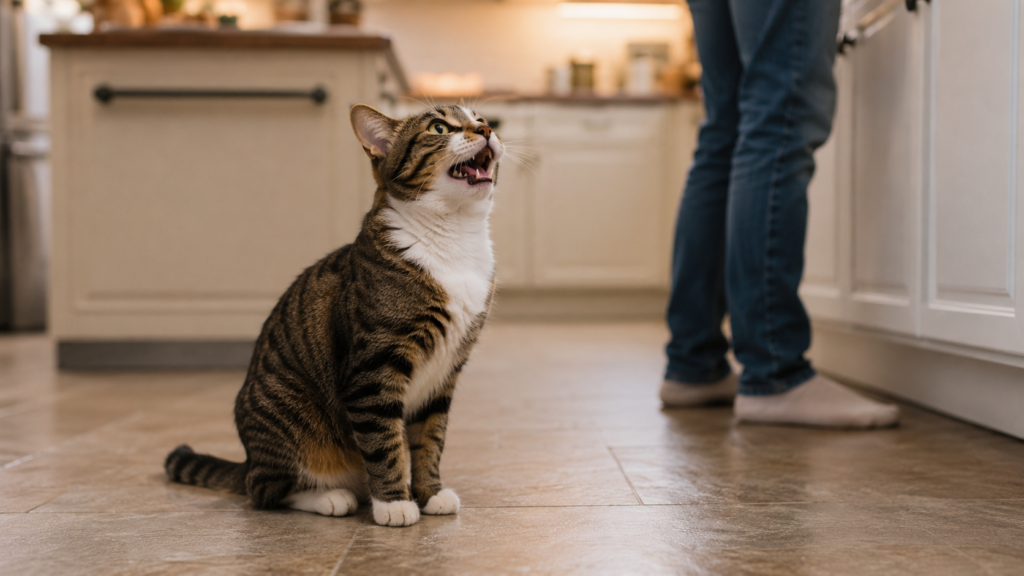
A few tells that it’s behavioural rather than true hunger:
- Your cat “starves” loudly but is at a perfectly healthy weight.
- The begging is tied to you — when you enter the kitchen, open the fridge, or wake up — rather than to an empty bowl.
- They walk away from food that’s actually available and hold out for the good stuff.
None of that means your cat is being dramatic for no reason. It just means the fix is about routine and boundaries, not more food.
The harmless reasons your cat acts starving
Boredom
Indoor cats have a lot of empty hours to fill, and eating is entertainment. A bored cat treats the food bowl the way a bored human treats the fridge — not because they’re hungry, but because there’s nothing better going on. (PetMD)
The fix isn’t food, it’s stimulation: more play, climbing space, window views, and food puzzles that make them work for a snack.
The food itself isn’t satisfying
Cats are obligate carnivores — they’re built to run on animal protein. A cheap, filler-heavy food packed with carbohydrates can leave a cat technically “fed” but not actually satisfied, so they finish the bowl and immediately want more. (Great Pet Care)
A higher-protein, quality diet often means a cat feels fuller on the same number of calories. And if your hungry cat also nibbles houseplants or lawn, that’s a separate instinct worth understanding — here’s why cats eat grass.
The portions are genuinely too small
It’s easy to under-feed by accident. Guidelines on the bag are averages, and an active young cat may simply need more than you’re giving. If your cat is hungry and on the lean side or losing condition, they may not be getting enough calories to maintain their weight. (This one overlaps with the medical section — weight loss plus hunger is always worth a vet check.)
Free-feeding chaos or a messy schedule
A single big bowl in the morning can be gone by noon, leaving a long, hungry afternoon. Cats generally do better on several small, predictable meals than one feast-then-famine.
Competition in a multi-cat home
Where there are multiple cats, a bolder cat may be eating fast and guarding the bowls, leaving a shyer cat genuinely under-fed — and looking hungry because they are. Separate stations solve a surprising number of “always hungry” complaints.
Life stage and weather
Kittens, pregnant or nursing cats, and very active cats legitimately need more food. Some cats also eat more when it’s cold. These are normal, temporary increases — not a problem to fix.
The medical reasons — when hunger means “call the vet”
Here’s the part that matters most. In cats, a real, sustained increase in appetite has a name — polyphagia — and it can be the first visible sign of a serious underlying condition. The classic warning combination is eating more but losing weight. A cat whose body can’t use or absorb its food will eat and eat while wasting away. (PDSA)
Hyperthyroidism
This is one of the most common culprits, especially in middle-aged and older cats. A usually benign growth on the thyroid gland overproduces thyroid hormone, which revs the metabolism into overdrive. The hallmark picture is a cat that is ravenously hungry yet steadily losing weight, often with increased thirst, restlessness or hyperactivity, and sometimes vomiting. It’s very treatable — but it needs diagnosis. (PetMD)
Diabetes mellitus
Common in middle-aged and overweight cats. When the body can’t properly use insulin, glucose can’t get into the cells — so the cells are effectively starving even though the cat is eating plenty. The result is hunger paired with weight loss, increased thirst, and more frequent urination. Diabetes is manageable, and early diagnosis makes a big difference. (Great Pet Care)
Intestinal parasites (worms)
Worms and other parasites live off what your cat eats, siphoning away nutrients before your cat can use them. The cat compensates by eating more. Parasites can also cause vomiting or diarrhoea, and are easily checked for and treated by a vet. (PDSA)
Absorption problems — IBD and EPI
Conditions like inflammatory bowel disease (IBD) and exocrine pancreatic insufficiency (EPI) interfere with how the gut digests and absorbs food. The cat is eating normally or more than normal but simply can’t extract enough nutrition, so hunger stays switched on — usually alongside weight loss and often loose or abnormal stools.
Other causes
Less commonly, certain medications (such as steroids), some cases of kidney disease, and — rarely — tumours that affect appetite hormones can drive increased eating. This is exactly why a vet visit matters: the symptom is the same, but the cause (and the treatment) is very different.
Red flags: see a vet promptly if your cat is hungry AND…
- Losing weight despite eating well
- Drinking noticeably more or urinating more
- Vomiting or having diarrhoea
- Suddenly ravenous when their appetite used to be normal
- Lethargic, hiding, or “not themselves”
- An older cat with any new, out-of-character hunger
Any one of these turns “my cat is a bit greedy” into “my cat needs to be checked.” A change in appetite is one of the most useful early warning signs cats give us — it’s worth acting on. (PetMD)
If the vet gives your cat a clean bill of health
Great — now it’s a management problem, and these usually help:
- Feed measured meals on a set schedule. Weigh or measure portions instead of eyeballing them, and split the daily amount into two to four small meals so there’s never a long hungry gap.
- Upgrade to a quality, higher-protein food. A more satisfying diet often quiets the begging without adding calories.
- Make them work for it. Puzzle feeders and slow-feeder bowls turn a ten-second gulp into ten minutes of enrichment, which fights boredom and slows down the food-inhaler.
- Use a timed automatic feeder. For cats convinced you are the vending machine, a feeder that dispenses small portions on a timer breaks the “yell at human = food” loop — and the 5 a.m. wake-ups.
- Add play and enrichment. A good hunt-and-pounce session before meals satisfies the instinct that food alone doesn’t.
- Separate feeding stations in multi-cat homes so everyone actually gets their share.
- Don’t reward the begging. Feeding a yelling cat teaches it to yell louder. Feed on your schedule, not theirs.
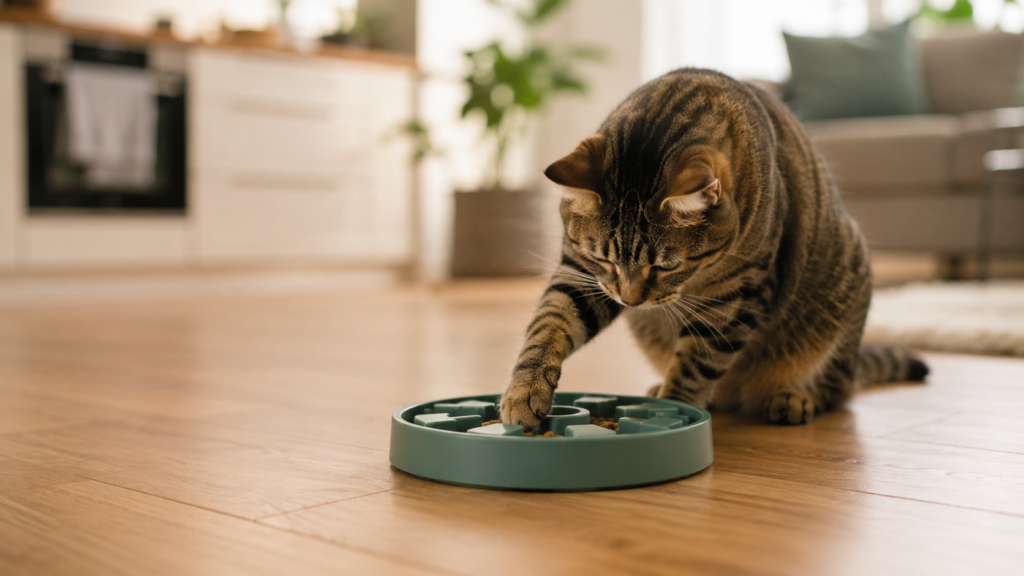
A cat that’s always hungry is usually telling you one of two things: “I’m bored and I’ve trained you,” or “something in my body isn’t working right.” If your cat is a healthy weight and the hunger is really about routine, boredom, or portions, you can fix it at home with schedule, better food, and enrichment.
But if the hunger is new, intense, or paired with weight loss, more drinking, or vomiting — don’t wait it out. That’s your cat handing you an early clue, and a quick vet visit is the kindest, smartest response.
FAQ
This is usually behavioural — learned begging, boredom, or a food that isn’t satisfying — rather than a medical problem. A cat at a healthy, stable weight who “performs” hunger is typically after your attention and routine, not calories. Try measured meals, a higher-protein food, and puzzle feeders. If anything changes, especially weight, see your vet.
Some cats are naturally food-motivated, and kittens, pregnant, nursing, or very active cats genuinely need more. But a sudden or extreme increase in appetite — especially with weight loss — is not normal and is worth a vet check, since it can signal conditions like hyperthyroidism or diabetes.
Yes. Intestinal parasites feed on the nutrients your cat eats, so the cat compensates by eating more while often losing weight. Worms can also cause vomiting or diarrhoea. It’s easily diagnosed and treated, so ask your vet about a stool test and deworming if you suspect parasites.
An older cat with a new, out-of-character increase in appetite should be checked, especially if it’s losing weight or drinking more. Hyperthyroidism and diabetes both become more common with age and both cause increased hunger. Early diagnosis makes them much easier to manage, so don’t wait.
Feed measured meals on a consistent schedule, choose a satisfying high-protein food, and use puzzle or slow feeders plus extra play to fight boredom. A timed automatic feeder helps break the “wake the human for food” habit. Most importantly, don’t feed in response to begging — it only trains more of it. If begging is sudden or intense, rule out medical causes first.
Sources
- PetMD — Why Is My Cat Always Hungry? Causes of a Hungry Cat and When To Worry — https://www.petmd.com/cat/symptoms/causes-of-hungry-cat
- PDSA — Why is my cat always hungry? — https://www.pdsa.org.uk/pet-help-and-advice/pet-health-hub/symptoms/why-is-my-cat-always-hungry
- Great Pet Care — 9 Reasons Your Cat Is Always Hungry — https://www.greatpetcare.com/cat-nutrition/reasons-your-cat-is-always-hungry/
- Kingsdale Animal Hospital — Why Is My Cat Constantly Hungry? A Vet Explains — https://www.kingsdale.com/why-is-my-cat-constantly-hungry-a-vet-explains
- Cornell Feline Health Center — Feeding Your Cat — https://www.vet.cornell.edu/departments-centers-and-institutes/cornell-feline-health-center
Keep reading:
- Why Do Cats Eat Grass When They Go Outside?
- Why Do Cats Knead? (a.k.a. Making Biscuits)
- Why Do Cats Purr?
Was this article helpful?