
The herb that turns cats into cartoons
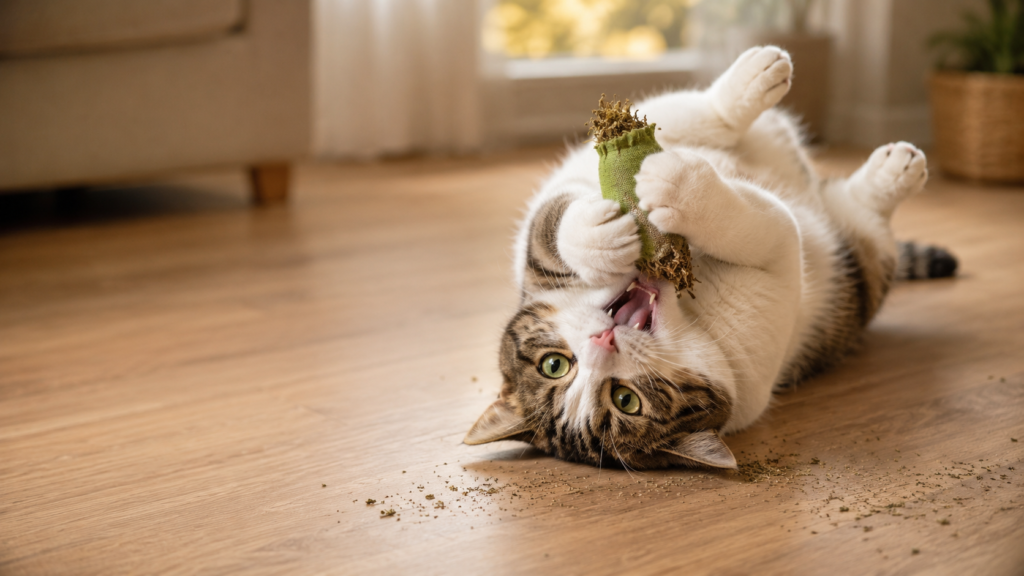
You sprinkle a pinch of dried green leaves on the floor, and within seconds your dignified, aloof cat is flat on their back, drooling, rubbing their face in it, and kicking the air like they’ve completely lost the plot. Ten minutes later they get up, shake it off, and stroll away as if nothing happened.
That’s catnip. But what is actually going on inside your cat’s head — and why does the exact same herb do absolutely nothing to the cat next door? Here’s the real science, minus the fluff.
The magic molecule: nepetalactone
Catnip (Nepeta cataria) is a member of the mint family, and its power comes from a single compound in its leaves and stems called nepetalactone.
When your cat sniffs catnip, nepetalactone drifts into their nose and binds to receptors in the nasal tissue. Those receptors fire a signal up to the olfactory bulb, the brain’s smell-processing center, which then lights up two key regions: the amygdala, which governs emotions, and the hypothalamus, which controls behavioral responses. (Scientific American)
The result is a flood of feel-good neurotransmitters. Many scientists think nepetalactone essentially hijacks the pathways that respond to feline “happy” pheromones — which is why researchers often describe the catnip high as a kind of harmless, temporary euphoria. Your cat isn’t drugged or drunk; their brain is simply being told everything is wonderful.
Smelling vs. eating: two very different highs
Here’s a detail most people miss — catnip does opposite things depending on how your cat uses it.
- Sniffing it tends to be the stimulating experience: the rolling, flipping, rubbing, zoomies, and general mad-cat behaviour.
- Eating it tends to be mellowing, almost sedative. Cats who nibble fresh catnip often go calm and dreamy rather than hyper. (PetMD)
So the same plant can wind your cat up or chill them out, depending on whether it goes up the nose or into the mouth. Cats have a curious relationship with plants in general — it’s the same instinct behind why cats nibble grass.
Why doesn’t it work on every cat?
If you’ve ever watched your cat completely ignore a catnip toy, you haven’t done anything wrong — they simply may not have the gene for it.
The response to catnip is hereditary, passed down as a dominant genetic trait. Only around two-thirds of cats (roughly 50–70%) inherit the sensitivity; the rest feel nothing at all. (Animal Humane Society)
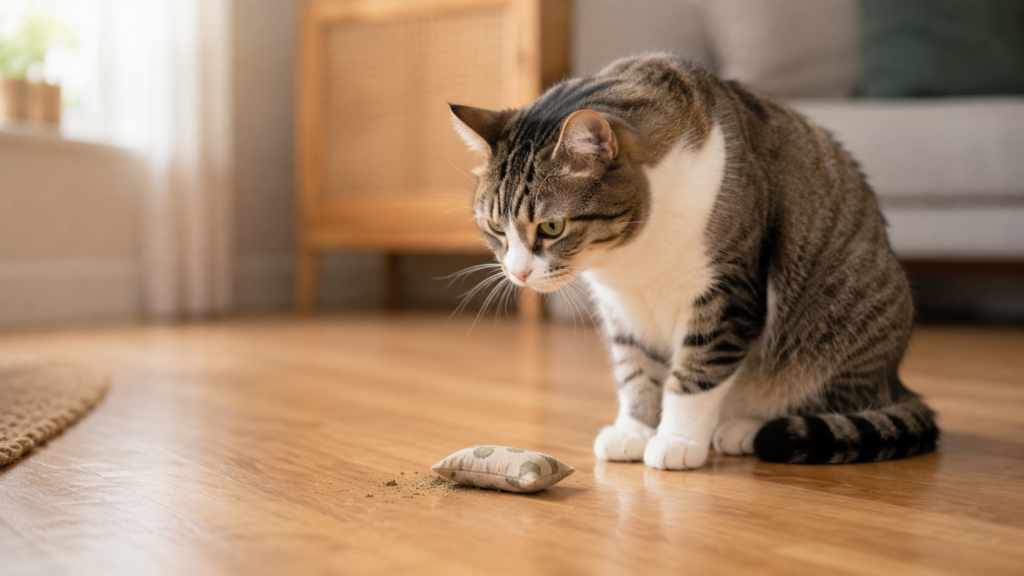
Age matters too. Kittens usually don’t react to catnip until they’re about three to six months old, because their sensitivity develops with maturity. Very young kittens and some senior cats may show little to no response. And big cats aren’t immune — lions and other wild felines can react to it as well.
How long does the catnip high last?
Not long — which is part of what keeps it safe and novel.
For most cats, the effects last around 10 to 15 minutes, after which your cat simply loses interest and wanders off. Then there’s a “cool-down” period: it usually takes another 30 minutes to an hour before a cat can respond to catnip again. Waving the toy in their face during that window won’t restart the party — the receptors need time to reset. (Small Door Veterinary)
Is catnip safe? (Yes — with common sense)
Good news: catnip is non-toxic, non-addictive, and safe for the vast majority of cats. Your cat can’t get hooked on it, and they can’t overdose from smelling it. (PetMD)
A few sensible cautions:
- Don’t let them eat a huge amount. Too much fresh or dried catnip in one sitting can cause mild tummy upset — some vomiting or diarrhoea — that passes on its own.
- Watch for overstimulation. A small number of cats get a little worked up or nippy when high. If yours does, give them space and offer catnip in calmer, smaller doses.
- Less is more. Offering catnip only two or three times a week keeps the effect strong and prevents your cat from becoming desensitized to it.
If your cat is pregnant, or has a known health condition, it never hurts to check with your vet before introducing it.
Clever ways to actually use it
Catnip isn’t just for a two-minute laugh — it’s a genuinely useful enrichment tool:
- Redirect scratching. Rub catnip on a scratching post to lure your cat away from the sofa.
- Get a lazy cat moving. A catnip toy can turn a couch-potato cat into an athlete for a much-needed burst of exercise.
- Ease stress. A little catnip can help nervous cats relax before a vet trip, a car ride, or a move — much like the self-soothing you see when cats knead a soft blanket.
- Keep toys interesting. Refresh old toys by storing them in a jar of dried catnip.
Not working? Try silver vine
If your cat is one of the third who shrug at catnip, don’t give up — there’s a stronger alternative.
Silver vine (often called “Japanese catnip”) produces the same rolling, rubbing, blissed-out response, but more powerfully. Studies suggest around 80% of cats respond to silver vine — including about 75% of the cats who don’t react to catnip at all. Its effects tend to last around half an hour. Other alternatives include valerian root and Tatarian honeysuckle. (PetMD — Silvervine)
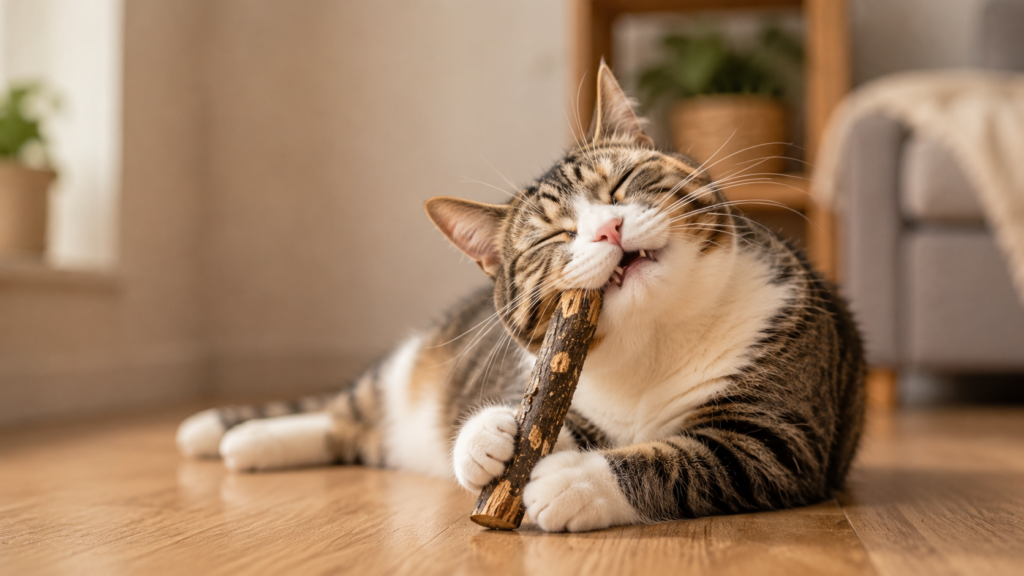
It’s worth keeping a couple of options on hand — many cats have a clear favourite.
Catnip is one of nature’s better practical jokes: a mint that hijacks your cat’s happy-brain for ten glorious minutes, then wears off with no harm done. Whether your cat responds comes down to genetics, and whether they get hyper or sleepy comes down to sniffing versus nibbling. Use it sparingly, keep an eye out for the rare grumpy reaction, and if catnip falls flat, silver vine will probably win them over. Either way, you’ve got a cheap, safe, and highly entertaining way to make your cat’s day.
FAQ
Sensitivity to catnip is inherited, and only about 50–70% of cats have the gene for it — the rest simply don’t respond, no matter how good the catnip is. Age also matters: kittens usually don’t react until three to six months old, and some senior cats respond less. If yours isn’t affected, try silver vine, which works on many “catnip-immune” cats.
Yes. Catnip is non-toxic and non-addictive, and cats can’t overdose from smelling it. The only real caution is eating large amounts at once, which can cause temporary mild vomiting or diarrhoea. Offer it two or three times a week to keep the effect strong, and give overstimulated cats a bit of space.
The catnip high typically lasts about 10 to 15 minutes, after which your cat loses interest. There’s then a cool-down period of roughly 30 minutes to an hour before they can respond again — so re-offering it immediately won’t work, since the brain’s receptors need time to reset.
Yes. Smelling catnip is usually the stimulating experience — the rolling, rubbing, and zoomies — while eating it tends to have a calmer, more sedative effect. So the same plant can either rev your cat up or mellow them out, depending on how they consume it.
Both trigger the same euphoric response, but silver vine (“Japanese catnip”) is generally stronger and works on more cats — around 80%, including many that don’t respond to catnip. Silver vine’s effects are a bit shorter, around 30 minutes. If catnip does nothing for your cat, silver vine is the best alternative to try.
Sources
- Scientific American — How Does Catnip Work Its Magic on Cats? — https://www.scientificamerican.com/article/experts-how-does-catnip-work-on-cats/
- PetMD — What Is Catnip and What Does It Do to Cats? — https://www.petmd.com/cat/general-health/what-is-catnip
- Animal Humane Society — Catnip: The herb that drives cats wild — https://www.animalhumanesociety.org/resource/catnip-herb-drives-cats-wild
- Small Door Veterinary — Everything You Need to Know About Catnip — https://www.smalldoorvet.com/learning-center/medical/catnip/
- PetMD — Silvervine Plant: An Alternative to Catnip — https://www.petmd.com/cat/general-health/silver-vine-plant-alternative-catnip
Keep reading:
- Why Do Cats Knead? (a.k.a. Making Biscuits)
- Why Do Cats Purr?
- Why Do Cats Eat Grass When They Go Outside?
Was this article helpful?