
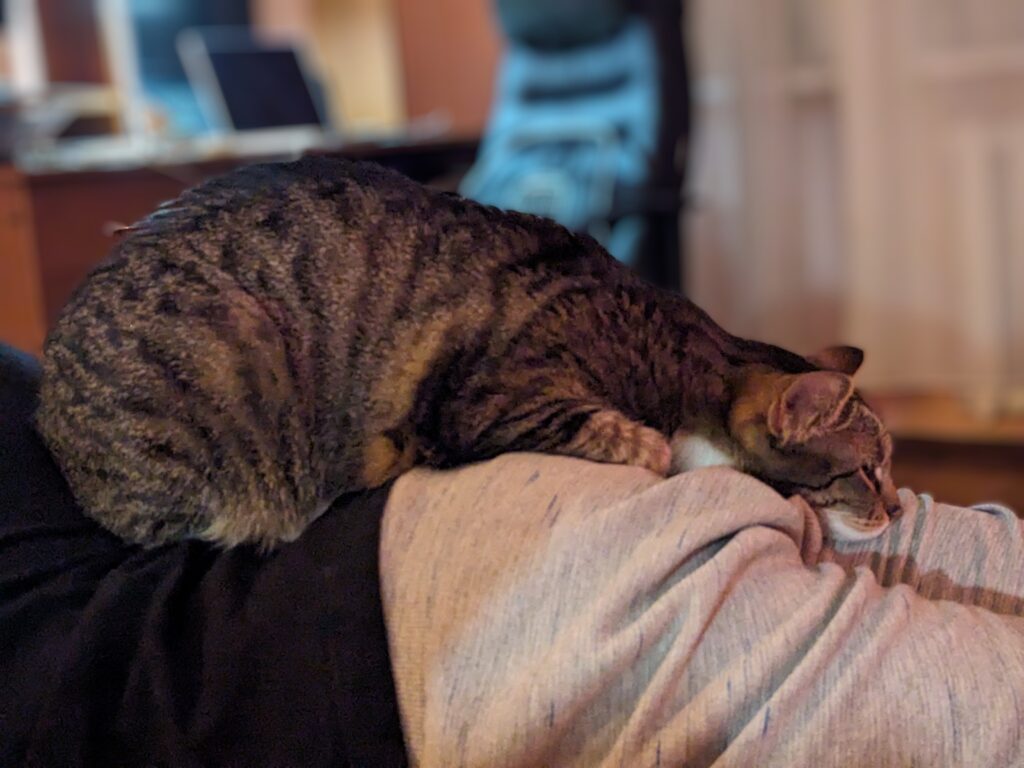
You are the warmest thing in the room
Start with the least sentimental reason. Cats are comfortable at temperatures far above what we keep our homes at — somewhere around 86 to 97F, against the 70F or so most people settle on. Your cat is mildly cold most of the time, and does something about it.
A human body running at 98.6F is the best heat source available, better than the radiator because it is soft, and better than the sunny patch because it does not move away as the afternoon goes on. Your chest and lap are also slightly concave, which traps heat around a curled cat rather than letting it escape.
This is why the behaviour intensifies in winter and eases off in July. It is also why cats target the specific spots they do: between your legs, on your chest, against your back. Those are the places where a cat loses the least warmth to the air.
There is a metabolic reason to care about this. Keeping warm costs energy, and a cat that borrows heat from you spends less of its own maintaining body temperature. Over a night that is a meaningful saving for an animal built to conserve energy between hunts. Curling into a tight circle does the same job, which is why a cold cat is a compact cat and a warm one sprawls.
Sleeping on you is a statement about trust
A sleeping cat is a defenceless cat, and cats know it. In deep sleep the reaction time that keeps a small predator alive is gone. So the choice of where to sleep is a genuine safety decision, not a matter of comfort alone.
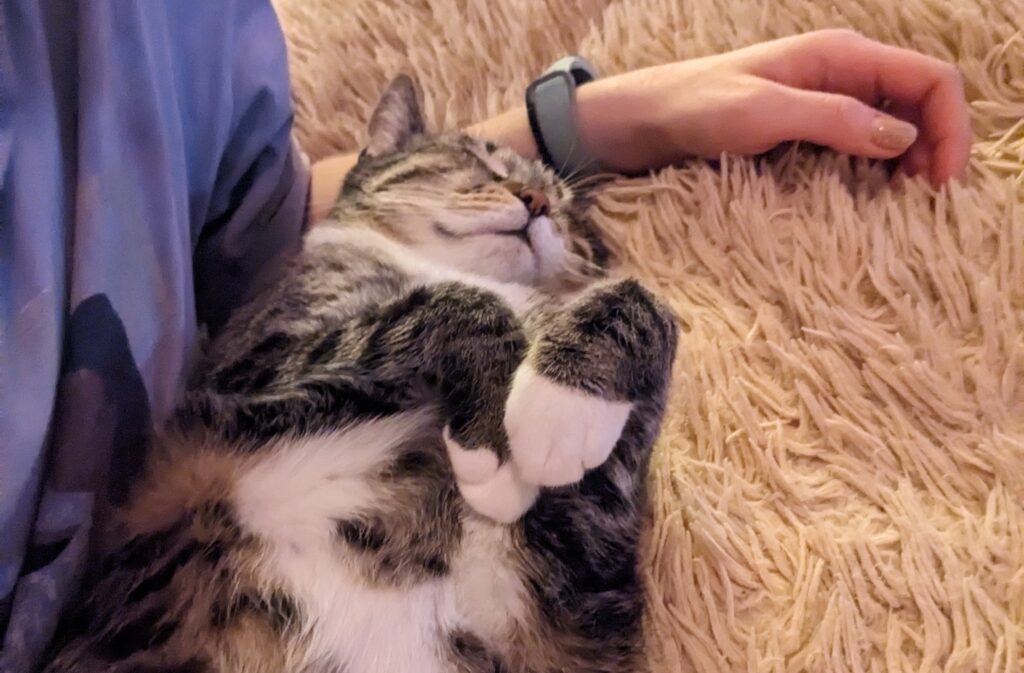
Cats sleep in layers. Most of their rest is light dozing, ears still tracking the room, and only about a quarter is deep sleep. Choosing to enter that vulnerable state on top of a much larger animal means your cat has concluded you are not a threat and, better than that, that you are worth using as cover.
Watch which position your cat picks. A cat curled tightly with its back to you and its face outward is resting somewhere safe while keeping watch. A cat sprawled on its side or belly-up across you, limbs loose, has stopped keeping watch at all. The second one is the real compliment, and it is the same instinct that has your cat kneading you before it settles.
Kittens carry this over from the litter, where they slept in a pile against their mother and siblings for warmth and security. Adult cats that live alongside people transfer the behaviour to whoever fills that role, which is usually the person who feeds them or the one who sits still longest.
It is worth saying that the reverse is not true. A cat that does not sleep on you has not judged you untrustworthy — plenty of confident, well-attached cats simply prefer a high perch, where they can see the room and nobody rolls over on them. Sleeping position is one signal among many, and a cat that follows you between rooms and settles nearby is telling you the same thing from a metre away.
You smell right
Ask why does my cat sleep on me and most people stop at warmth and affection. Scent is the part owners tend to miss, because we are not built to notice it. Cats live in a world organised by smell, and a colony of cats maintains a shared group scent by rubbing against each other and sleeping together.
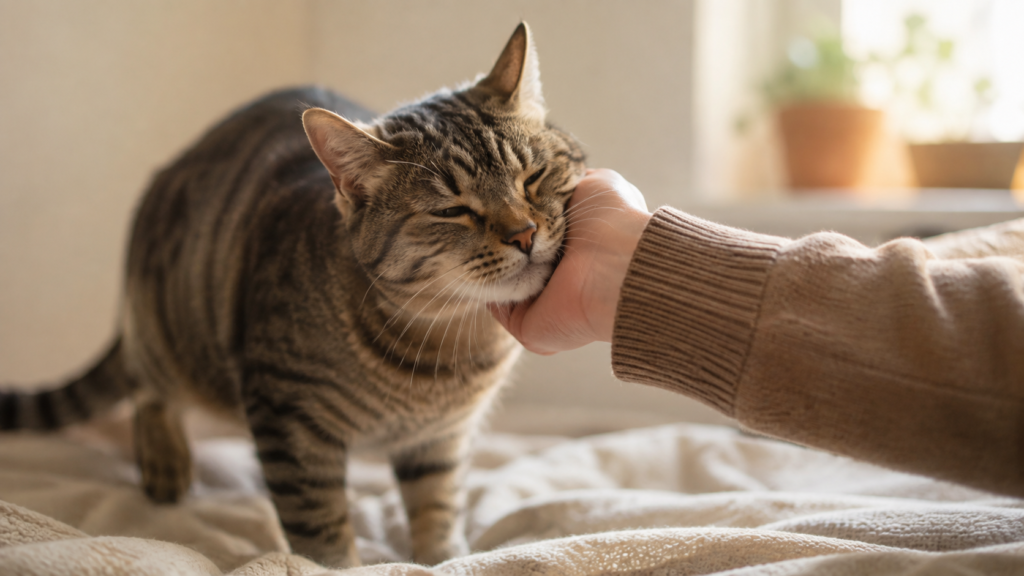
When your cat sleeps against you, it is depositing scent from glands in its cheeks, paws and flanks, and picking up yours. The result is a blended smell that marks you as part of its group. This is social bookkeeping, not ownership: the same mechanism that makes cats headbutt your shins and wind around your ankles.
It also explains something that otherwise looks like rudeness. A cat that has been at the vet often comes home smelling wrong to its housemates and gets hissed at until the group scent is restored. Your cat sleeping on you is quietly maintaining that shared scent, night after night.
Why does my cat sleep on me and not someone else?
Households with several people usually produce one clear favourite, which is not always the person who wanted to be chosen. A few things decide it:
- Stillness. Cats prefer the person who moves least in their sleep, and the one who does not shift position every twenty minutes.
- Routine. Predictable people are restful people. A cat learns who goes to bed at eleven and stays there.
- Temperature. People genuinely differ in how warm they sleep, and cats notice.
- Quiet acceptance. The person who does not grab, squeeze or reposition the cat gets picked. Indifference is attractive here.
If your cat has switched allegiance recently, look for a change in one of those rather than reading it as rejection. A new work schedule, a different bedtime or a house guest sleeping in the spare room will all reshuffle the ranking.
Multi-cat households add another layer. Cats that get on will sleep touching each other and share the group scent between them, so a cat with a bonded companion may need you less as a heat source. When one of a bonded pair dies, the survivor often starts sleeping on its people for the first time, which is worth expecting rather than being startled by.
When it becomes a problem, and what to do
For most people this is a welcome habit, and the question of why does my cat sleep on me never needs an answer beyond enjoying it. It stops being welcome when a cat wakes you nightly, sleeps on your face, or starts the dawn shift at 4 a.m. — and there the honest answer is that cats are crepuscular, most active around dawn and dusk, so a cat that wakes you early is on schedule, not being spiteful.
What works is redirection rather than shutting the cat out, which usually produces a night of door-scratching instead. Set up a heated cat bed close to where you sleep — the heat is what makes it competitive with your body. Feed a solid meal shortly before bed, since a fed cat naps rather than hunts. Play to a proper catch in the evening so the hunting sequence finishes instead of trailing off. And keep the response to a 4 a.m. wake-up boring, because getting up to feed a cat that woke you teaches it that waking you works.
Do not punish the behaviour. It is affiliative, it is deeply rooted, and a cat that is scolded for seeking closeness does not conclude it should sleep elsewhere. It concludes that you are unpredictable.
One health note worth knowing: a cat that has always slept on you and abruptly stops, or one that suddenly starts after years of independence, has changed something. Pair that with hiding, appetite or thirst changes, weight loss, or reluctance to jump, and it is worth a vet visit rather than a wait-and-see.
The bottom line
So why does my cat sleep on you? Warmth first, safety second, and scent-marking third — the same three reasons cats sleep against each other. You are being treated as a warm, trustworthy member of the group, which for a solitary predator is not a small thing to conclude about anybody.
If the habit suits you, enjoy it. If it does not, redirect it with heat and routine rather than a closed door, and know that the cat is not trying to inconvenience you. It is just running very old software about where the safest warm place is.
FAQ
Cats pick the person who is stillest, warmest and most predictable, which is not always the person who wants to be picked. Sleeping position, bedtime routine and body temperature all feed into it, as does who leaves the cat alone rather than repositioning it. A recent switch usually tracks a change in schedule or sleeping arrangements rather than affection.
It means your cat trusts you, which is the closest measurable thing. Deep sleep leaves a cat defenceless, so choosing to do it on a much larger animal is a real safety judgement. Add the scent-marking involved and the picture is affiliative: your cat is treating you as a member of its group, the way it would another cat it lives with.
Your chest is the warmest part of you, it moves rhythmically, and it is slightly concave, so a curled cat loses less heat there than anywhere else. Some cats also seem settled by the sound and movement of breathing, much as kittens are by a mother’s. If the weight bothers you, a heated bed placed nearby is the practical alternative.
That is a personal call rather than a health rule. For most healthy adults it is fine, and many people sleep better for it. Reconsider if you have allergies or asthma, if you are severely immunocompromised, or if the cat wakes you repeatedly, since broken sleep is a genuine cost. Keeping parasite prevention current matters more than the sleeping arrangement itself.
Redirect rather than exclude, because a shut door usually buys you scratching instead of silence. Put a heated bed within sight of yours, feed a substantial meal just before bedtime, and finish an evening play session with a real catch so the hunting sequence completes. Keep any night-time waking boring, since getting up to feed the cat teaches it that waking you works.
Sources
- Why Does My Cat Sleep on Me? — PetMD — https://www.petmd.com/cat/behavior/why-does-my-cat-sleep-on-me
- Understanding your cat’s behaviour — PDSA — https://www.pdsa.org.uk/pet-help-and-advice/looking-after-your-pet/cats
- Feline communication and social behaviour — International Cat Care — https://icatcare.org/advice/
- Cornell Feline Health Center — Cornell Feline Health Center — https://www.vet.cornell.edu/departments-centers-and-institutes/cornell-feline-health-center
Keep reading
Was this article helpful?