
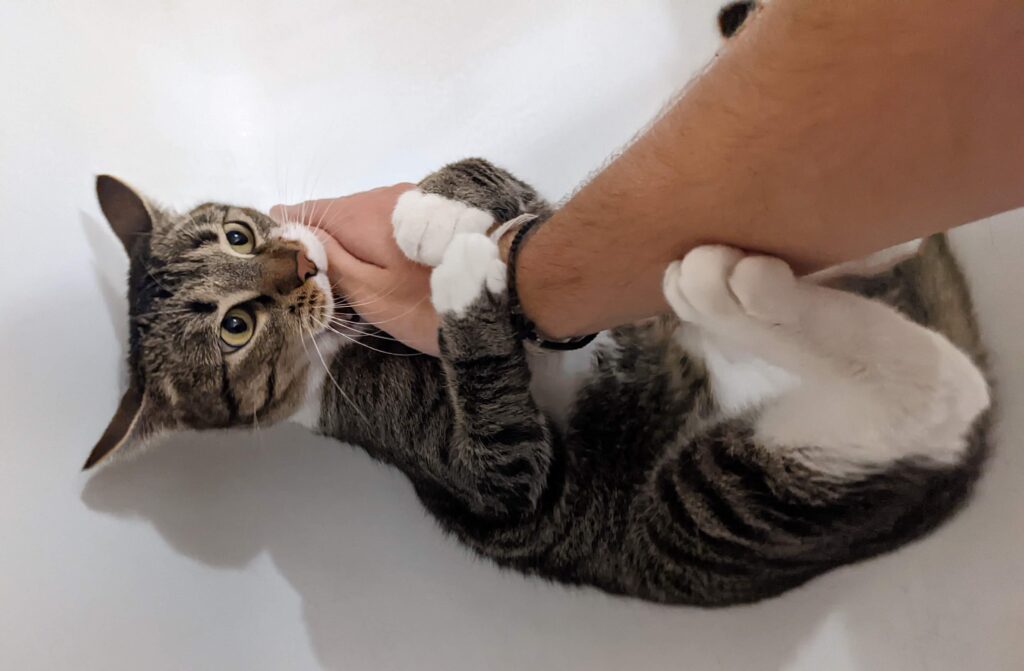
Why does my cat bite me? The five reasons, sorted
Bites look similar and mean different things. Sorting yours into one of these tells you what to change.
Overstimulation. The classic: your cat is enjoying being stroked, then abruptly bites the hand doing it. Petting-induced aggression is well documented and is not spite. Repetitive stroking builds up sensory input, and past a threshold the pleasant becomes irritating. Long-haired cats and cats stroked along the back and base of the tail hit that threshold sooner.
Play. Kittens learn bite inhibition from littermates, who squeal and stop playing when bitten too hard. A kitten raised alone, or separated from the litter early, often never learns where the limit is. Add an owner who used bare hands as toys, and you get an adult cat that hunts ankles in the hallway and means nothing hostile by it.
Fear. A frightened cat prefers to leave. Cornered, restrained, or trapped at the vet, it will bite because the escape route is gone. These bites come with a clear posture: crouched body, flattened ears, dilated pupils, often a hiss first.
Pain. A cat that bites when touched in one specific place — a hip, an ear, the base of the spine — is frequently telling you something hurts. Arthritis in older cats and dental disease are the usual culprits, and both are easy to miss because cats conceal discomfort well.
Attention. A gentle nip that reliably produces food, conversation or eye contact is a behaviour your cat has trained you into, not the other way round. It works, so it continues.
Worth separating from all five: the soft, pressure-free nibble that comes in the middle of stroking, often alongside purring and licking. Cats groom each other with gentle nibbles, so that one is social contact rather than a complaint, and it belongs in the same category as kneading.
Read the ten seconds before the bite
Cats give warnings. People miss them because the signals are small and we are watching the face rather than the body.
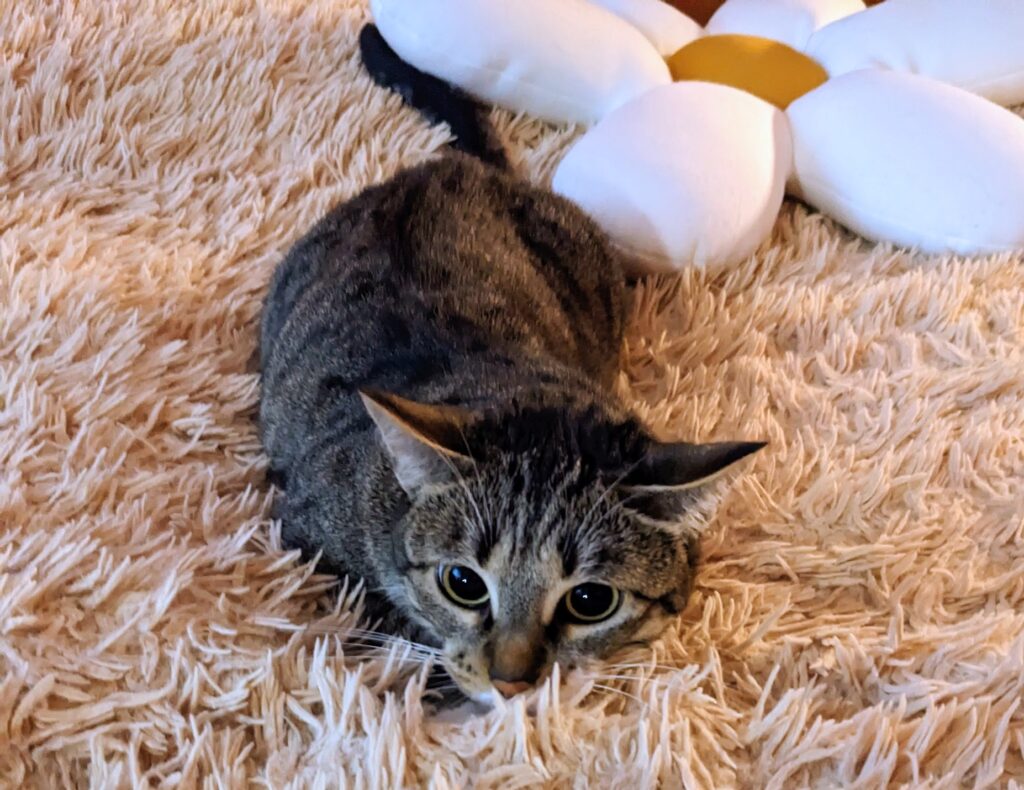
Before a bite, look for:
- The tail. A twitching or thumping tail tip is the most reliable early signal. A relaxed cat’s tail is still.
- The ears. Rotating sideways or flattening back, often called airplane ears.
- The skin. Rippling or twitching along the back, especially near the base of the tail.
- The body. Muscles tensing, weight shifting, the head turning toward your hand.
- Pupils. Widening, in unchanged light.
Any one of these means stop stroking now. Not slow down — stop, and take your hand away. The bite is the last message in a sequence, not the first, and cats that are ignored at the earlier stages learn to skip straight to the end. That is how owners end up with a cat that “bites without warning”: the warnings were there and stopped working.
Cats also differ enormously in tolerance. Some accept 20 minutes of stroking, others barely 2, and the ones who seek out your lap are not necessarily the ones who want prolonged handling. Learn your own cat’s number rather than an average.
What to do in the moment
The instinct is to snatch your hand back. Resist it.
Freeze instead. Do not pull your hand away.
A cat’s teeth curve backwards, so yanking against a bite drags them through tissue and turns a puncture into a tear. Going still removes the resistance the cat is reacting to, and most cats release within 1 to 2 seconds. If your cat is holding on, push gently toward the bite instead of away, which usually prompts a release.
Then withdraw quietly and end the interaction. No shouting, no tapping the nose, no scruffing.
Scruffing deserves a specific mention, because it persists as advice and it is poor advice. Adult cats are not carried by the scruff and do not read it as maternal correction; being held that way is restraint, and restraint is precisely what triggers a fear response in a cat that is already agitated.
Punishment fails here for a specific reason. It does not communicate “biting is wrong”; it communicates that hands are unpredictable and sometimes frightening. With a fear-based biter you make the underlying problem worse, and with a play-biter you often make the game more exciting. What actually works is that the fun stops — silently, immediately, every time.
Preventing it from happening again
Match the fix to the cause, and be consistent about it:
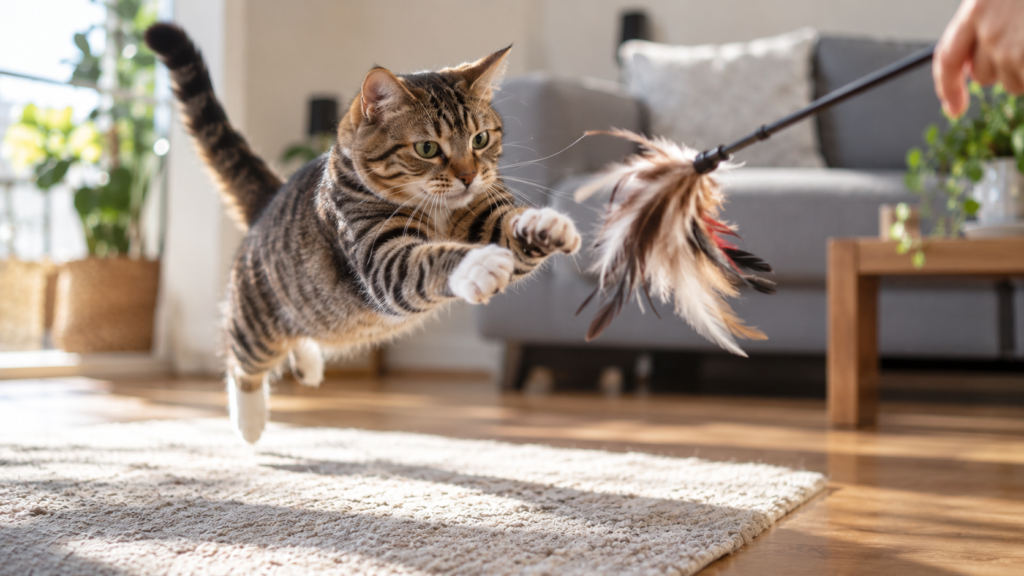
- Never use hands as toys. Not with a kitten, not once. Wand toys and kickers give the cat something legal to bite, and they keep your skin out of the game.
- Give play a proper ending. A hunting sequence that finishes in a catch and a small meal settles a cat. Play that just stops leaves it wound up.
- Pet where cats like to be petted. Cheeks, chin, base of the ears. Most cats are far less enthusiastic about the belly, the back legs and the base of the tail.
- Stop early. End the session while your cat still wants more, rather than waiting for it to tell you.
- Enrich the environment. Vertical space, window views, puzzle feeders. A bored indoor cat invents its own entertainment, and ankles are available.
- Ambush the ambusher. If your cat attacks feet from behind furniture, carry a toy and redirect the pounce onto it before you reach the corner.
For a kitten that bites during play, the littermate method works: a sharp “ow”, then all movement and attention stop for 20 to 30 seconds. Kittens learn this quickly because it is the feedback they would have got from a sibling.
When a bite means see the vet
Two separate concerns here, and both matter.
For your cat, sudden biting in an animal that never bit before is a symptom until proven otherwise. Book a check-up if the biting is new, if it happens when one particular area is touched, or if it comes with hiding, reduced jumping, appetite changes, litter box problems or a scruffy coat. Pain and illness change temperament, and dental disease and arthritis are both common and both treatable.
For you, cat bites deserve more respect than they usually get. Those narrow, deep punctures seal over quickly and drive bacteria into the tissue underneath, and bites over a joint — the hand and wrist especially — can become serious fast. Wash immediately under running water, and seek medical advice the same day for any bite that punctures the skin. Get it looked at promptly if you see spreading redness, swelling, heat, pus or fever, if the bite is on your hand or over a joint, if you are immunocompromised, or if your tetanus cover is not current. Rabies risk depends on your region and the cat’s vaccination status; an unknown or unvaccinated cat changes the calculation, so say so when you call.
The bottom line
So why does my cat bite me? Overstimulation, play that was never taught limits, fear, pain, or a habit that keeps working — in roughly that order of likelihood.
None of them are about dominance, and none respond to punishment. Watch the tail and the ears, stop before your cat asks you to, give the hunting instinct a legal target, and get a sudden change in behaviour checked. Bites are a communication failure, and the part you control is the listening.
FAQ
This is petting-induced overstimulation, and it is extremely common. Repeated stroking builds sensory input until what felt pleasant becomes irritating, and the bite is the request to stop. Watch for a twitching tail, ears rotating sideways or skin rippling along the back, and end the session before those appear. Most cats tolerate stroking around the cheeks and chin far longer than along the back.
Soft nibbling with no pressure is usually social rather than aggressive. Cats groom each other with gentle nibbles, so a light bite during stroking often belongs to that routine. It can also be learned attention-seeking if it has previously produced food or conversation. As long as the skin is not broken and no tension shows in the body, it is generally affiliative.
Stop using hands as toys entirely, and give the hunting instinct a legal target with wand toys and kickers. When a bite happens, freeze rather than pulling away, then end the interaction silently. For ankle ambushes, carry a toy and redirect the pounce before you reach the usual corner. Consistency matters more than any single technique.
No. Punishment does not teach a cat that biting is wrong; it teaches that hands are unpredictable, which worsens fear-based biting and often makes play biting more exciting. The effective response is removal of the reward: all movement, attention and interaction stop immediately and silently, every time. Cats learn from consequences that are consistent, not severe.
Any bite that punctures the skin deserves medical advice the same day, because narrow punctures seal quickly and trap bacteria underneath. Seek care promptly for bites on the hand or over a joint, for spreading redness, swelling, heat, pus or fever, if you are immunocompromised, or if your tetanus cover is out of date. Mention the cat’s vaccination status when you call.
Sources
- Aggression in Cats — PetMD — https://www.petmd.com/cat/behavior/aggression-cats
- Feline Behavior Problems: Aggression — Cornell Feline Health Center — https://www.vet.cornell.edu/departments-centers-and-institutes/cornell-feline-health-center
- Cat behaviour: biting and play — PDSA — https://www.pdsa.org.uk/pet-help-and-advice/looking-after-your-pet/cats
- Understanding feline aggression — International Cat Care — https://icatcare.org/advice/
Keep reading
- Why Does My Cat Always Sit on My Lap?
- Why Do Cats Knead?
- What Does Your Cat’s Tail Position Really Mean?
Was this article helpful?