
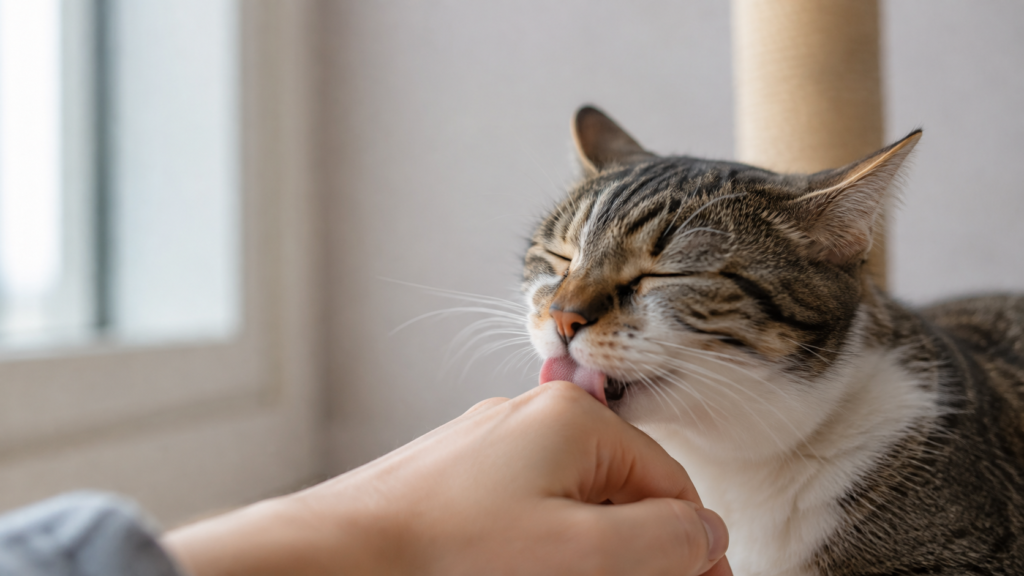
Allogrooming: the social mechanism behind it
Cats that live together groom each other. The behaviour has a name, allogrooming, and researchers who study feline colonies find it follows clear patterns: it concentrates on the head and neck, it happens most between cats that are already bonded, and it tends to run from the more confident cat toward the less confident one.
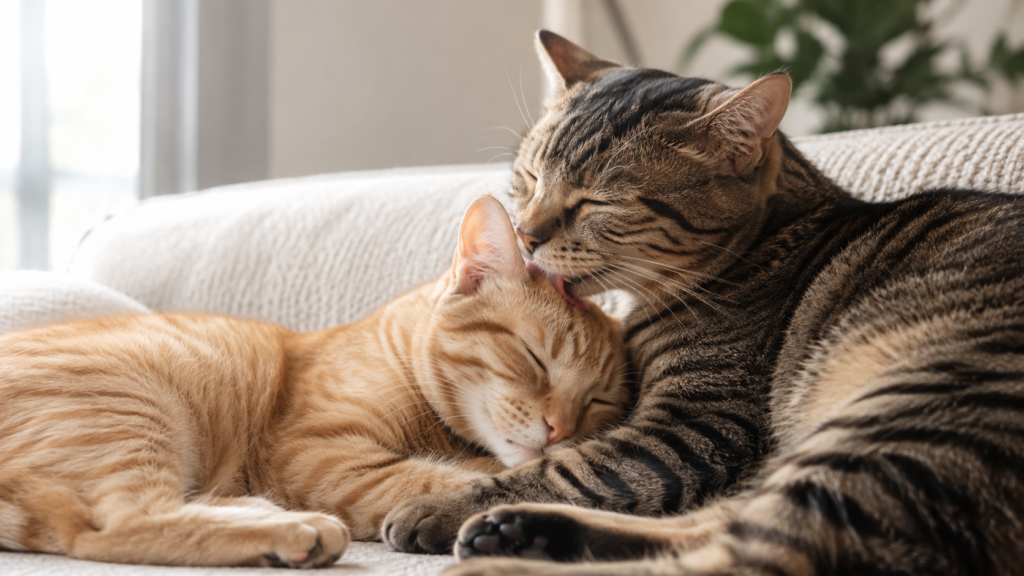
The last detail is the interesting one. Allogrooming is not simply a favour. It is a way of maintaining a relationship and, in some readings, of quietly asserting position within it. A cat licking your hand or your hair is running the routine it would run on a housemate cat.
Colony studies put numbers on the pattern: the large majority of allogrooming lands on the head and neck, and it is markedly more common between cats that already share a resting place than between cats that merely tolerate each other.
The head-and-neck focus explains a puzzle owners often raise. Your cat licks your hands, your face, your hair — the parts of you that correspond to the parts of a cat that another cat can reach and it cannot reach itself. Cats groom their own bodies perfectly well. What they cannot do is groom their own heads, which is exactly where a bonded companion helps out.
You are being scent-marked
Grooming moves scent around, and scent is how cats organise their world.
A colony of cats maintains a shared smell by rubbing, sleeping together and grooming each other. That group scent is the badge that says who belongs. When your cat licks you, it deposits its own scent and picks up yours, blending the two — the same bookkeeping behind head-butting and ankle-winding.
Scent also has a practical dimension people underrate. A cat that comes home from the vet smelling of disinfectant is often hissed at by a housemate it has lived with for years, until the shared smell is restored. Licking you keeps your entry in that scent ledger current.
This is why licking often comes in a package with other affiliative behaviours. Your cat kneads, purrs, licks, then settles against you, and the sequence is not random: it is the full set of things a cat does with an individual it counts as its own.
The tongue itself explains a lot
Anyone who has been licked by a cat knows it feels like sandpaper. The texture is functional, not incidental.
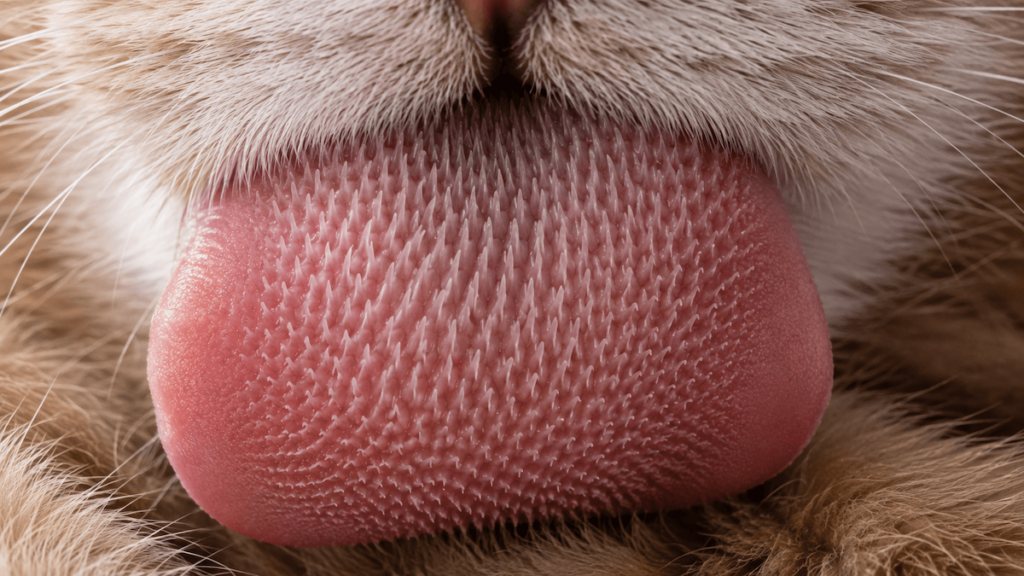
A cat’s tongue carries roughly 300 backward-facing keratin spines called papillae, and research at Georgia Tech using high-speed imaging showed they are not simple hooks but tiny scoops, curved and hollow at the tip. Each one holds a small amount of saliva and releases it against the skin, which is how a cat cleans down to the roots of its fur rather than just over the surface.
The same mechanism doubles as air conditioning. Cats sweat only through their paw pads, so evaporating saliva off the coat does most of the cooling work. A cat grooming heavily on a hot day is regulating its temperature, not just tidying up. Grooming occupies a large share of a cat’s waking hours — commonly cited figures run from a quarter to half of the time it is not asleep — which puts the scale of the behaviour in perspective.
Two practical consequences follow. First, the rasp on your skin is a grooming tool doing exactly what it evolved to do, not affection turned up too high. Second, a few licks are fine but sustained licking on one spot can genuinely abrade human skin, especially thin skin on the inner arm, so it is reasonable to redirect rather than endure it.
Why do cats lick you for reasons other than bonding?
Social grooming covers most cases. A few other explanations come up, in roughly this order of frequency:
- You taste interesting. Salt from sweat, hand cream, cooking residue on your fingers. Harmless, though check that whatever is on your skin is not something you would rather a cat did not ingest.
- Attention that worked before. If licking has ever produced stroking or conversation, it has been reinforced. Cats are efficient about this.
- Kittenhood carried forward. Cats weaned early, or hand-reared, often lick more as adults, along with more kneading and suckling on fabric.
- Self-soothing. Licking is calming, and some cats do it more when they are unsettled — a house move, a new pet, a change in routine.
- Genuine anxiety. Rare, but real when licking becomes compulsive rather than social.
The stress category deserves a note of its own, because it overlaps with a great deal of ordinary cat behaviour. Cats respond to change by increasing whatever self-soothing routine they already have, which for some is grooming and for others is hiding, over-eating or seeking out enclosed spaces. None of those are problems in themselves. They become problems when they displace normal activity.
The compulsive end of the scale is worth separating from the rest. Occasional licking is normal. Licking that has become repetitive, hard to interrupt, and paired with overgrooming of the cat’s own coat — bald patches on the belly or inner thighs are the classic sign — is a different matter, and worth a vet visit rather than a behavioural guess, since pain and skin disease look identical to anxiety from the outside.
What to do if you would rather not be licked
You are allowed to not enjoy this. Plenty of people find the rasp uncomfortable, and there is nothing unkind about wanting it to stop. The trick is ending it without teaching your cat that closeness is punished.
What works is quiet redirection. Move your hand away calmly and offer a toy, a brush or a stroke instead — many cats are entirely happy to swap being the groomer for being the groomed, and a soft brush scratches the same social itch. Standing up and leaving without drama also works, because the behaviour simply stops paying.
What does not work is scolding, spraying or pushing the cat away sharply. Licking is affiliative, so punishing it does not read as “stop licking”. It reads as “this person is unpredictable near me”, and you can lose more than you wanted to.
If the licking is new, sudden and intense in an adult cat that never did it before, treat that as information. Behaviour that appears out of nowhere — in either direction — is one of the few reliable early signals owners get, and pairing it with appetite changes, hiding or overgrooming is worth a call to your vet.
The bottom line
So why do cats lick you? Because you are part of the group, and grooming is what cats do with their group. It is social maintenance, scent-sharing and, judged by feline standards, a fairly direct compliment.
The sandpaper feel is a tongue built for cleaning fur. The persistence is a bonded animal doing what bonded animals do. If it suits you, let it happen. If it does not, redirect to a brush and keep the exchange friendly — the point is to change the activity, not the relationship.
FAQ
Usually overstimulation. Grooming sequences between cats often include gentle nibbling, so a light bite after licking is part of the normal routine rather than aggression. It can also mean your cat has had enough contact and is asking you to stop. Watch for the warning signs that precede it: a twitching tail, skin rippling along the back, or ears rotating sideways.
It means your cat counts you as part of its social group, which is the closest cats come to expressing it. Allogrooming happens between bonded cats and rarely between strangers, so being licked places you firmly on the inside. Combined with kneading, purring and sleeping against you, it is a reliable sign of a settled, attached cat.
A cat’s tongue is covered in backward-facing keratin spines called papillae. High-speed imaging has shown they are hollow, scoop-shaped structures that wick saliva down to the skin, which is how cats clean their coats and cool themselves. The texture is a grooming tool working as designed. Brief licking is harmless, though sustained licking can abrade thin human skin.
For most healthy people, occasional licking on intact skin carries very little risk. Avoid letting a cat lick broken skin, wounds or your face, since cat mouths carry bacteria. People who are pregnant, immunocompromised or receiving chemotherapy should be more cautious and discuss it with their doctor. Washing afterwards is a sensible habit either way.
A sudden change in an adult cat is worth attention. Stress from a move, a new pet or a routine change can increase licking, since it is self-soothing. So can pain or skin disease, which look identical to anxiety from the outside. If the licking is compulsive, hard to interrupt, or paired with bald patches on your cat’s own coat, book a vet visit.
Sources
- Why Does My Cat Lick Me? — PetMD — https://www.petmd.com/cat/behavior/why-does-my-cat-lick-me
- Cat behaviour and communication — PDSA — https://www.pdsa.org.uk/pet-help-and-advice/looking-after-your-pet/cats
- Allogrooming and social behaviour in cats — International Cat Care — https://icatcare.org/advice/
- Cornell Feline Health Center — Cornell Feline Health Center — https://www.vet.cornell.edu/departments-centers-and-institutes/cornell-feline-health-center
Keep reading
Was this article helpful?