
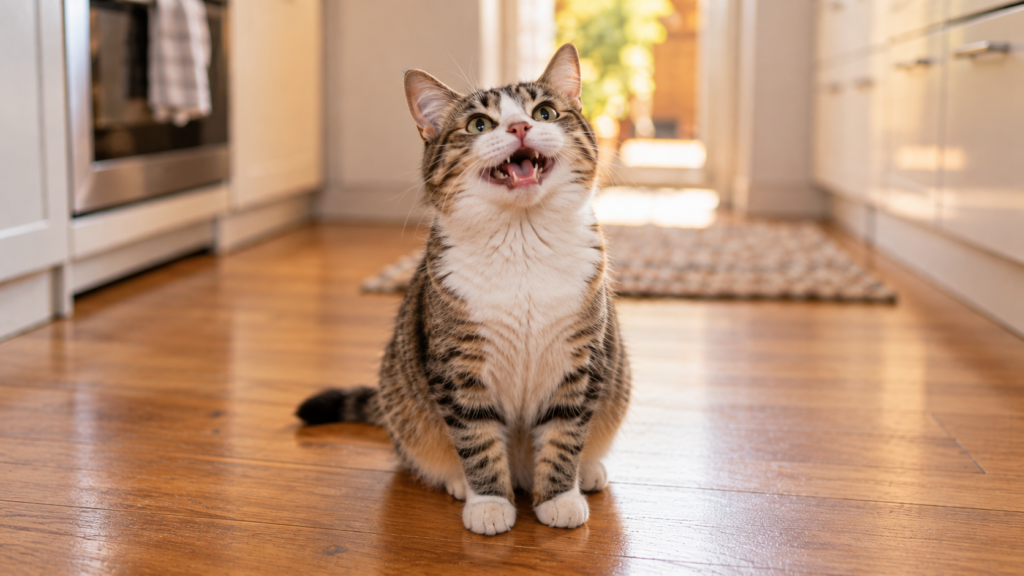
A cat that has started meowing constantly is asking for something, and the list of possible somethings is short: food, attention, access, distress, or a medical problem. Cats do not meow at each other as adults — the meow is a signal they developed specifically for people. So when you ask why is my cat always meowing, you are asking what your cat has learned to request, and whether something has changed.
The meow is aimed at you, not at other cats
Adult cats barely meow at one another. They hiss, growl, chirp, yowl and communicate by scent and posture, but the classic meow largely disappears from cat-to-cat interaction after kittenhood.
Kittens meow at their mother. Domestic cats kept it, redirected it at humans, and refined it — research on feline vocalisation suggests cats adjust their calls to be more effective on us, and owners are better at interpreting their own cat’s meows than a stranger’s. It is a learned, individualised channel between one cat and its people.
That has a practical consequence. If your cat is meowing constantly, it is trying to communicate with you specifically, and the behaviour is being maintained by something in your household — including, quite often, your own responses.
Why is my cat always meowing? The common causes
Hunger, or the expectation of food. The single commonest reason. Cats learn feeding times precisely and will campaign in advance.
Attention. If meowing has ever produced conversation, stroking or eye contact, it has been reinforced. Cats are efficient about repeating what works.
Access. A closed door is a frequent trigger, and the meow is the doorbell.
Greeting. Many cats simply announce arrivals and departures, which is normal and needs no fixing.
Boredom or under-stimulation. An indoor cat with nothing to do invents a project, and that project is often you.
Stress or change. New home, new pet, new baby, building work, a change in schedule. Cats dislike change and say so.
Being in season. An unspayed female in heat yowls loudly and persistently, often for days, and unneutered males call in response. Neutering resolves it.
Cognitive decline. In cats over roughly 11, night-time yowling and apparent disorientation are common and recognised.
Pain or illness. Always on the list, and the reason a sudden change in vocalisation deserves attention rather than management.
Two of these deserve separating out, because owners routinely misread them. A cat that meows insistently around the food bowl may not be hungry in the ordinary sense: hyperthyroidism and diabetes both raise appetite genuinely, so a cat that has started demanding food constantly while losing weight is describing a medical problem rather than a preference. And a cat that has become vocal since a household change may be signalling stress that will show up elsewhere too, often in litter tray behaviour.
When meowing is a medical sign
This is the part worth reading carefully, because several of the conditions that cause increased vocalisation are common, treatable, and easy to miss early.
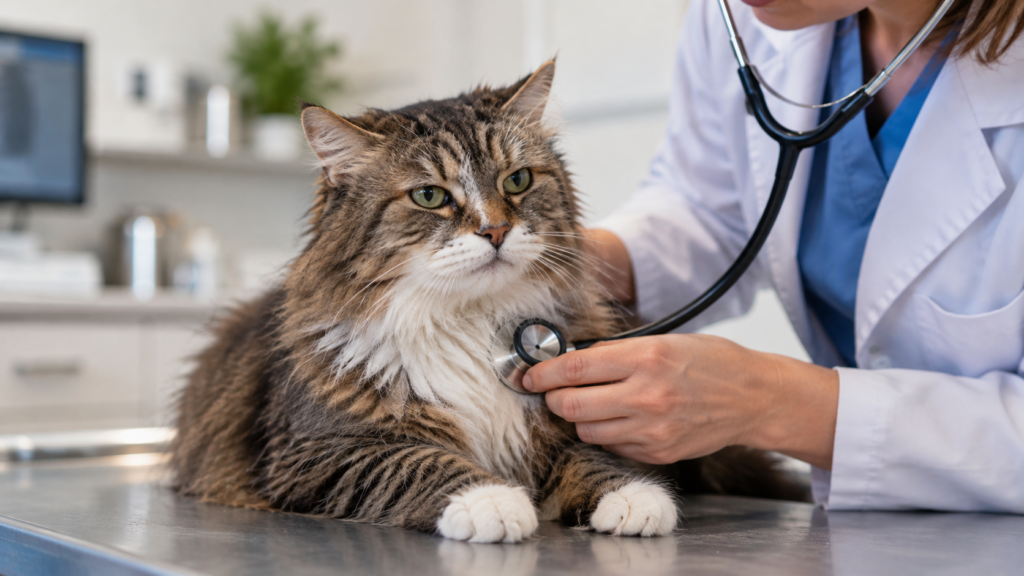
Hyperthyroidism is the classic culprit in older cats. An overactive thyroid raises appetite and activity while the cat loses weight, and increased vocalisation — often loud, at night — is a recognised feature. It is common in cats past middle age and very treatable once diagnosed.
Kidney disease and diabetes both cause increased thirst and urination, and a cat that feels unwell often becomes more vocal. Any cat drinking noticeably more than it used to needs testing.
High blood pressure and pain from arthritis or dental disease both change temperament and vocal behaviour. Cats conceal discomfort well, so a change in how much a cat talks can be one of the earlier external signs.
Cognitive dysfunction in senior cats produces night-time calling in an apparently empty room, disorientation, altered sleep, and sometimes litter tray accidents in a previously reliable cat. It is manageable, and worth diagnosing rather than accepting.
Sensory loss matters too. Cats losing hearing often vocalise more loudly because they cannot judge their own volume, and a cat losing vision may call more when disoriented.
Call your vet if
Book an appointment, rather than waiting it out, when the meowing is new or has clearly changed and comes with any of these:
- Weight loss, especially alongside a good or increased appetite
- Drinking or urinating noticeably more than before
- Night-time yowling in a cat over about 11, particularly with disorientation
- Vomiting, diarrhoea, or a change in litter tray habits lasting beyond a day or two
- Hiding, reduced jumping, or a coat that has become unkempt
- Vocalising when touched in one particular spot, or when using the litter tray
Seek same-day veterinary care if a cat is crying in obvious distress, is straining in the litter tray without producing urine, is breathing with difficulty, or is vocalising and cannot settle at all. A male cat straining and crying in the tray is a potential urinary blockage, which is a genuine emergency and cannot wait until morning.
If your cat is healthy: how to reduce the noise
Once medical causes are excluded, the behavioural work is straightforward but requires consistency. It is also the point where asking why is my cat always meowing turns into a question about your own habits.
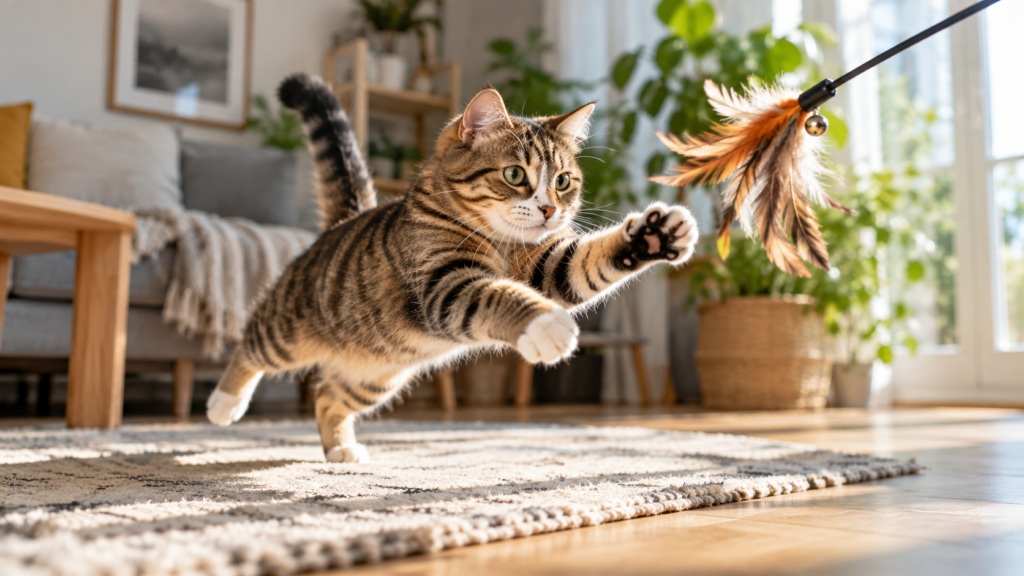
The core principle is that attention rewards the behaviour. Responding to a meow — even by telling the cat off — teaches that meowing produces you. What works is ignoring the demand completely, then giving attention when your cat is quiet. Expect it to get worse before it improves, because a behaviour that has always worked gets tried harder before it is abandoned.
Around that, address the underlying want. Feed on a fixed schedule so campaigning has no effect, and consider a timed feeder for cats that wake you — the machine becomes the source of breakfast rather than you. Provide daily play that ends in a proper catch, since unspent hunting drive has to go somewhere. Add climbing space, window perches and puzzle feeders for cats that are simply bored. And leave doors open where you reasonably can, because a closed door is an argument waiting to happen.
Never punish vocalisation. Shouting is attention, and spray bottles teach a cat that you are unpredictable without teaching it to be quiet.
Timing matters as much as method. Cats that wake their owners early are running on a dawn-and-dusk schedule that no amount of discouragement will rewrite, so the practical fix is to work with it: a substantial meal last thing at night, a timed feeder set for early morning, and blackout curtains if light is the trigger. Getting up to feed a cat that woke you at 5 a.m. guarantees a 5 a.m. wake-up tomorrow.
Some cats are just talkative. Siamese, Bengals, Orientals and their relatives are famously vocal, and a chatty cat of that background is being itself rather than signalling a problem. What matters is change from your own cat’s normal, not comparison to a quieter neighbour.
The bottom line
So why is my cat always meowing? Because meowing is the channel cats built for talking to humans, and yours is using it to request something — most often food, attention or access.
Rule out medical causes first, particularly in a cat over ten or one whose vocalisation has changed suddenly. Then look honestly at what your responses have taught. Most healthy cats quieten down when the demand stops working and the underlying need is met on your schedule instead of theirs.
FAQ
A sudden change is the version worth taking seriously. Hyperthyroidism, kidney disease, diabetes, high blood pressure and pain from arthritis or dental disease all increase vocalisation, and several are common in older cats. Stress from a household change is the other frequent cause. Book a veterinary check first, particularly if your cat is over ten or has lost weight.
Cats are most active around dawn and dusk, so some night activity is normal. Persistent night-time yowling in a cat over about eleven suggests cognitive dysfunction, especially with disorientation or calling in an empty room, and hyperthyroidism produces the same pattern. In younger cats it is usually hunger, boredom or a learned habit that waking you produces food.
For attention-seeking in a healthy cat, yes, and consistently. Any response, including telling the cat off, rewards the behaviour, so the effective approach is ignoring the demand entirely and giving attention when your cat is quiet. Expect it to intensify before it fades. This only applies once a vet has ruled out medical causes, and never to a cat in obvious distress.
Siamese are the best known, along with Orientals, Balinese, Bengals, Burmese and Tonkinese. These breeds are naturally talkative, and a chatty cat from that background is behaving normally rather than signalling a problem. What matters clinically is a change from your own cat’s usual baseline, not how vocal it is compared with other cats.
Seek same-day veterinary care if your cat is crying in obvious distress and cannot settle, is breathing with difficulty, or is straining in the litter tray without producing urine. That last combination, particularly in a male cat, can indicate a urinary blockage, which is life-threatening within hours and must not wait until the next morning.
Sources
- Why Is My Cat Meowing So Much? — PetMD — https://www.petmd.com/cat/behavior
- Cornell Feline Health Center — Cornell Feline Health Center — https://www.vet.cornell.edu/departments-centers-and-institutes/cornell-feline-health-center
- Cat behaviour and communication — PDSA — https://www.pdsa.org.uk/pet-help-and-advice/looking-after-your-pet/cats
- Caring for an elderly cat — International Cat Care — https://icatcare.org/advice/
Keep reading
Was this article helpful?