
Tonkinese
The Tonkinese is a lively blend of Siamese and Burmese breeds, combining the best traits of both. These social, playful cats are known for their aqua eyes, silky coat, and engaging personalities.
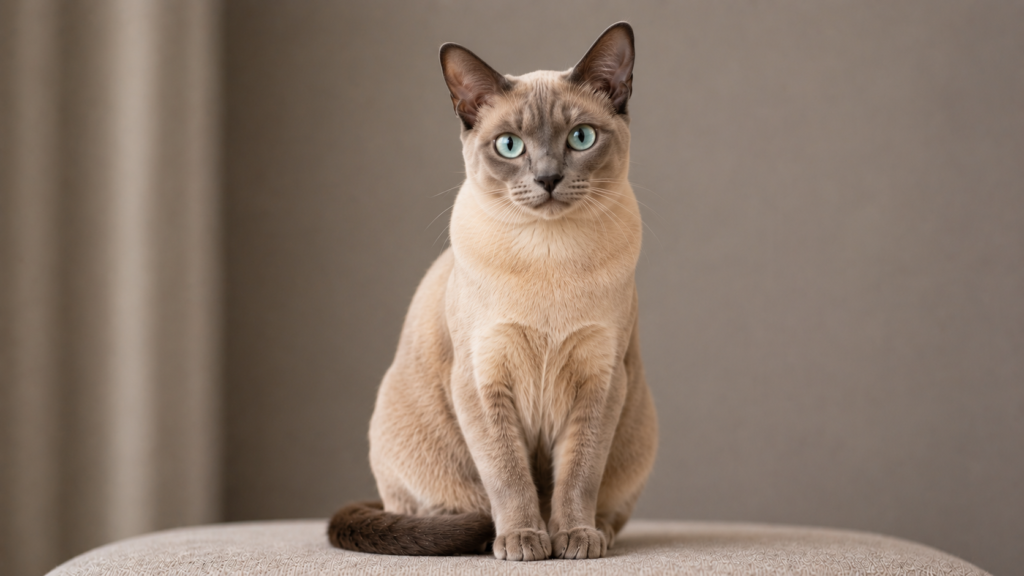
About the Tonkinese
History and Origins
Crosses between Siamese and Burmese cats occurred naturally in Southeast Asia for centuries, and the Burmese breed itself traces back to a brown Thai cat named Wong Mau imported to the United States in 1930 — a cat many now believe was exactly such a hybrid.
The deliberate breed came later. In the 1960s, Canadian breeder Margaret Conroy crossed a sable Burmese with a seal point Siamese, aiming for a cat midway between the two: less extreme than the show Siamese, less compact than the Burmese, with a distinctive intermediate coat. American breeders including Jane Barletta took up the project in the 1970s, and the name eventually settled as Tonkinese.
The result is genuinely a blend rather than a compromise. Because the mink coat comes from having one Siamese and one Burmese colour gene, mink-to-mink pairings always produce a mix of mink, pointed and solid kittens — all fully Tonkinese, all registrable, and all differing chiefly in eye colour and contrast.
Personality and Temperament
Tonkinese are outgoing, busy and enormously entertaining. They keep a kitten’s playfulness well into adulthood, and owners often describe living with one as living with a permanent adolescent.
They are highly intelligent and inventive — they learn to open doors and drawers, work out puzzle feeders, play fetch reliably, and take well to leash training. Several will greet visitors at the door and supervise any activity in the house.
Socially they are among the most people-dependent of all breeds. Tonkinese want lap time, shoulder rides and constant involvement, and they do not merely dislike solitude — they suffer in it. Long working days without company are a genuine welfare issue for this breed, and many breeders will only place kittens in pairs or into homes with another cat.
They are vocal but pleasantly so, with a softer, more melodic voice than the Siamese, and they are generally confident and friendly with children, dogs and other cats.
Care and Grooming
Grooming is easy. The short, fine, close-lying mink coat has minimal undercoat and needs only a weekly brush with a rubber mitt or soft slicker, which is enough to keep the characteristic satiny sheen. Shedding is minimal and baths are rarely required.
Enrichment is the real commitment. Provide daily interactive play, puzzle feeders, tall climbing trees and window perches, and rotate toys so novelty persists. A bored Tonkinese becomes a destructive and unhappy one.
Because they are so social, plan for company: a second cat is the standard solution for households that are empty during the day, and it usually works well given how sociable the breed is.
Watch the waistline, as Tonkinese enjoy their food and gain weight readily indoors. Add regular tooth brushing, nail trims and ear checks, and keep the home warm — like the Siamese, they seek out heat.
Health and Lifespan
Tonkinese are generally healthy and typically live 12–16 years, but they inherit specific risks from both parent breeds and you should screen for them.
Hypertrophic cardiomyopathy (HCM) is the most significant concern, thickening the heart wall and reducing pumping efficiency. There is no reliable DNA test for HCM in this breed, so responsible breeders screen breeding cats by echocardiogram with a veterinary cardiologist — ask for dated reports.
Progressive retinal atrophy (PRA) causes gradual retinal degeneration and eventual blindness, and here a DNA test does exist, so there is no reason to accept an untested line.
From the Burmese side, some lines carry risk of gingivitis and dental disease, and hypokalaemia — a potassium deficiency causing muscle weakness — for which DNA testing is also available. Burmese ancestry additionally raises the possibility of craniofacial defect carriers in certain lines, which responsible breeders test for and avoid pairing.
Some Tonkinese also inherit the Siamese tendency toward asthma and toward pica, the compulsive chewing of wool or plastic, which can cause intestinal blockage. Choose a breeder who tests thoroughly, keep the cat lean, maintain dental hygiene and keep up annual examinations.
Cost and Is the Tonkinese Right for You?
A Tonkinese kitten from a reputable US breeder generally costs $800 to $1,800, with mink-coated, aqua-eyed kittens from health-tested lines toward the upper end.
The Tonkinese suits people who genuinely want an interactive, playful, affectionate cat that behaves rather like a small dog, and who are home much of the day or willing to keep two cats. They are excellent with children and other pets and reward training and enrichment.
They are a poor choice for households empty all day, for owners wanting a calm, independent or ornamental cat, and for anyone unwilling to seek out a breeder who echocardiogram-screens for HCM and DNA tests for PRA and hypokalaemia.
Explore More
Meet both parent breeds — the vocal Siamese and the compact Burmese — to see which side of the blend appeals more. For similar moderate pointed cats, compare the Thai and the white-mitted Snowshoe, or browse all cat breeds.
Frequently Asked Questions
Mink, point and solid, and all three are equally Tonkinese. Mink cats have the classic medium contrast coat with distinctive aqua eyes. Point cats show higher contrast like a Siamese with blue eyes. Solid or sepia cats have low contrast like a Burmese with green to gold eyes. A single litter routinely contains all three.
No, only the mink-coated ones. The striking blue-green aqua eye colour results from carrying one Siamese and one Burmese colour gene together, which is what produces the mink coat. Pointed Tonkinese have blue eyes and solid or sepia Tonkinese have green to gold eyes. All three are correct for the breed and equally registrable.
Not comfortably. Tonkinese are among the most people-dependent breeds and can become genuinely distressed when isolated, showing destructive behaviour, excessive vocalising or withdrawal. Many breeders will only place kittens in pairs or into homes that already have a cat. If your household is empty for a full working day, plan on keeping two.
They are talkative but noticeably gentler. The Tonkinese voice is softer and more melodic than the loud, low-pitched Siamese yowl, and they tend to converse rather than demand. Most owners find the level pleasant rather than intrusive, which makes the breed a good middle ground for someone who wants a communicative cat without the Siamese volume.
Ask for dated echocardiogram results screening breeding cats for hypertrophic cardiomyopathy, since no reliable DNA test exists for it in this breed. Also ask for DNA results for progressive retinal atrophy and, given the Burmese ancestry, for hypokalaemia and craniofacial defect carrier status. A breeder who cannot produce documentation for these is worth walking away from.