
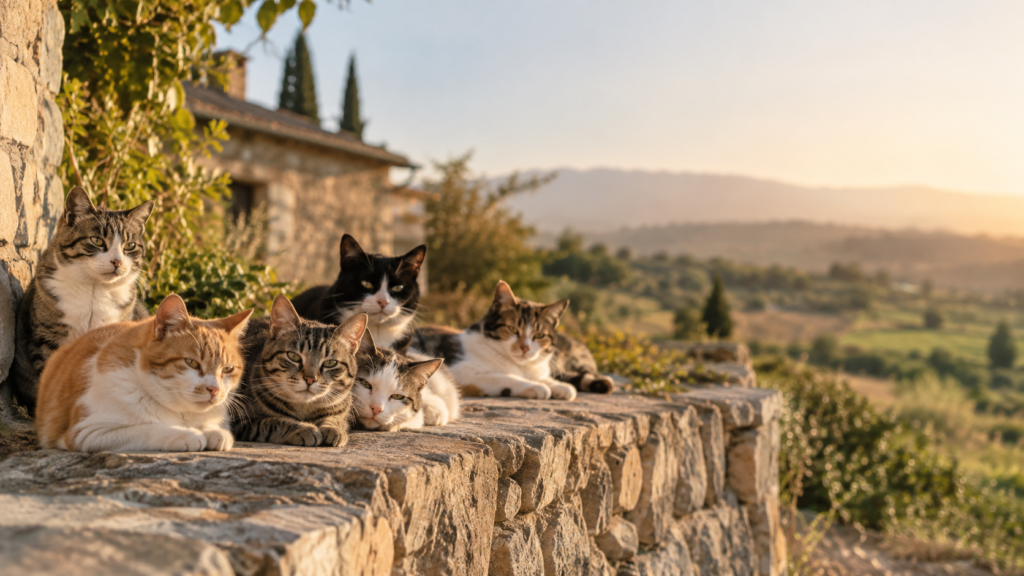
What is a group of cats called? Clowder, and its origins
Clowder is the standard collective noun for a group of domestic cats. It is related to the older English word clutter, and both descend from the same root — a clowder is, etymologically, a cluttering of cats. Anyone who has watched several cats occupy a small kitchen will find that satisfying.
Two variants turn up in older sources and are also accepted: clutter itself, and glaring, the latter usually explained as describing cats that are uneasy with each other and watching warily. Whether that explanation is genuine or invented after the fact is hard to establish, which is true of a great deal of collective-noun folklore.
You will also see pounce offered. It is charming and it circulates widely, but it appears to be a modern invention rather than a historical term, and it is worth treating as such.
The other terms worth knowing
The vocabulary is more specific than most people expect, and the distinctions are genuinely useful.
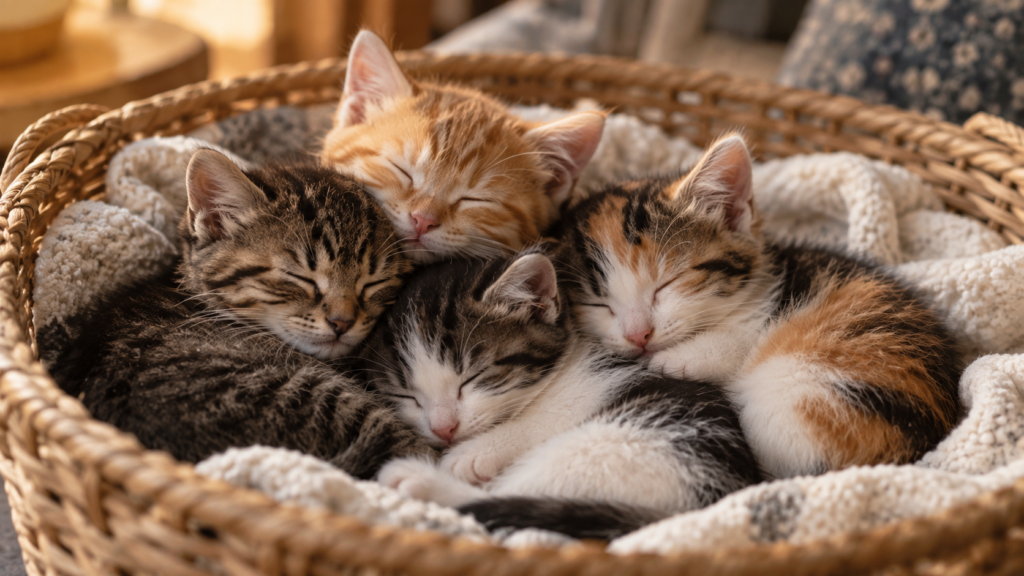
- Kindle — a group of kittens, specifically a litter. From the Middle English kindelen, to give birth. A queen kindles her kittens.
- Litter — the everyday word for the same thing, and perfectly correct.
- Destruction — a group of wild or feral cats. Bleak, memorable, and reflecting how free-roaming cats were historically regarded.
- Dowt or dout — an older variant for a group of wild cats, now rare.
- Tom or tomcat — an adult male, particularly an unneutered one.
- Queen — an adult unspayed female, especially one that is pregnant or nursing. The term comes from breeding rather than flattery.
- Molly — an informal term for a female cat, chiefly used to distinguish a spayed female from a queen.
- Gib — an archaic word for a neutered male, still occasionally used by breeders.
A note on how seriously to take any of this. Collective nouns of this kind sit in an odd category: they are real English words with documented histories, and they are also almost never used by the people who work with the animals. No veterinarian says clowder. No shelter worker says kindle. They survive because they are pleasing, which is a perfectly good reason for a word to survive, but they are closer to a parlour game than to working vocabulary.
Where these came from is largely medieval. Elaborate collective nouns for animals were a fashion of the fifteenth century, catalogued in hunting manuals and books of courtesy — the same tradition that gave English a murder of crows and a parliament of owls. Many were invented as wordplay for an educated audience rather than recorded from common speech, which is why so many sound like jokes. They partly were.
Do cats actually form groups?
This is the more interesting question, and the answer is not the one the solitary-cat stereotype suggests.
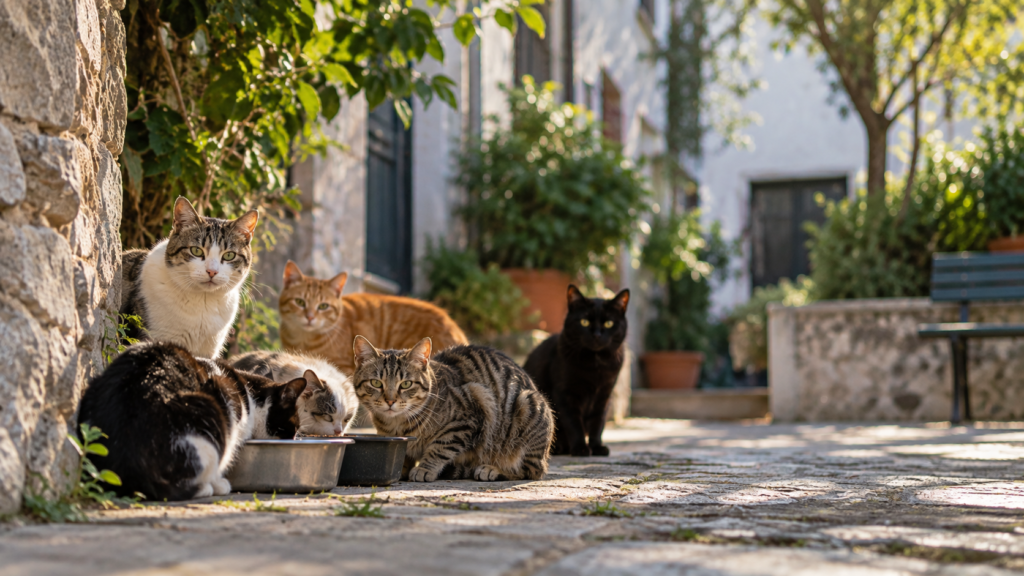
Domestic cats descend from a solitary desert ancestor, and they retain the ability to live alone. But they are facultatively social — capable of forming groups where conditions allow, rather than obliged to. The condition that allows it is almost always a concentrated food source: a farm, a fishing dock, a colony fed by people.
Where those colonies form, the structure is consistent and worth knowing about. They are built around related females — mothers, daughters and sisters — who share a territory, and who will nurse and defend each other’s kittens communally. Males tend to occupy larger, overlapping ranges and sit more loosely attached to any one group.
Colony size tracks food supply closely. A well-provisioned dock or farm can support dozens of cats living at close quarters, while sparse resources push the same population toward solitary ranging. The cats have not changed temperament; the economics have. This is the single most useful thing to understand about feline sociability, and it applies indoors as directly as it does on a farm.
That structure explains something practical about multi-cat homes. Cats do best with cats they are related to or were raised with, which is why bonded siblings usually settle far better than two adult strangers introduced by an owner. It also explains why conflict between unrelated housemates is so often about resources: in a natural colony, membership is negotiated over food, and that negotiation does not stop indoors.
Colony cats also maintain a shared group scent by rubbing and grooming each other, which is the same mechanism behind a cat rubbing against your legs. A colony smells like itself, and a cat that smells wrong is treated as an outsider until the scent is restored.
Kitten socialisation adds another layer. The window in which a kitten learns that other cats and people are safe runs from roughly 2 to 7 weeks, and cats that miss it often struggle with company for life. A cat that cannot tolerate a housemate is frequently not being difficult; it simply never learned the skill during the few weeks when it could.
A quick word on the wilder relatives
Since the terms differ by species, the neighbouring ones are worth having:
A group of lions is a pride — famously the only truly social big cat. A group of tigers, on the rare occasions they gather, is a streak or an ambush. Leopards are a leap. Most wild felids are solitary, which is why these terms are so seldom needed and so often invented for the sake of completeness.
Domestic cats sit in an unusual position among felids: solitary by ancestry, sociable by opportunity, and unusually flexible about which mode they run in. That flexibility is a large part of why they ended up living with us at all.
Using the words without sounding odd
If you want to actually deploy any of this, a little judgement helps.
Clowder works well in writing and lands as a pleasant piece of trivia in conversation. Kindle is charming but ambiguous now that it shares a name with an e-reader, so context matters. Queen and tom are the two terms with genuine working currency — breeders and veterinary staff use both routinely, and knowing them is useful if you are ever reading a pedigree or a shelter record.
Destruction is the one to use sparingly. It describes feral cats in language that belongs to a period when they were regarded as vermin, and it sits awkwardly alongside modern trap-neuter-return work, where the same cats are the subject of considerable care.
The bottom line
So what is a group of cats called? A clowder, with clutter and glaring as accepted alternatives, a kindle if they are kittens, and a destruction if they are wild.
The terms are medieval wordplay more than zoology, and half the fun is that they were partly invented to amuse. The underlying biology is the better story: cats are not the solitary animals they are made out to be, and where food allows it they build stable, related, cooperative groups — clowders in the fullest sense.
FAQ
A clowder is the standard collective noun for a group of domestic cats, related to the older word clutter. Glaring and clutter are both accepted alternatives, with glaring usually said to describe cats warily watching each other. Pounce circulates online but appears to be a modern invention rather than a historical term, so it is best treated as informal.
A kindle, which specifically means a litter of kittens. The word comes from the Middle English kindelen, meaning to give birth, and survives in the verb form too: a queen kindles her kittens. Litter is the ordinary everyday word for the same thing and is entirely correct, so use whichever suits the context.
A destruction, which is among the bleaker collective nouns in English and reflects how free-roaming cats were historically viewed. An older variant, dowt or dout, appears in some sources but is now rare. The distinction between a clowder of domestic cats and a destruction of wild ones is a genuine one in traditional usage.
An adult male is a tom or tomcat, particularly if unneutered, while a neutered male is archaically a gib. An adult unspayed female is a queen, especially when pregnant or nursing, a term that comes from breeding rather than compliment. Molly is an informal word for a female cat, often used for a spayed female.
Yes, where conditions allow. Cats are facultatively social, meaning they can live alone but form groups when a concentrated food source supports it, such as a farm or a fed colony. Those groups are built around related females who share territory and raise kittens communally, while males range more widely and attach more loosely.
Sources
- Cat — Britannica — https://www.britannica.com/animal/cat
- Cat behaviour and social structure — International Cat Care — https://icatcare.org/advice/
- Cornell Feline Health Center — Cornell Feline Health Center — https://www.vet.cornell.edu/departments-centers-and-institutes/cornell-feline-health-center
- Understanding cats — PDSA — https://www.pdsa.org.uk/pet-help-and-advice/looking-after-your-pet/cats
Keep reading
Was this article helpful?